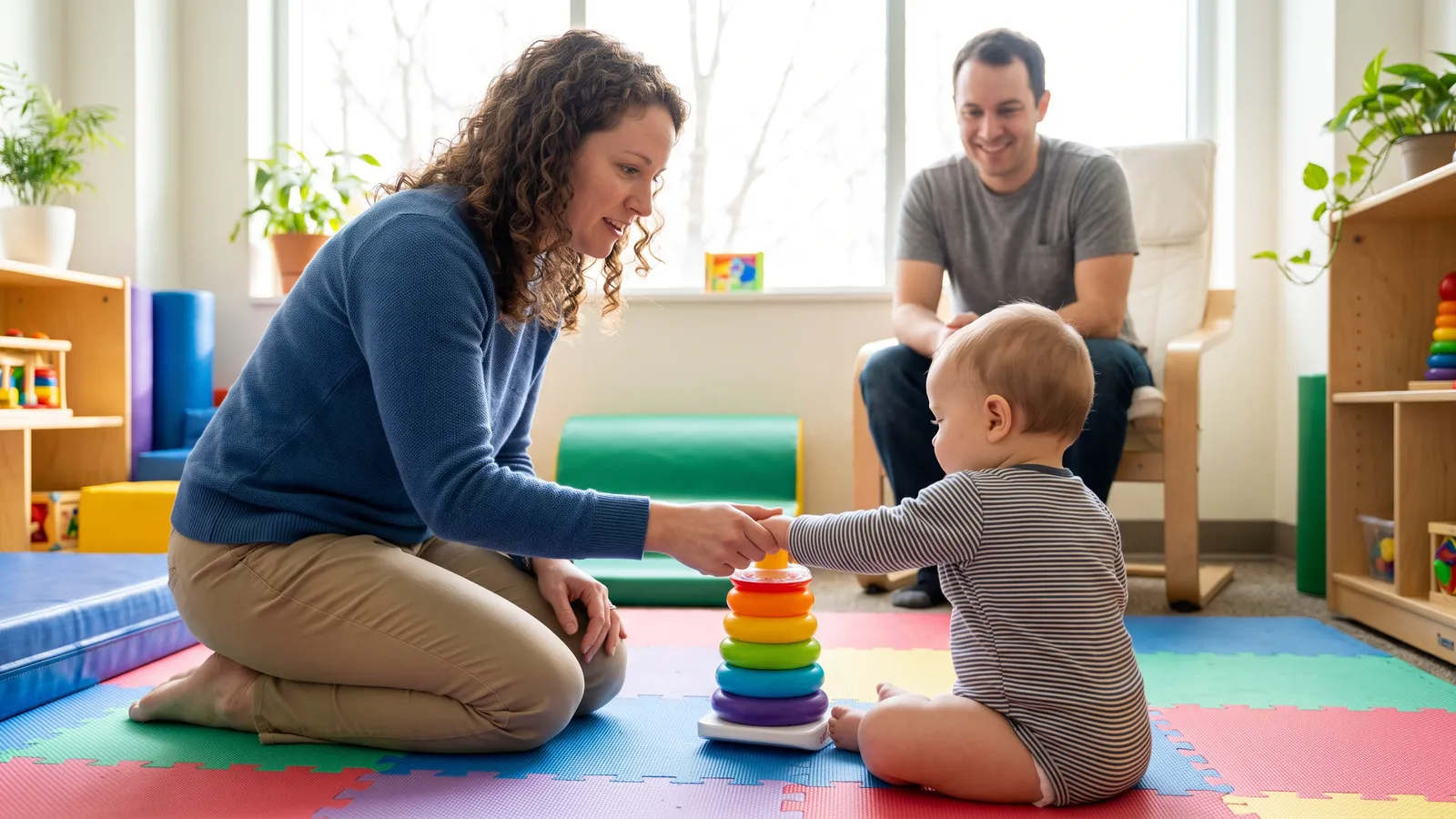
For four weeks, babies and toddlers in Roanoke, Virginia, and Columbus, Ohio, spent three hours a day, five days a week, playing with a therapist. Every game had a purpose: get the weaker hand to reach, grab and help. Six months later their hand skills were better than when they started, and it made little difference which of three methods they had received.
That is the main finding of Baby CHAMP, a trial funded by the National Institutes of Health that enrolled 58 children aged 6 to 24 months with unilateral cerebral palsy, meaning cerebral palsy that mainly affects one side of the body. The results appeared in Pediatrics Open Science in February 2026, and Virginia Tech announced them on March 16, 2026.
Constraint therapy and bimanual therapy both had good evidence in children older than 2. For babies younger than that, there was little head to head data to choose between them.
“The brain in the first two years of life is remarkably plastic. By delivering high-dose, play-based therapy early, we're capitalizing on a window of opportunity when the nervous system is especially responsive to experience.”
— Stephanie DeLuca, PhD, Fralin Biomedical Research Institute at Virginia Tech
What the children did
Every child got 60 hours of therapy: three hour sessions, five days a week for four weeks, at home or another everyday setting. Parents added 45 to 60 minutes of practice a day. Before the trial, the children had averaged about 1.4 to 2.1 hours of therapy a week.
Children were randomly assigned to constraint induced movement therapy (CIMT) with a cast on the stronger arm worn day and night, CIMT with a splint worn only during sessions, or bimanual therapy. CIMT limits the stronger arm so the child must use the weaker one. Bimanual therapy trains both hands to work together, with no restraint. Occupational and physical therapists ran all three.
What changed
The main measure, the Mini Assisting Hand Assessment (Mini-AHA), scores how well the weaker hand helps during play. Six months after treatment, average gains were 10.5 points with bimanual therapy, 9.8 with the splint and 11.4 with the cast, a difference that was not statistically significant. Fine motor skill in the weaker hand improved in every group, and gains were larger at six months than at the end of treatment.
The stronger arm held up
Parents often worry that restraining the stronger arm will set it back. In this trial it kept or gained skill in every group, and the cast group gained about 5.9 fine motor points more than the bimanual group, a finding the authors say needs caution. Constraint was not always easy. Therapists logged frustration in 77% of children with splints and 50% with casts on at least one day, and about 10% of casted children had skin irritation, all easily treated.
Limits
Only 41 of 58 children returned at six months. The bimanual group started with stronger skills, and there was no usual care group. The authors call the results hypothesis generating.
Questions to ask
The authors say family preference and treatment goals should guide the choice. Parents can ask whether an intensive block fits their child, how many hours it involves and how progress is measured. The CDC says state early intervention programs for children under 3 are free or reduced cost for eligible children, with no doctor’s referral required. A 2021 guideline in JAMA Pediatrics says intervention should start as soon as possible once a child is at high risk of cerebral palsy.