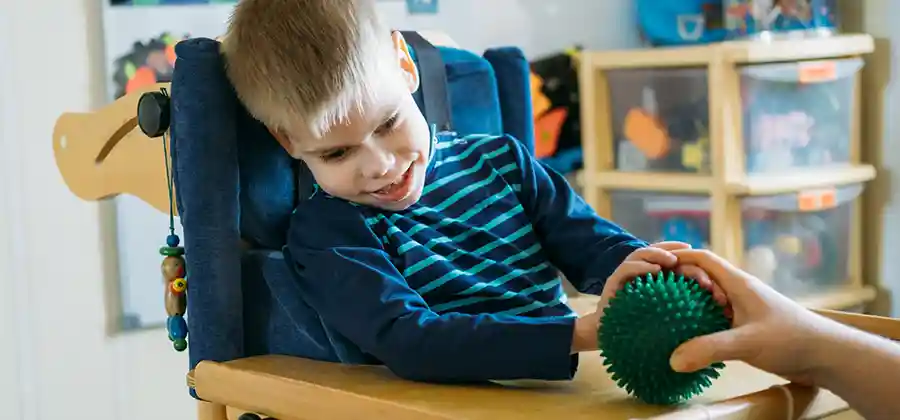
Occupational therapy is one of the most effective early treatments for children with CP, helping them develop the skills needed for daily activities, communication, self-care, and play. The sooner it begins, the greater its impact on independence and quality of life.
CP can now be identified in infants as young as 3 months, enabling earlier OT intervention
75%
Of children with CP experience some degree of vision impairment, a key OT focus area
1–2x / week
Typical initial OT session frequency plus daily home exercises
What is occupational therapy?
Occupational therapy is a healthcare specialty focused on helping people participate in the activities of everyday life. For children with cerebral palsy, OT addresses both the physical and cognitive skills needed for independence, from dressing and feeding to school tasks and play.
Therapists use structured, goal-oriented activities tailored to the child’s needs and interests. Improving hand strength might involve stacking blocks; coordination practice might be built into drawing or cutting activities. OT works across domains at once, addressing movement, sensory processing, communication, and emotional engagement.
In short, occupational therapy bridges the gap between a child’s current abilities and the demands of everyday life, using practical, evidence-based interventions. It complements physical therapy (which focuses on gross motor skills) by targeting the fine motor and functional skills needed for real-world independence.
Yes. Research consistently supports occupational therapy as an effective intervention for children with cerebral palsy. The evidence is clear across multiple outcome areas.
Studies show that OT:
It improves fine motor control in the affected limb, builds independence in self-feeding and dressing, widens participation at school and with peers, and reduces the daily load on caregivers by increasing what a child can do unaided. A 2019 systematic overview that graded every cerebral palsy intervention published between 2012 and 2019 names several of the approaches occupational therapists use among those with demonstrated effect: bimanual training, constraint-induced movement therapy, goal-directed training, task-specific training, home programs and environmental enrichment. Botulinum toxin combined with occupational therapy also appears on that list, and it outperforms the injection given alone.
Two design choices matter more than the specific exercises. Therapy aimed at a goal the family chose outperforms open-ended sessions on both engagement and measured progress, which is why goal-directed training appears on the evidence list and general exercise does not. And family-centered approaches, where parents are trained to continue therapy strategies at home, have also led to significant progress in mobility, self-care, and social engagement.
Occupational therapy addresses both immediate functional goals and long-term quality of life, making it a cornerstone of cerebral palsy treatment.
Brief history of occupational therapy for cerebral palsy
OT’s role in CP care has evolved steadily over nearly two centuries, from early clinical observations to the evidence-based, technology-assisted practice used today.
Mid-1800s
Dr. William John Little published early descriptions of cerebral palsy (then called “Little’s disease”), and advocated for treatment to improve mobility and function.
Late 1800s
Sir William Osler introduced the term “cerebral palsy” and documented cases in children, noting the benefits of early intervention.
Early 1900s
Occupational therapy became established as a profession. By the 1930s, OTs were working with children affected by polio and CP, developing individualized activities to improve independence.
Mid-1900s
Practitioners like Margaret S. Rood developed treatment techniques for central nervous system dysfunction, directly influencing modern OT approaches for CP.
Today
OT for CP now incorporates virtual reality, robotics, constraint-induced movement therapy, and family-centered care models, all grounded in the original principles of functional improvement and participation.
What occupational therapy exercises are used for cerebral palsy?
OT for CP uses a range of structured exercises designed to improve functional skills. They are individualized, ensuring they target the child’s specific needs while keeping therapy engaging and relevant to daily life.
Common OT techniques
1
Bimanual training. activities requiring both hands to work together: building with blocks, buttoning clothing, manipulating toys
2
Constraint-induced movement therapy (CIMT). temporarily restricting the stronger limb to encourage use of the affected limb through repetitive practice
3
Postural and trunk control exercises. supporting stability and balance for better seated and standing performance
4
Hand strengthening tasks. therapy putty, clothespins, or small objects to improve dexterity and grip
5
Sensory integration activities. helping children process and respond to sensory input for smoother movement and attention
6
Technology-based interventions. virtual reality games or interactive computer programs that encourage movement and engagement
How early can you start occupational therapy for cerebral palsy?
Early intervention is critical. Advances in early diagnosis now allow CP to be identified in some infants as young as three months. Starting OT in the first year of life takes advantage of the brain’s neuroplasticity (the ability to form new neural connections), maximizing potential for motor and cognitive development.
The diagnostic tools now support that timing. Cerebral palsy can be identified before 6 months corrected age using term-age MRI at 86% to 89% sensitivity, the Prechtl General Movements Assessment at around 98%, and the Hammersmith Infant Neurological Examination at around 90%, so waiting for a formal diagnosis is rarely necessary and often costly. Infants who receive early occupational therapy develop better motor skills, experience fewer secondary complications, and achieve higher levels of independence compared to those who start later. Even in cases where CP is suspected but not yet confirmed, beginning therapy can address developmental delays and prevent loss of function.
Don’t wait for a confirmed diagnosis
If your child is showing signs of developmental delay or unusual muscle tone, ask your pediatrician about early intervention services. In most states, children under 3 qualify for free early intervention programs. Starting therapy before a formal CP diagnosis is confirmed is both appropriate and beneficial.
How often is occupational therapy needed?
Therapy frequency varies based on age, severity of symptoms, and treatment goals. Sessions typically take place in a clinic setting and are supplemented by daily home exercises recommended by the therapist.
Initial Phase
1–2x / week
Clinic sessions of 30–60 minutes each. Focus on assessment and building foundational skills.
Ongoing Phase
Adjusted
Frequency adapts based on progress. Some children continue regular sessions for years; others transition to periodic check-ins.
Home Program
Daily
Exercises and activities recommended by the therapist to reinforce clinic work and accelerate progress.
How does occupational therapy change over time?
Goals turn over completely across childhood, and the reason is not only growth. Longitudinal data on 657 children followed to age 21 found no average decline in gross motor function at GMFCS levels I and II, while levels III, IV and V peaked around age seven and then lost ground. Occupational therapy is therefore building capacity in one group and defending it in another, and the plan should say which. Goals relevant in infancy get replaced by school-age and then adult-living priorities, ensuring therapy always targets what matters most right now.
Infancy – Toddler
Posture, reaching & feeding
Focus on head control, reaching, grasping, and feeding skills. Preventing contractures and building foundational motor patterns.
Preschool
Fine motor skills & play
Emphasis on fine motor skills, early self-care, and play-based learning to prepare for school entry and peer interaction.
School Age
Handwriting, technology & routines
Support for handwriting, adaptive technology use, participation in sports or art, and increased independence in daily school and home routines.
Adolescence
Vocational skills & self-management
Development of vocational skills, community mobility, and self-management strategies to support the transition to adult life.
Adulthood
Independent living & workplace adaptation
Assistance with workplace adaptations, independent living skills, and long-term health maintenance as the person navigates adult responsibilities.
Is occupational therapy for CP covered by Medicaid?
In most states, Medicaid covers occupational therapy for children with cerebral palsy when it is deemed medically necessary. Coverage paths include Early Intervention programs, school-based services, and outpatient rehabilitation benefits.
Coverage is typically available through:
Coverage usually arrives through one of three routes. Early Intervention serves children from birth to age three and is free in most states once a developmental delay is identified, with no physician order needed to self-refer. School-age children receive services written into an Individualized Education Program. And outpatient rehabilitation benefits come through state Medicaid plans or Home and Community-Based Services waivers, which frequently cover what standard plans decline.
Requirements vary by state, and some programs have session limits or require periodic reauthorization. Parents should work closely with healthcare providers and case managers to document medical necessity and secure ongoing coverage. Explore all available options in our guide to disability benefits for cerebral palsy.
Help funding your child’s therapy
When insurance and government programs fall short, a birth injury legal claim can fill the gap. Awards often cover years of therapy costs. Get a free case review today.
Other therapies recommended alongside OT
A well-built CP treatment plan usually includes multiple therapies working in coordination with occupational therapy. Each addresses a different dimension of function and independence.
Physical therapy builds strength, balance and gross motor skill, concentrating on walking and mobility while occupational therapy concentrates on the hands. Speech-language therapy covers communication, language and swallowing, and swallowing safety matters more than its profile suggests, since it is the function most tied to long-term outcomes. Orthotics hold posture and hand position between sessions. Assistive technology, from adaptive utensils to eye-tracking systems, is usually specified and fitted with occupational therapy input. Specialized programs such as constraint-induced movement therapy, aquatic therapy and hippotherapy sit alongside conventional work, and hippotherapy is one of the few in that category with graded evidence behind it. And surgery or medications come in where spasticity or a structural problem limits what therapy alone can reach.
Acting early is the most powerful decision you can make
Evidence shows that OT started during critical developmental periods leads to better outcomes in adulthood. While every child’s path is unique, timely therapy gives them the best possible chance to develop independence, confidence, and an improved quality of life.
Frequently asked questions about OT for cerebral palsy
It builds the skills that decide how much of daily life a person manages alone: feeding, dressing, grooming, handwriting, and operating a device. Several of the approaches occupational therapists use appear among the interventions with demonstrated effect in a 2019 evidence review, including bimanual training, constraint-induced movement therapy, goal-directed training and home programs.
Structured activities chosen for a specific functional goal rather than general exercise. Stacking blocks for hand strength, threading and fastening for fine motor control, and practising the actual task a family wants, whether that is using a fork or writing a name. For a child with one affected side, constraint-induced movement therapy restrains the stronger hand while bimanual training uses tasks requiring both.
Earlier than most families are offered it. Cerebral palsy can now be identified before 6 months corrected age, and neuroplasticity peaks across the first three years, so therapy started in infancy produces gains that the same therapy at six does not fully replicate. A confirmed diagnosis is not required to begin: developmental delay or unusual tone is enough to trigger a referral to Early Intervention, and families can self-refer.
It varies with age, severity and what the current goals are. Weekly or twice-weekly sessions are common in the early years, tapering as skills consolidate. The frequency that appears on a schedule matters less than the home programme built around it, since an hour of therapy a week is an hour and the rest belongs to the family. Home programs appear on the evidence list in their own right.
In most states Medicaid covers occupational therapy for children with cerebral palsy where it is documented as medically necessary. Coverage comes through Early Intervention for children under three, through an Individualized Education Program at school age, or through outpatient rehabilitation benefits and Home and Community-Based Services waivers. Session limits and periodic reauthorization are common, and waiver programs often cover what standard plans decline.
Physical therapy for mobility and gross motor function, speech-language therapy for communication and swallowing, orthotics to hold position between sessions, and assistive technology that occupational therapy usually helps specify. Surgery and medication enter where spasticity or a structural problem limits what therapy can reach, and tone reduction is generally scheduled to open a window in which therapy can achieve something rather than as an end in itself.