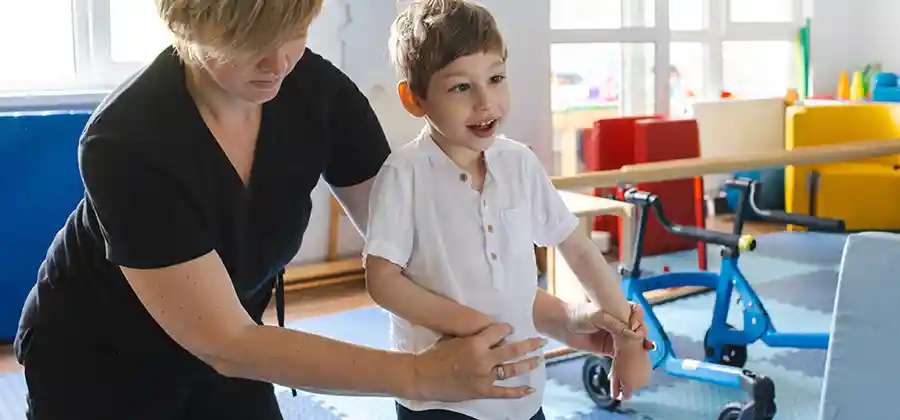
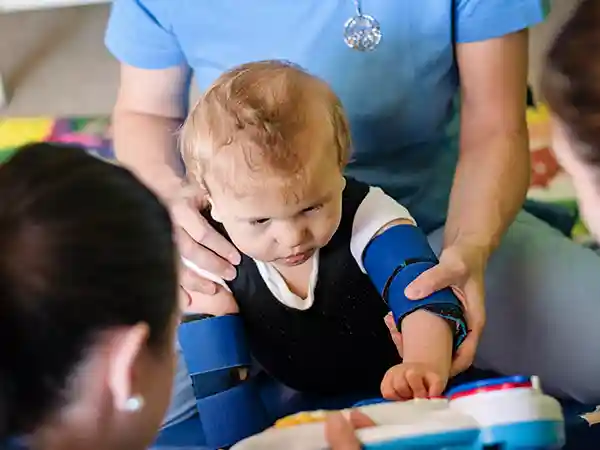
Early intervention with physical therapy can make a powerful difference for children with CP. Starting sooner gives your child’s muscles, joints, and brain the best chance to adapt, strengthen, and build new skills, tapping into the brain’s natural ability to rewire and form new connections.
Early intervention window, PT can begin even before a formal CP diagnosis
66%
Of people with CP can walk independently or with assistive devices
Free
Early intervention PT under IDEA, available to children birth to age 3 in all states
What is physical therapy for cerebral palsy?
Physical therapy is a healthcare profession centered on movement and function. A licensed physical therapist assesses muscle strength, flexibility, balance, coordination, posture, and gait, then builds a personalized plan to help your child move more effectively and comfortably.
Physical therapy opens doors. With the right guidance, children with CP can improve balance, mobility, and confidence, and discover new ways to explore their world. It’s not about “fixing” your child; it’s about giving them what they need to take part in everyday life on their own terms.
Through consistent, tailored therapy, children with CP can learn postural control and alignment, reduce muscle tightness and spasticity, gain strength in both weak and overcompensating muscle groups, and improve coordination through guided practice in shifting weight, transitioning positions, and walking.
Physical therapists use a toolbox of movement-based techniques. Each child’s plan draws from a combination depending on their age, needs, ability, and response to therapy. See our companion guides on PT exercises and assistive devices for deeper detail.
Stretching & Mobility Drills
Reduce spasticity and maintain range of motion in affected joints. Often paired with orthotics for sustained positioning.
Strength Training
Resistance bands, light weights, and body-weight exercises build posture and aid walking, targeting both weak and overcompensating muscles.
Gait Training
Parallel bars, treadmills, body-weight support systems, and assistive devices to improve or relearn walking patterns and mechanics.
Balance & Coordination Drills
Standing on foam pads, balance beams, or catching a ball while standing. Builds postural stability and proprioceptive awareness.
Aquatic Therapy
Buoyancy supports movement and reduces impact, encouraging exercises that may be difficult or painful on land. Especially effective for spasticity.
Functional Electrical Stimulation (FES)
Electrical pulses activate muscles to enhance strength, reduce spasticity, and encourage improved walking or upper-limb use. Good safety profile.
Hippotherapy
Rhythmic motion of a horse (or simulator) improves postural control, balance, trunk strength, and sensory integration in an engaging setting.
Whole-Body Vibration
May improve motor function, speed, and bone density. Evidence is still emerging but results are promising for children with spastic CP.
Living with cerebral palsy
Throughout my journey with CP, I have been aquatic therapy’s biggest advocate. It has been the most effective form of movement for me. I feel brand new every time I get out of the pool. I strongly suggest it for your child.
How early can you start physical therapy for cerebral palsy?
The sooner, the better. Early intervention, typically available from birth to 36 months through programs under IDEA (Individuals with Disabilities Education Act), can begin physical therapy even before a definitive CP diagnosis is confirmed. See our deeper guide on PT for children with CP.
If you suspect CP or notice your baby isn’t meeting motor milestones (not holding their head up, not rolling over, not sitting at the expected ages), reach out to your pediatrician or local early intervention provider immediately. Delays of even a few weeks can matter, but starting now sets the stage for stronger development ahead.
Early PT takes advantage of the brain’s neuroplasticity (the ability to form new neural connections), which is greatest in the first three years of life. Therapy during this window can permanently shape motor pathways in ways that become far harder to achieve later.
Don’t wait for a confirmed diagnosis
In most states, children under 3 qualify for free Early Intervention services when developmental delays are present, no formal diagnosis required. Ask your pediatrician for a referral to your state’s Early Intervention program today.
Are there physical therapists specialized in cerebral palsy?
Yes. Physical therapy branches into pediatric and neurological specialties, and the best outcomes for children with CP come from therapists trained specifically in pediatric neurodevelopment.
Look for therapists with a Doctor of Physical Therapy (DPT) degree, followed by a pediatric residency or board certification in pediatrics (PCS). A handful of specialized approaches are used in cerebral palsy.
Several named approaches are in routine use, and they are not equally supported. Neurodevelopmental Treatment, often called Bobath, aims at normalizing movement patterns and reducing abnormal tone, and it remains widely practised despite thin evidence. Vojta therapy uses reflex locomotion principles to trigger innate movement patterns. GMFCS-based goal setting uses the Gross Motor Function Classification System to keep targets realistic for a child’s level, which matters because motor development curves diverge sharply by level. Robot-assisted walking programs, available at larger pediatric centers, are used particularly for spastic diplegia. Worth knowing what the 2019 evidence review actually found: goal-directed training, task-specific training, treadmill training, partial body weight support treadmill training, strength training, fitness training and bimanual training all have demonstrated effect. Open-ended exercise does not.
Seek therapists or clinics attached to pediatric hospitals or early intervention networks, where play, family input, and adaptive strategies blend with clinical training.
How often do children with CP need physical therapy?
Frequency varies depending on the child’s age, severity of symptoms, and therapy goals. Many children begin with more intensive schedules (especially in infancy or after surgeries), then transition to maintenance as they gain skill. For families who prefer therapy in a familiar setting, in-home PT is often a sustainable option.
Early / Intensive
2–5x / week
Infancy and post-surgical periods. Higher intensity in young children yields better outcomes.
Ongoing
1–2x / week
Standard ongoing schedule. Adjusted as the child progresses and goals are met.
Maintenance
Biweekly–monthly
As skills stabilize. Daily home exercises continue to be critical between sessions.
Family-led “carryover” between sessions (daily stretches and strengthening activities woven into play) amplifies therapy’s effectiveness significantly. Your child’s therapist will provide a home program and adjust session frequency based on progress and your family’s rhythm. For more on what PT delivers long-term, see our guides on the benefits of PT and the role of PT in CP management.
Living with cerebral palsy
I often view cerebral palsy as a use-it-or-lose-it type of situation, meaning if you’re stagnant, things can get worse. I would say 3 PT sessions a week is suitable, supplemented by daily stretching.
Cerebral palsy doesn’t follow a single path as children grow, and neither should their therapy. Goals and techniques shift to match the child’s developmental stage, body, and environment.
0–3 years
Posture, rolling & early mobility
Emphasis on posture, rolling, sitting, and crawling. Therapy is play-based, frequent, and focused on building foundational motor patterns during peak neuroplasticity.
3–6 years
Walking, running & school readiness
Focus shifts to walking, running, adapting assistive devices, and developing balance needed for playground and school settings.
6–12 years
Fitness, stairs & adaptive strategies
Skills like jumps, stairs, and playground activities become central. Strength maintenance and adaptive strategies for school and sports are prioritized.
Adolescence+
Alignment, pain prevention & transitions
Therapy supports alignment, mobility, and pain prevention around puberty and growth spurts. Focus moves toward maintenance, community participation, and adult transitions.
Is physical therapy for cerebral palsy covered by Medicaid?
Yes, typically. Medicaid generally covers medically necessary physical therapy whether provided through early intervention, school settings, outpatient clinics, or at home.
Funding comes through four routes. Early Intervention covers birth to age three under Part C of the Individuals with Disabilities Education Act, free or low-cost in most states once a developmental delay is identified, and families can self-refer without a physician order. School-based services run from ages three to 22 under Part B through an Individualized Education Program. Outpatient Medicaid covers clinic-based therapy where it is documented as medically necessary, often with session limits or prior authorization. And most private plans cover physical therapy with a referral, though annual session limits and out-of-pocket maximums are worth checking before the first appointment rather than after.
Work with your provider or school to get through authorization requirements. Therapy isn’t out of reach financially, but families sometimes still face gaps. A birth injury legal claim can fill those gaps. See our disability benefits guide and explore CP treatment costs for a full picture.
Other therapies recommended alongside PT
Physical therapy works best as part of a broader support network. PT lays the groundwork for movement; other therapies build skills, expression, and independence on top of that foundation.
A team approach works best
Physical therapy rarely works alone. Occupational therapy handles fine motor skill, dressing and feeding, and adaptive technology. Speech-language therapy covers communication and, just as importantly, swallowing safety. Orthotics and bracing, including ankle-foot orthoses, splints and serial casting, hold alignment between sessions and prevent contracture, and casting appears on the evidence list in its own right. Adaptive sports and recreational therapy build strength and social confidence, and hippotherapy is among the few in that category with graded support. Surgery addresses structural problems therapy cannot reach. And medications such as botulinum toxin and baclofen reduce spasticity, with botulinum toxin combined with occupational therapy or with casting outperforming the injection used alone.
Physical therapy as a path to independence
A CP diagnosis can feel like it arrives with a thousand questions and not nearly enough answers. But one truth is clear: starting the right therapies early (especially physical therapy) sets your child on a path toward greater independence, comfort, and joy.
Every stretch, every skill learned, every playful exercise in the clinic or at home is a small investment in your child’s future. Physical therapy is not about “fixing” your child, it’s about giving them the tools to meet their world with more ease, confidence, and possibility. It helps them discover ways to move, play, and participate in daily life that make sense for them.
What matters is taking that first step toward treatment, surrounding your child with a care team that understands CP, and believing in the progress that is possible with consistent, thoughtful therapy. If you’re still early in the journey, our nurses are available 24/7 to help you understand your options and connect you with the right resources.
Help funding your child’s therapy
A birth injury legal claim can cover years of PT, OT, and equipment costs. Request a free case review to find out if your family qualifies.
Frequently asked questions about PT for cerebral palsy
Absolutely. Physical therapy is one of the most effective ways to improve mobility, strength, and coordination for children with CP. Through guided stretches, strengthening activities, and balance exercises, children can reduce stiffness, prevent contractures, and gain independence in daily activities. While therapy cannot cure CP, it can dramatically improve comfort, function, and confidence, especially when started early and paired with a daily home exercise program.
There is no one-size-fits-all answer. Physical therapy is a cornerstone treatment for gross motor skills and mobility. Occupational therapy supports daily activities like dressing and feeding. Speech therapy addresses communication and swallowing. For some children, aquatic therapy, hippotherapy, or adaptive sports provide unique benefits. The key is an individualized plan (often involving more than one therapy) created by a team that understands CP.
The best exercise is one that meets your child’s specific needs, is safe, and keeps them engaged enough to do consistently. Stretching reduces muscle tightness, strength training supports posture, balance drills improve coordination, and gait training builds walking skills. Swimming, adaptive cycling, and hippotherapy boost core strength and confidence. Consistency creates the biggest long-term gains, not intensity.
PT focuses on gross motor skills (big movements like crawling, standing, walking, and balance) as well as strength, flexibility, and coordination. OT focuses on fine motor skills (smaller movements like grasping, using utensils, dressing, and writing) plus sensory integration and adaptive strategies for daily activities. Most children with CP benefit from both.
Costs vary by location, frequency, and setting. Many children qualify for coverage through Medicaid, private insurance, or school-based IEP services. Early intervention programs (birth to age 3) are often provided at low or no cost. Always check coverage and authorizations with your provider. Many therapists also teach parents home programs to supplement clinic visits. For families where costs still exceed what’s covered, a birth injury legal claim can be a primary funding source.
For many children (especially in the early years), weekly or multiple sessions per week make a significant difference, particularly when combined with daily home exercises. As goals are met, frequency may shift to biweekly or monthly maintenance sessions. The exact schedule depends on age, goals, and any upcoming surgeries or growth spurts. Consistency is key regardless of frequency.