Four research centers opened studies in 2026 that test whether a mild electrical current, sent through sticky pads on the skin of the back, can ease the muscle stiffness of cerebral palsy. The University of Pittsburgh started on March 30, the University of Leeds on April 29, Shirley Ryan AbilityLab in Chicago on May 28 and the University of Washington on August 13.
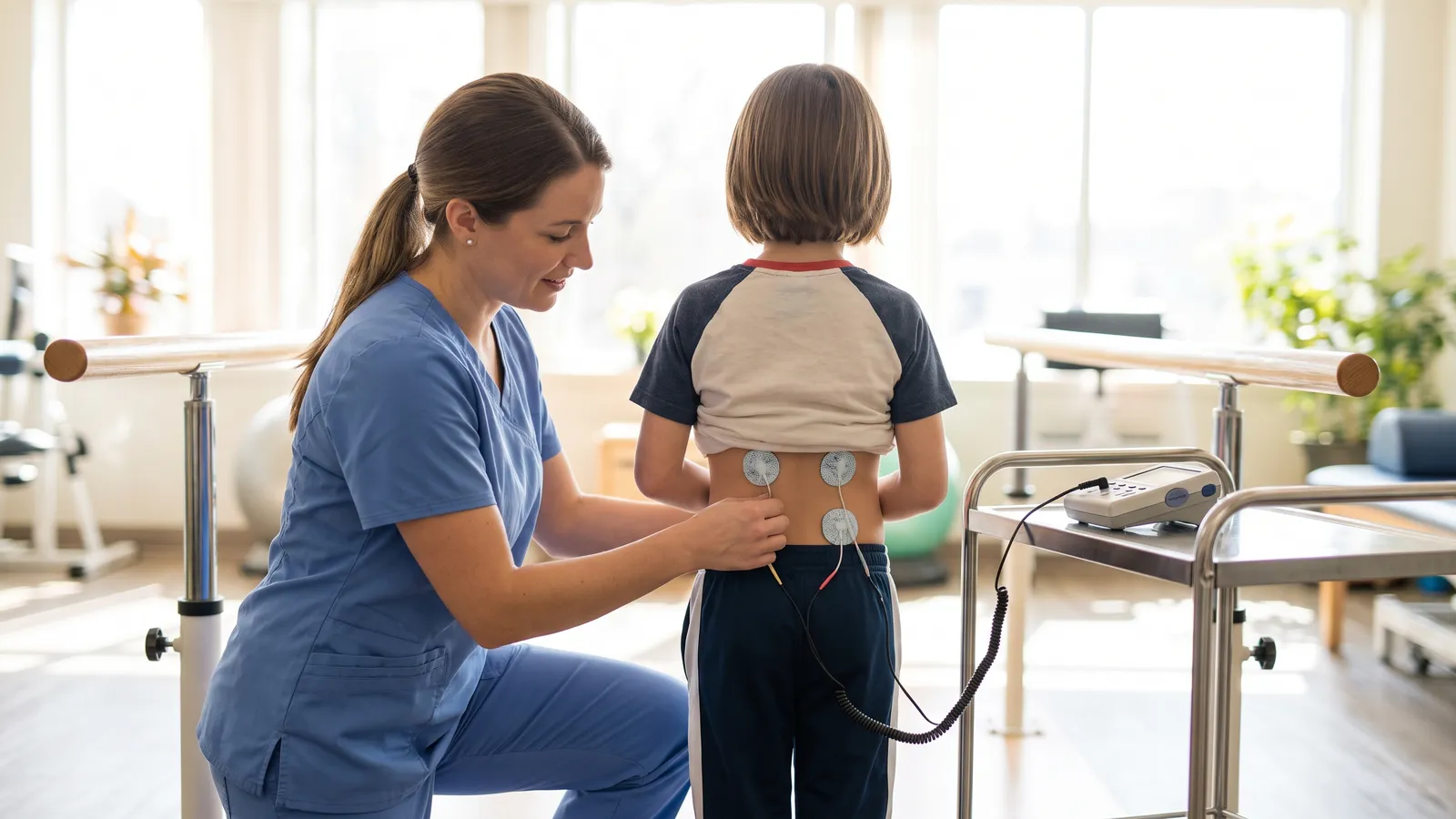
The technique is called transcutaneous spinal cord stimulation, or tSCS. Transcutaneous means through the skin. Nothing is implanted. The current is usually switched on while a child walks on a treadmill or practices arm and hand tasks.
The published evidence so far covers a few dozen children at most. This is what those studies found, how tSCS differs from surgery, and what each new trial is actually measuring.
“The early numbers are encouraging and very small: one study of 16 children, one of four, one of a single boy. The 2026 trials are built to find out whether those results hold up.”
— Cerebral Palsy Center Editorial Team
How it differs from surgery
Spasticity in cerebral palsy comes partly from reflex circuits in the spinal cord that fire too easily. Selective dorsal rhizotomy (SDR) treats this with an operation: a neurosurgeon cuts some of the sensory nerve rootlets in the lower spine, and the change is permanent. Epidural stimulation needs surgery too, to place electrodes on the covering of the spinal cord. tSCS works from outside the body.
What the early studies found
In a pilot published in IEEE Transactions on Biomedical Engineering in April 2025, four children did 24 sessions of short-burst treadmill training alone and 24 with tSCS. On the Modified Ashworth Scale, a clinician's rating of muscle stiffness, scores fell an average 1.40 points with stimulation and 0.43 without. The gains held 8 weeks later.
A 2024 case study in Children followed one 13-year-old boy. After 20 sessions of locomotor training alone, his walking speed rose from 1.05 to 1.1 meters per second. After 20 more with tSCS, it reached 1.43, and his GMFCS level went from III to II. In a 2022 Nature Communications study, all 16 children, GMFCS levels I to V, improved on a standard motor test after 8 weeks of twice weekly sessions, with no serious side effects. None used a separate control group.
What the 2026 trials are testing
- Pittsburgh: 30 children aged 5 to 17, some without CP for comparison. It measures reflexes during stimulation; there is no training program.
- Leeds, UK: 18 young people aged 12 to 21 with hemiplegic CP (one side of the body affected). Two arm and hand sessions, one with stimulation.
- Washington: 20 people aged 4 to 65 who walk (GMFCS I to III), two treadmill visits, with and without the SpineX SCiP device.
- Shirley Ryan AbilityLab: 80 children aged 4 to 17, 16 weeks of training three times a week, with an optional arm adding the cancer drug 5-azacitidine.
FDA status and finding a trial
We found no tSCS device cleared by the FDA for cerebral palsy as of October 2026. The one cleared system, ONWARD's ARC-EX (December 2024), is for adults with spinal cord injury. SpineX's pediatric CP device holds a Breakthrough Device designation, which speeds review but is not approval.
Each listing on ClinicalTrials.gov gives eligibility and a contact. Pittsburgh and Washington exclude anyone with a baclofen pump or other implant; Washington also excludes prior SDR. A child's neurologist or rehabilitation doctor can help judge fit.