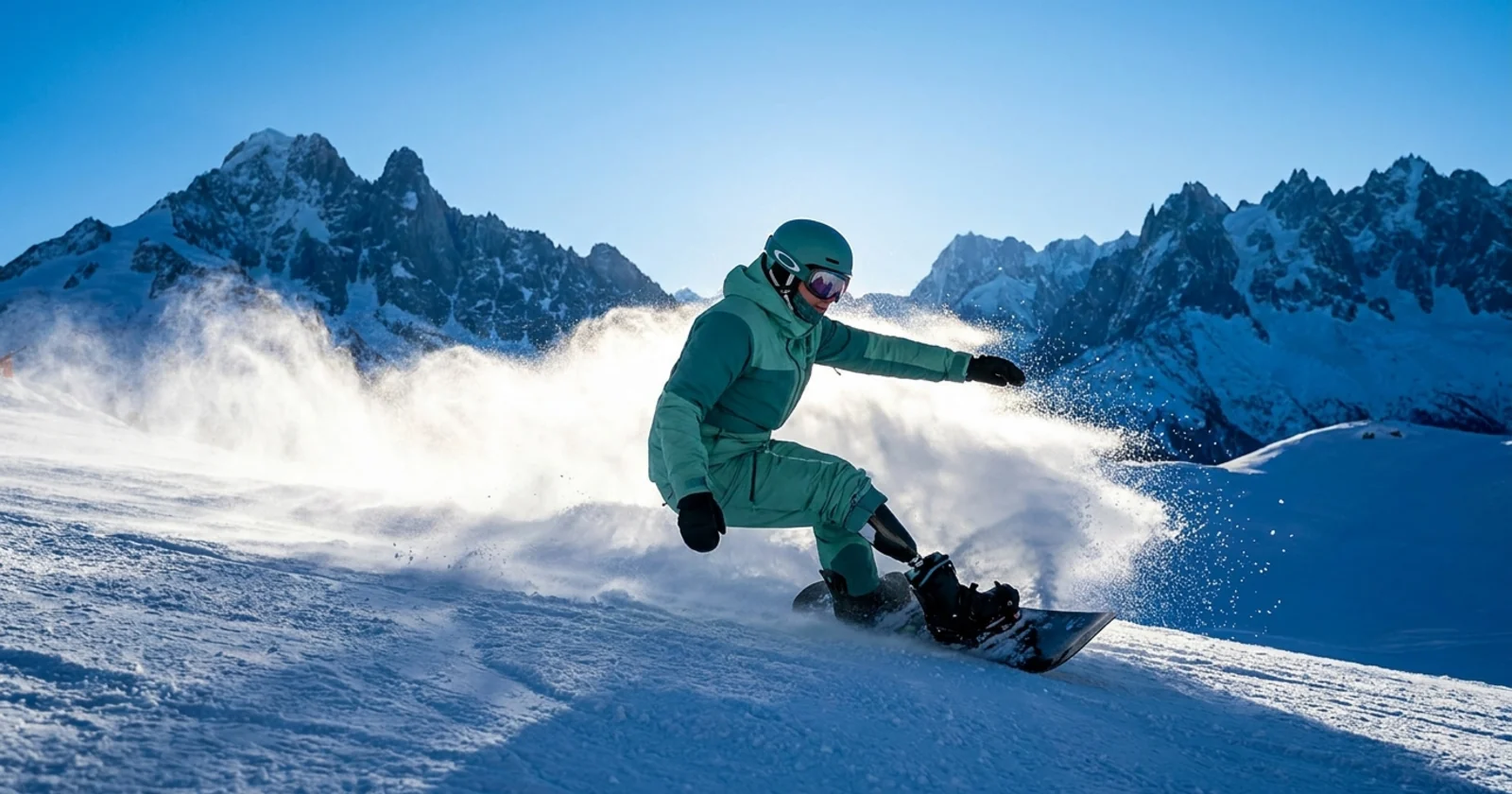
Zach Miller went to his second Paralympic Winter Games in March 2026 looking for his first Paralympic medal. While he might've missed out by finishing fifth in banked slalom and sixth in snowboard cross, this only tells part of his inspiring story.
Miller was diagnosed with left hemiplegic cerebral palsy at six months old. He's now a world champion snowboarder, an ESPY winner, and a two time Paralympian who competes at the top of an event where riders drop into a course at speed with three others beside them. The medal count is simply a technicality.
For parents of a child diagnosed with cerebral palsy, stories like this one are easy to misread. The point is not that your child should become an elite athlete, but what a sport did for one kid who was handed a diagnosis before he could walk.

“Treating him as a competitor rather than as an inspiration is closer to respect than the alternative.”
— Cerebral Palsy Center Editorial Team
A Colorado kid with hemiplegia
Miller was born on March 10, 1999, in Colorado, and diagnosed with left hemiplegic cerebral palsy at only six months of age. Hemiplegic cerebral palsy affects one side of the body. In Miller's case, the left. He describes his condition as affecting the connection between the brain and muscles, limiting muscle growth on that side.
That is a tough thing to manage on a snowboard, where balance runs through both legs and where the board responds to pressure shifts that require exactly the kind of fine control hemiplegia interferes with.
Miller grew up in a state where snow is simply what winter is. He started out taking ski lessons, watched snowboarders going by, and eventually switched out of curiousity.
Instead of the benefit of special programs for the disabled, he was forced to adapt in normal ski programs. In pursuing snowboarding, Miller saw something that looked like more fun and simply went after it.
From the hill to the national team
Miller joined the United States Para Snowboard Team in 2018, at 19. Moving quickly, he earned his first world championship medal in snowboard cross in 2019, then added banked slalom medals in 2021, 2023 and 2025. In 2022 he became world champion in banked slalom at Lillehammer.
Para snowboarding is divided into classes so that athletes compete against others with comparable impairment. Miller competes in SB-LL2, the class for athletes with lower limb impairment that has a moderate effect on the ability to ride.
The two events look different. Banked slalom is a timed run against the clock down a course of banked turns, a test of precision and edge control. Snowboard cross puts riders on the course together, racing over rollers and jumps, where positioning and nerve matter as much as technique.
In 2023 he won the ESPY for Best Athlete with a Disability, a voter-led award that reaches well outside the small world of para snowboarding.
Beijing, then Milano Cortina
Miller competed at the 2022 Paralympic Winter Games in Beijing. He returned for Milano Cortina 2026 as one of 32 athletes nominated to Team USA by U.S. Ski and Snowboard, and as one of the American athletes flagged in previews as worth watching.
He finished fifth in the men's banked slalom LL2 and sixth in the men's snowboard cross LL2. In an event where the field is deep and the margins are small, those are strong results. However, they weren't the medals Miller said he came for.
That's an important thing to note about Zach Miller. In contrast to most disabled athlete stories where participation is the achievement, Miller went to Italy with the open goal of winning. His disappointment at placing fifth and sixth shows he is a true competitor, and wants to be judged as such.
The habit of choosing hard things
Ahead of the Games, Miller talked publicly about a practice he keeps: seeking out things that frighten him, on purpose, on a regular basis. It is a useful idea coming from someone who has spent his life doing physically difficult things with a body that makes them harder.
It has shown up away from the mountain too. In August 2024, while riding his motorcycle through Parleys Canyon in Utah, Miller came upon a truck on fire. He alerted the driver, helped get him out, and worked to keep the flames down with water bottles until help arrived.
What can new CP families take from Zach's story
While inspiring, it's important to remember most children will never be a Paralympian or Olympian, with or without cerebral palsy. First, alleviate any pressure of what your child should achieve.
What is more useful to note is:
- Sport is therapy that doesn't feel like therapy. Balance, motor planning, strength and endurance all get worked in adaptive sport, and children tend to do far more of it when it is fun.
- Adaptive programs exist, and they are more available than most families realize. Adaptive ski and snowboard schools, therapeutic recreation programs at children's hospitals, and organizations like Move United and the Challenged Athletes Foundation run programs across the country, frequently with equipment provided and financial help available.
- The social side may matter as much as the physical side. Being around other kids who move differently, and being coached rather than treated, changes how a child sees themselves.
- Start where your child is. Adaptive cycling, swimming, horseback riding, sled hockey, and wheelchair basketball all have entry points that do not require anyone to already be good at something.
Talk to your child's physical therapist before starting, particularly about equipment, positioning and any orthopedic considerations. A good PT usually knows the local adaptive programs by name.
Zach Miller may have come up short on his medal hunt so far. However, a child diagnosed at six months old grew up, found something he loved, got extremely good at it, became world champion, went to two Paralympic Games chasing dreams of a medal.
He will presumably be back. That, more than any podium, is the part worth passing along to a child who has been told there are things they will find hard.