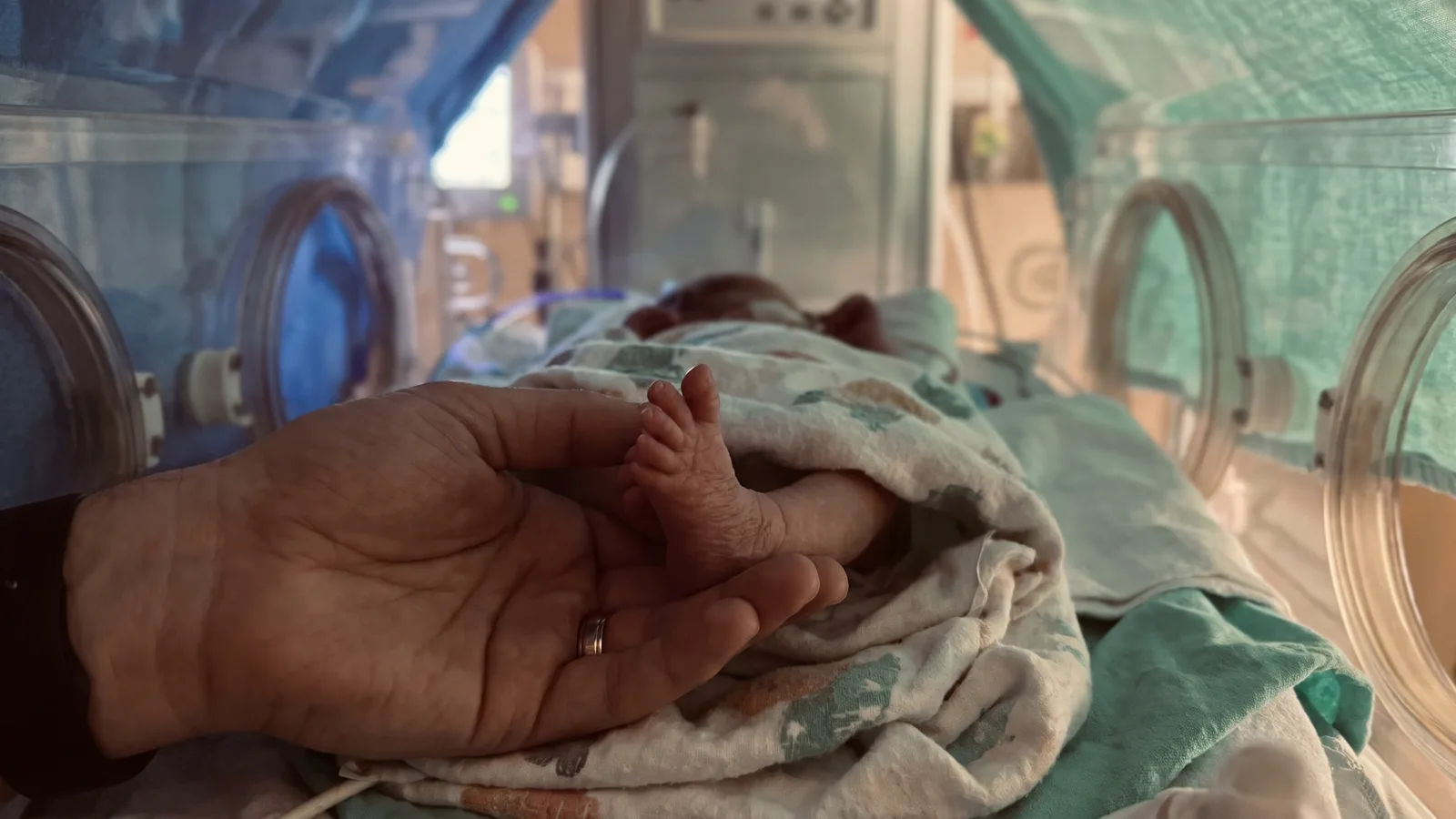
Most premature babies do not develop cerebral palsy, but the risk climbs the earlier a baby is born. A review of 26 studies found cerebral palsy in 14.6% of babies born at 22 to 27 weeks, 6.2% at 28 to 31 weeks, 0.7% at 32 to 36 weeks and 0.1% of babies born at term (Himpens and colleagues, 2008). In the first year, judge a premature baby’s milestones by corrected age, and watch for a stiff or floppy body, a head that lags when lifted, and one hand used far more than the other.
Testing has moved earlier too. Used together, an MRI, a movement assessment and a neurological exam can now point to cerebral palsy before 6 months’ corrected age, where the diagnosis once waited until 12 to 24 months (Novak and colleagues, JAMA Pediatrics, 2017). For the signs that apply to every baby, full term or not, see our guide to early signs of cerebral palsy in infants.
“Historically, the diagnosis has been made between age 12 and 24 months but now can be made before 6 months' corrected age.”
— Novak et al., JAMA Pediatrics, 2017
Cerebral palsy risk in premature babies, week by week of birth
- In western Sweden, a population study of 94,466 births from 2003 to 2006 found cerebral palsy in 71.4 per 1,000 babies born before 28 weeks (about 1 in 14), 39.6 per 1,000 born at 28 to 31 weeks (about 1 in 25), 6.4 per 1,000 at 32 to 36 weeks and 1.41 per 1,000 after 36 weeks (Himmelmann and Uvebrant, 2014).
- In the United States, the NICHD Neonatal Research Network followed 6,927 surviving children born before 27 weeks and examined them at 18 to 26 months’ corrected age between 2008 and 2019. Of those children, 18.8% had cerebral palsy and 53.7% had a normal neurological exam. The adjusted rate of cerebral palsy rose each year of the study (DeMauro and colleagues, Journal of Pediatrics, 2024).
- The CDC lists birth before 37 weeks as a risk factor, “especially” birth before 32 weeks, along with a birth weight under 2,500 grams (5 pounds, 8 ounces), with the greatest risk under 1,500 grams (CDC risk factors for cerebral palsy).
Premature babies make up nearly half of the people diagnosed with cerebral palsy in high-income countries (Boyd and colleagues, Pediatric Research, 2025). Even in the earliest group in the 2008 review, about 85 of every 100 babies did not develop it.
Why being born early raises the risk
A premature baby’s brain is still building itself, and two kinds of injury are most closely tied to cerebral palsy. The first is periventricular leukomalacia (PVL), damage to the white matter that sits around the brain’s fluid-filled spaces, called ventricles. A 2009 review in The Lancet Neurology describes PVL as the main form of brain injury in premature infants and notes that it often comes with injury to nerve cells in other parts of the brain (Volpe, 2009).
The second is intraventricular hemorrhage (IVH), bleeding into those ventricles, graded from 1 (mild) to 4 (severe). A 2022 meta-analysis of 38 studies found that children with grade 3 to 4 IVH had about five times the odds of cerebral palsy of premature children without a brain injury (odds ratio 4.98). Grade 1 to 2 bleeds also raised the odds, though far less (odds ratio 1.76) (Rees and colleagues, Pediatrics, 2022). Our page on premature birth as a cause of cerebral palsy explains these injuries in more detail.
Corrected age: the clock to use for a premature baby
The American Academy of Pediatrics explains corrected age in two steps. Count your baby’s age in weeks from the birth date, then subtract the number of weeks your baby was born early (40 minus the gestational age at birth). Its example: a baby born at 32 weeks arrived 8 weeks early, so at 4 months old she has a corrected age of 2 months and should be expected to do what a 2 month old born at term does. The AAP advises using corrected age for milestones during the first 2 years (AAP, HealthyChildren.org).
Signs to watch in the first year, by corrected age
The milestones below come from the CDC’s developmental checklists, and the warning signs come from the CDC’s page on cerebral palsy. The CDC notes that some children without cerebral palsy show these signs too, so none of them is a diagnosis on its own (CDC, About Cerebral Palsy).
Around 3 to 4 months corrected
By 4 months, most babies hold their head steady when held, bring their hands to the mouth, push up onto the elbows or forearms during tummy time and hold a toy put in their hand (CDC 4 month milestones). Signs the CDC lists for babies under 6 months: the head lags when the baby is picked up from lying on the back, the body feels stiff or floppy, the back and neck overextend when the baby is cradled, and the legs stiffen and cross or scissor when the baby is lifted.
Around 6 months corrected
Most babies roll from tummy to back, push up on straight arms and lean on their hands to support themselves when sitting (CDC 6 month milestones). Signs listed for babies older than 6 months: not rolling over in either direction, trouble bringing the hands together or to the mouth, and reaching with one hand while the other stays in a fist.
Around 9 months corrected
Most babies sit without support, get into a sitting position on their own and pass things from one hand to the other (CDC 9 month milestones).
Around 12 months corrected
Most babies pull up to stand, walk while holding on to furniture and pick up small things between thumb and pointer finger (CDC 1 year milestones). For babies older than 10 months, the CDC flags a lopsided crawl (pushing off with one hand and leg while dragging the other side) and scooting on the bottom or hopping on the knees instead of crawling on all fours. More signs are on our page on early symptoms of cerebral palsy in infants.
Tests that can flag cerebral palsy before 6 months corrected
The 2017 international guideline led by Iona Novak found that before 5 months’ corrected age, three tools best predict cerebral palsy: an MRI at term-equivalent age (86% to 89% sensitivity), the Prechtl General Movements Assessment (98%) and the Hammersmith Infant Neurological Examination, or HINE (90%). After 5 months, MRI and the HINE remain the strongest tools. The guideline recommends combining these tests with the baby’s medical history rather than relying on one (Novak and colleagues, 2017).
The General Movements Assessment needs no needles or scans. A trained assessor watches the baby’s spontaneous movements. Healthy babies make small, fluid “fidgety” movements of the neck, trunk and limbs, the main movement pattern of an awake baby at 3 to 5 months; their absence, or stiff “cramped synchronized” movements that persist, reliably predicts later cerebral palsy (Einspieler and Prechtl, 2005). We explain all three tests in how cerebral palsy is diagnosed early, and newer research on AI tools that score general movements from video.
Early answers are still the exception. In Australian Cerebral Palsy Register data, only 21% of children were diagnosed in the first 6 months of life (Boyd and colleagues, 2025). An early diagnosis opens the door to therapy while the brain is changing fastest; see the benefits of early diagnosis.
NICU follow-up programs
The American Academy of Pediatrics classes the premature infant as a high-risk newborn and says follow-up needs should be defined as part of discharge planning (AAP Committee on Fetus and Newborn, 2008). Many children’s hospitals run NICU follow-up clinics for this purpose, but eligibility differs from one program to the next, and specialists do not fully agree on which premature babies should be followed (Boyd and colleagues, 2025). Before your baby leaves the NICU, ask whether your baby qualifies and when the first visit is.
What parents can do
The CDC’s advice is plain: don’t wait. If your baby is missing milestones, talk with the pediatrician, ask about developmental screening, ask for a referral to a specialist if you are still worried, and call your state’s early intervention program (CDC Learn the Signs. Act Early.). Questions worth bringing to appointments:
- Did my baby have a head ultrasound or MRI in the NICU, and what did it show?
- Is my baby enrolled in a NICU follow-up clinic, and when is the next visit?
- Has my baby had a General Movements Assessment or a HINE?
- Is my baby on track for corrected age, and what should we watch before the next check?
Common questions
What are the signs of cerebral palsy in premature babies?
The same as in any baby, judged by corrected age: a head that lags when lifted, a body that feels stiff or floppy, legs that scissor, not rolling by about 6 months, favoring one hand, and a lopsided crawl later in the first year.
Do most premature babies get cerebral palsy?
No. Even among babies born at 22 to 27 weeks, about 85 in 100 did not develop cerebral palsy in the 2008 review. The risk is far lower for babies born at 32 to 36 weeks.
How early can cerebral palsy be diagnosed in a premature baby?
With MRI, the General Movements Assessment and the HINE together, before 6 months’ corrected age, according to the 2017 guideline.