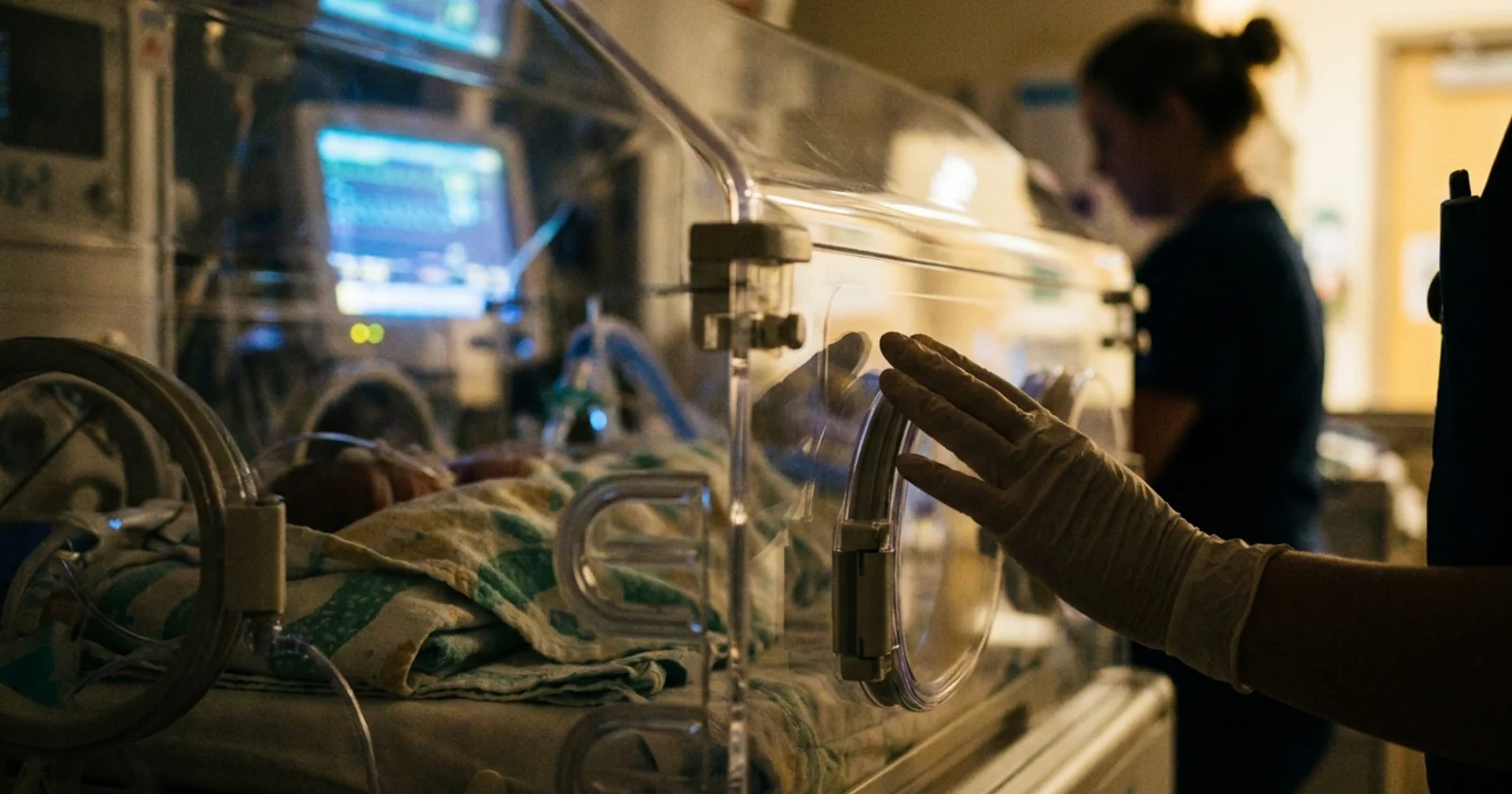
The American Academy of Pediatrics’ 2026 clinical report keeps cooling, or therapeutic hypothermia, as standard care for newborns with moderate to severe hypoxic ischemic encephalopathy (HIE). Cooling should start within six hours of birth and holds the baby at 33.5 to 34.5 degrees Celsius for 72 hours. The report advises against routine cooling for mild HIE outside research, and the COMET trial is testing whether it helps.
One particular treatment in newborn medicine has been shown to reduce a baby's risk of dying or developing cerebral palsy after a loss of oxygen at birth. And it isn't a drug, but rather cold therapy.
Therapeutic hypothermia, usually called cooling, lowers a newborn's body temperature by a few degrees for three days after a birth injury to the brain. It's been standard care for moderate to severe hypoxic ischemic encephalopathy, or HIE, for well over a decade.
This year, the American Academy of Pediatrics published an updated clinical report on the practice through its Committee on Fetus and Newborn. While not a headline grabbing document, it is something that can more useful to families. The report describes who should be cooled, how quickly, and what to do in situations that don't fit neatly into the criteria.
Here's an overview of the report, and what it means if you're a parent trying to understand what happened in your baby's first hours.
“Therapeutic hypothermia for mild HIE should not be routinely performed outside research settings.”
— American Academy of Pediatrics, 2026 Clinical Report
First, what HIE is and how does it occur?
Hypoxic ischemic encephalopathy is brain injury caused by a period of reduced oxygen and blood flow around the time of birth. It is one of the recognized pathways to cerebral palsy, though far from the only one. Most cerebral palsy is not caused by events during labor, a point worth repeating because parents often assume otherwise.
What makes HIE unusual is timing. The injury doesn't finish in the moment oxygen is restored. There is a second wave of cell damage that unfolds over the following hours, sometimes called reperfusion injury. This delayed damage is the reason cooling works. It opens a window in which slowing the brain's metabolism can limit how far the damage spreads.
The six hour window is the headline
Cooling should ideally begin within six hours of birth. This timeframe comes from the design of the original trials, and has held as the standard ever since. Every hour inside that window counts, which is why babies born at community hospitals are often transported urgently to a regional NICU with a cooling program, and why some transport teams begin passive cooling on the way.
During treatment, the baby's core temperature is held at 33.5 to 34.5 degrees Celsius for 72 hours using either a cooling blanket for the whole body or a cap for the head, followed by slow rewarming. The infant is monitored continuously throughout.
Who qualifies under the 2026 report
The report supports cooling for infants with biochemical evidence of a perinatal hypoxic ischemic event together with clinical signs of moderate to severe encephalopathy. Biochemical evidence typically means things like cord blood gas results showing significant acidosis. Clinical signs are assessed on a structured neurological exam looking at level of consciousness, tone, reflexes, posture and whether seizures are present.
One important point in the report for families: eligibility for cooling is based on those findings without having to confirm a hypoxic ischemic event. This means a single catastrophe like a placental abruption or a cord prolapse would qualify. Currently, plenty of babies arrive encephalopathic with no clean story of what happened, which would exclude them from a therapy they may benefit from.
What about mild HIE
This is the live debate in the field, and the report is direct about it. Cooling for mild HIE should not be routinely performed outside of a research setting. The evidence simply isn't there yet.
This is uncomfortable for some families, because in practice cooling has drifted toward milder cases as clinicians grew confident in it. The problem is that the original trials enrolled infants with moderate to severe encephalopathy. Extending a treatment that carries real physiological effects into a lower risk population, without trial evidence, is how medicine accumulates practices that later turn out not to help.
Trials are underway. The COMET study, a multicentre randomized trial comparing whole body cooling with normal temperature in mild neonatal encephalopathy, was still recruiting as of early 2026 with completion estimated toward 2030. Until results arrive, parents whose baby had mild encephalopathy and was not cooled should understand that this reflects the current state of evidence, not a lapse in care.
Late presentation and borderline cases
Some babies are not identified within six hours. Some are born at 34 or 35 weeks, outside the gestational ages the original trials studied. Some sit right on the boundary between mild and moderate.
The report addresses these with a recommendation that is really about communication: in borderline situations and where cooling would start late, between six and 24 hours, there should be a documented discussion with the family about the uncertainty involved to allow shared decision making. Parents are entitled to know when their baby's situation falls outside what the evidence clearly covers, and to be part of the choice.
What cooling therapy does and doesn't do
Cooling reduces the combined risk of death and major disability, including cerebral palsy. That is a real and meaningful effect and it is why the therapy became standard.
It is not a cure. Many cooled infants still develop cerebral palsy or other impairments, and researchers have spent the past decade looking for something to add on top of cooling to improve results further. The largest of those efforts, the HEAL trial, tested high dose erythropoietin alongside cooling in around 500 infants and found no neurodevelopmental benefit, with more serious adverse events in the treated group. Melatonin, allopurinol, magnesium sulfate and cord blood cells continue to be studied, but as of now, nothing has been proven to add benefit on top of cooling.
What families and advocacy groups are still asking for
Hope for HIE, a family led organization, published a position statement responding to the report. It welcomed the emphasis on equitable access, standardized protocols, family centered and trauma informed communication, and the evidence supporting safe parental holding and feeding during cooling, which is a genuinely significant quality of life point for parents in those three days.
The group also raised concerns: that no patient or family representatives sat on the workgroup, that mild HIE research needs to move faster, and that follow up should extend well beyond six months. Cerebral palsy and learning differences frequently are not apparent that early.
Questions worth asking your care team
- Was my baby evaluated for cooling, and what did the neurological exam and cord gases show?
- If cooling was started, when did it begin relative to birth?
- If cooling was not offered, what was the reasoning?
- What imaging was done, and when? MRI timing affects what it can show.
- What is the follow up plan, and at what ages will development be formally assessed?
Ask for copies of the records as you go. The labor and delivery record, cord blood gases, the newborn neurological exams, any EEG, and the MRI report are the documents that describe what happened, and they are far easier to obtain now than years later.
This article is general health information and not medical advice. Decisions about a newborn's care belong to you and your medical team.