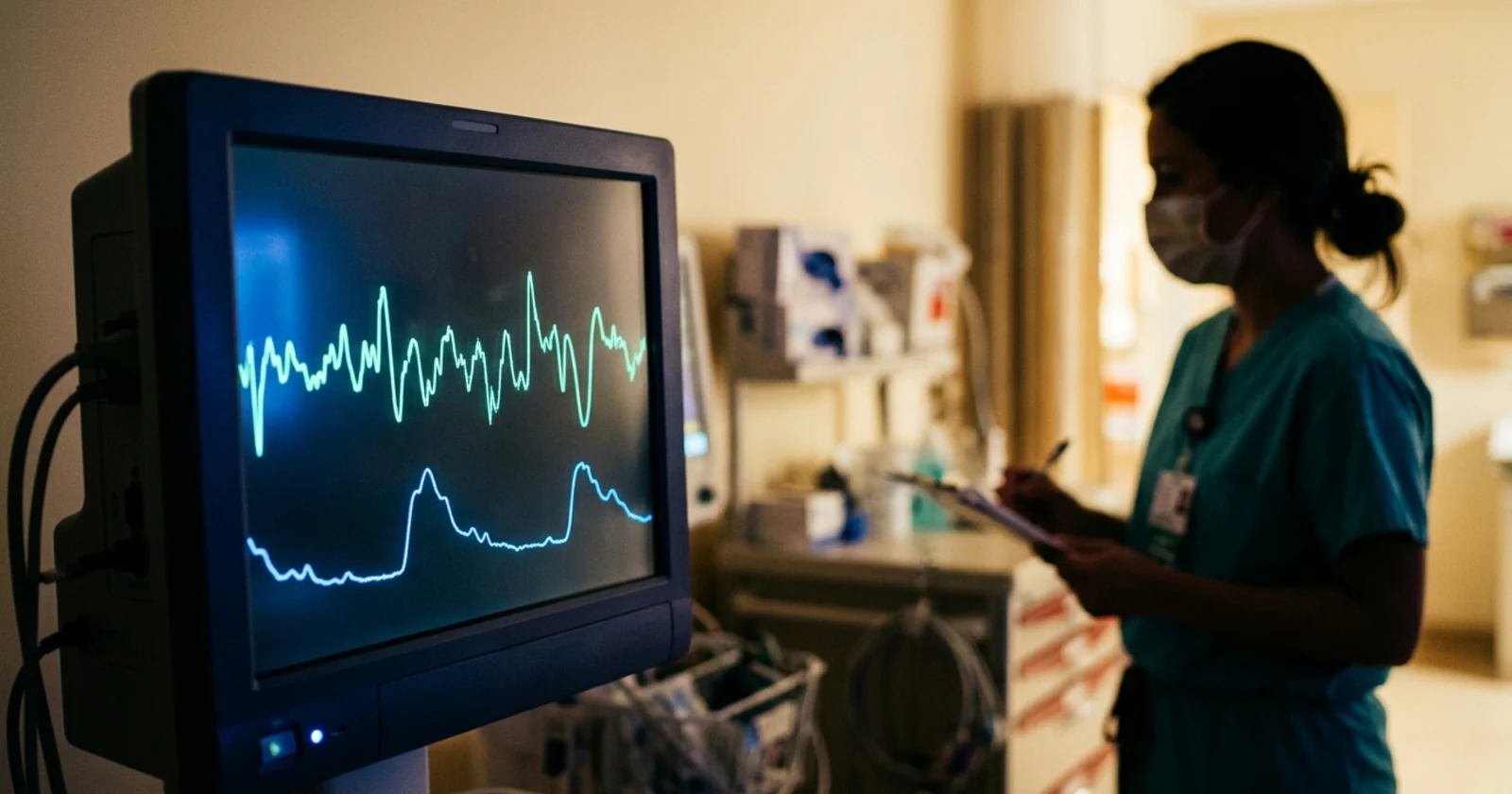
Almost every baby born in a hospital in the United States is monitored during labor by a machine that traces the fetal heart rate. This has been standard practice for roughly fifty years. Surprisingly it's also one of the most widely debated tools in all of obstetrics.
The reason is complicated. Continuous electronic fetal monitoring was adopted to alert when babies are in distress and prevent brain injury. While it's been shown to be a reliable detector, it also raises cesarean and instrumental delivery rates. And oftentimes, two experienced nurses looking at the same tracing may disagree over interpretation.
For years critics have asked: could software read these tracings better than people? A large clinical trial published in 2017 was doubtful, based on the technology available at that time. However, a wave of new artificial intelligence research says maybe.
Below we'll dive deeper into what the current evidence says and whether new technology may save more children from birth injuries.
“Computerised interpretation of cardiotocographs in women who have continuous electronic fetal monitoring in labour does not improve clinical outcomes for mothers or babies.”
— INFANT Collaborative Group, The Lancet
What does a fetal monitor measure?
Electronic fetal monitoring, also called cardiotocography or CTG, records two things: the baby's heart rate and the mother's contractions. Clinicians read the relationship between them. A baseline rate, how much the rate varies moment to moment, accelerations, and the shape and timing of any decelerations relative to contractions are all important.
The problem is the patterns which signal a baby running short of oxygen overlap heavily with patterns that are entirely benign. Most concerning tracings don't represent a baby who is under distress. That's why the tool produces so many false alarms, and why it's often so hard to turn a worrying strip into a confident decision.
Studies have repeatedly found wide variability in interpretation even among experienced clinicians, including disagreement with their own earlier readings of the same strip. That variability is the gap AI is being asked to close.
The trial that raised doubts over computer monitoring
This idea has been tested seriously once, at scale. The INFANT trial, published in 2017 in The Lancet, randomly assigned more than 47,000 women in labor across 24 maternity units in the United Kingdom and Ireland to have their continuous monitoring either supported by computerized interpretation and alerts, or not.
The result was flat. Poor neonatal outcome occurred in 172 babies, or 0.7 percent, in the decision support group and 171 babies, also 0.7 percent, in the group without it. Developmental assessment at two years of age showed no significant differences either. The authors concluded plainly that computerized interpretation of cardiotocographs in women receiving continuous monitoring in labor doesn't improve clinical outcomes for mothers or babies.
However, the timing of this study is crucial. Using date from 2010-2013 with a 2017 analysis simply didn't have the advantage of the AI capabilities we have at present.
How is technology different now?
The INFANT system used rule based logic, essentially an automation of published guidelines. Newer work uses deep learning trained on very large volumes of signal data, which can pick up patterns nobody wrote a rule for.
Recent published work gives a sense of where the technology sits. A 2025 algorithm described in Frontiers in Digital Health combined deep learning with rule based techniques to identify accelerations, decelerations and contractions, reporting F1 scores of 0.803 for accelerations, 0.520 for decelerations and 0.868 for contractions, with 91.5 percent baseline accuracy compared with clinician interpretation. A 2026 model reported sensitivity of 89.13 percent and specificity of 87.78 percent for detecting critical decelerations, trained on more than half a million unlabeled data points and refined on several thousand expert reviewed ones.
All of this is just a measure of whether the software agrees with human clinicians about what is on the strip. The deceleration score of 0.52 shows that interpretation remains the hardest puzzle.
A different approach: skip the interpretation
Some researchers are attacking this from another direction. Rather than reading the heart rate trace better, they are trying to measure something closer to what clinicians actually want to know, which is whether the fetus is short of oxygen.
A project at the Hudson Institute of Medical Research in Australia, working with Monash University engineering and obstetrics groups and collaborators at Emory University and Georgia Tech, is developing software that non-invasively monitors fetal physiological signals for signatures of hypoxia. The team frames the goal in both directions: fewer missed cases of genuine fetal distress and fewer unnecessary cesareans, which they estimate at up to 70,000 a year in Australia alone.
This would strike an important balance: A monitoring tool that catches more distress but triggers many more surgeries is not automatically a win. Cesarean delivery carries its own risks to mother and baby.
What would prove AI monitoring is a benefit?
For families, what matters is whether babies monitored with AI support have fewer brain injuries, less HIE, less cerebral palsy, and whether mothers undergo fewer or at least not more unnecessary operative deliveries.
That requires large randomized trials with neurodevelopmental follow up years out, exactly the design INFANT used. Until several of those report, AI assisted fetal monitoring should be understood as promising and unproven, and any product marketed as preventing birth injury should be asked directly for its outcome data.
Why this matters in a legal context too
Fetal monitoring strips are frequently central evidence in birth injury litigation. Cases often turn on what the tracing showed, when it changed, and how long it took the team to act. The variability in human interpretation cuts both ways: it explains why experts on opposite sides can each read the same strip in good faith and reach different conclusions.
If AI systems become routine, they will change that landscape. An algorithm that flags a pattern creates a timestamped record of a warning. Whether a clinician acted on it, overrode it, or never saw it becomes a factor. This is an area where technology and accountability will develop together, and it's not yet settled.
None of that changes what a family should do today. If you have questions about your delivery, request the complete labor and delivery record, including the monitoring strips, and keep it. Records get harder to obtain as time passes. You can read more about how these records are used on our page about birth injury lawsuits.
The bottom line
Electronic fetal monitoring is imperfect, and everyone in obstetrics knows it. Artificial intelligence is a reasonable idea for improving it, and the current models are noticeably better at signal reading than the systems tested a decade ago. But the only large trial of computer assisted interpretation to date found no benefit to babies, and no new system has yet cleared that bar. Cautious optimism is the honest position.
This article is general information and not medical or legal advice.