Here's a therapy study worth noting: When researchers compared eight weekly hours of modified sport against ordinary physiotherapy for children with cerebral palsy, the two tied on motor capacity improvement. However, when factoring for whether children followed through with the activity, they weren't even close.
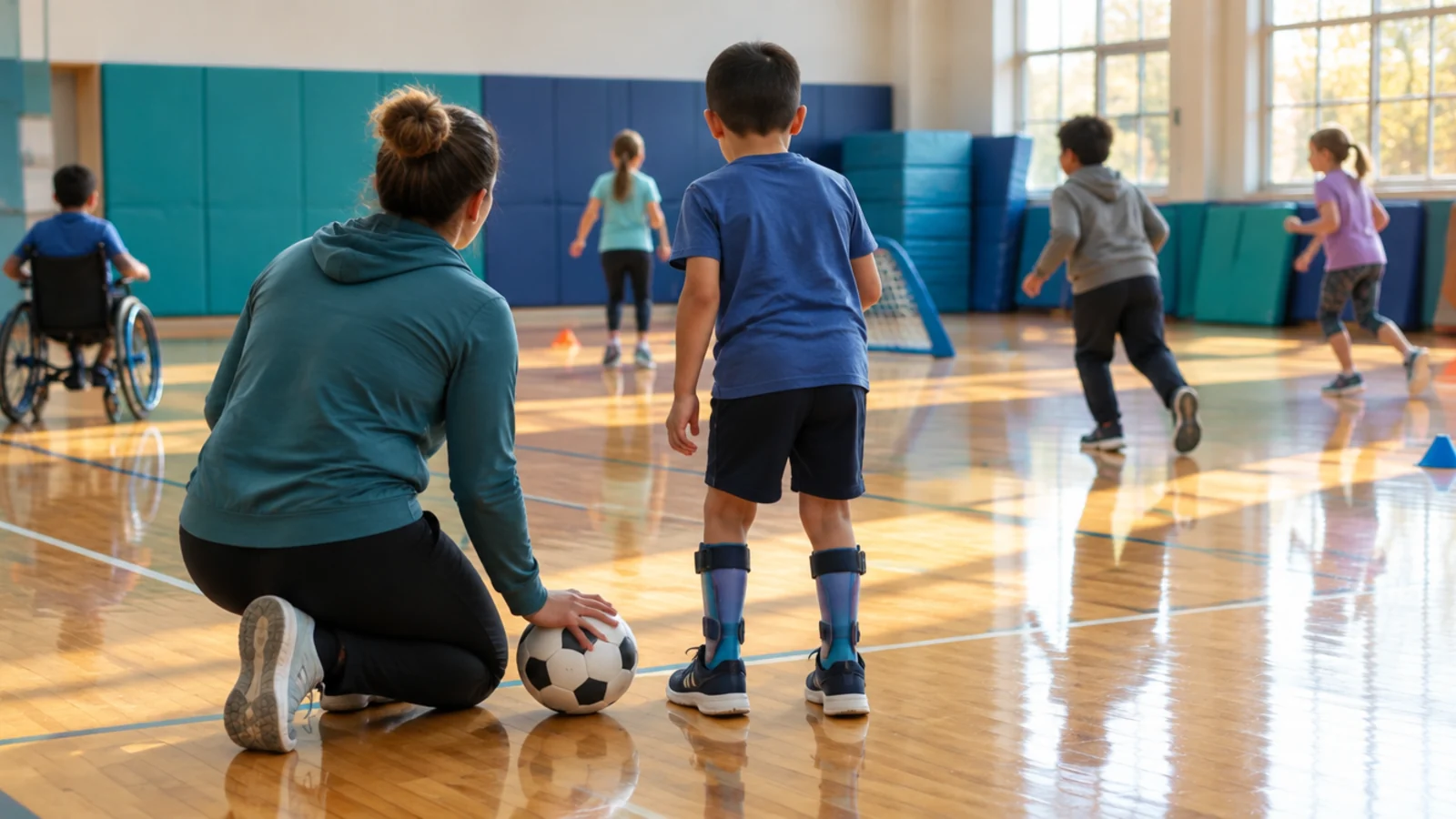
The trial ran in Brazil with 38 ambulant children aged 6 to 12, split evenly between the sports program and usual care. The sports group met once a week for an hour across eight weeks and worked through soccer, handball, basketball and athletics in a peer group.
The comparison wasn't a waiting list, but rather real therapy, one to two sessions a week, which added up to between 12 and 24 hours over the same period.
“Sports Stars Brazil was effective in improving leisure-time physical activity participation goals related to attendance and involvement among ambulant children with CP.”
— Sports Stars Brazil trial, Developmental Medicine & Child Neurology
Diving into the numbers
Participation goals were scored with the Canadian Occupational Performance Measure, which asks the family to name the activity that matters, then rate how it is going. The sports group gained 2.05 points more than usual care on attendance, an effect size of 0.97. On involvement, the quality of taking part rather than simply being present, the gain was 1.84 points.
Both held reasonably well at follow-up, at 1.85 and 0.86. Motor capacity, measured the conventional way, was similar in both groups.
How to interpret the findings
Eight hours of group sport matched 12 to 24 hours of individual physiotherapy on motor capacity. It cost less, and it produced something therapy did not: children who actually wanted to show up for their activity.
That isn't an argument for cancelling physiotherapy. A child with a hip at risk or a contracture developing certainly needs clinical care. A session of soccer isn't a substitute for that. However, it does raise the question of what is each hour of my child's therapy actually buying?
What made the sports sessions work
The design of the sports therapy certainly is a factor. Sessions were run in peer groups rather than one to one, the sports were modified so every child could take a meaningful turn, and the skills practised were ones the chosen sport needed. Children weren't just doing exercises that happened to look like sport - but rather actually playing the sport.
Importantly, the authors describe the program as low cost and suited to places that have few therapy resources, which includes many rural and underserved markets.
The limits of sports therapy
Thirty-eight children is a small study, and resuts should be tested across a larger sample. Also, everyone that took place in the trial was able to walk, so this says nothing about children who use wheelchairs full time. Finally, eight weeks is a short period, and the follow-up gains on involvement had faded by more than half. A program needs to be ongoing and consistent to maintain its effect.