Home›News›Full circle for CP patient-turned researcher shows...
Full circle for CP patient-turned researcher shows benefits of CIMT therapy
9/4/2025
Reviewed by: Cerebral Palsy Center Editorial Team
When Arden Grim’s family first faced the news that she may struggle to walk or talk due to a diagnosis of cerebral palsy, they were heartbroken. But against all expectations, Arden not only learned to move and communicate, she’s now a senior at Smith College, and conducting research at the very clinic where she received her life‑changing therapy.
Arden hopes to become a pediatric neurologist so she can someday work with children who’ve been given a similar prognosis. Yet her inspiring story also illustrates the transformative power of intensive therapies like Constraint‑Induced Movement Therapy (CIMT).
“"To see her come in as an adult, to be an intern in the clinic, not to receive treatment, was really a full-circle moment."”
— Mary Trucks
Arden Grim’s Journey: From Patient to Pediatric Neurologist in the Making
Arden’s life has unfolded in a beautifully full‑circle arc. Her mom recalls: “At about two months of age, we noticed that her right hand was a lot more fisted than her left.” A prenatal stroke from a blood clot had caused cerebral palsy, and weakness in her right side.
After her diagnosis was initially missed, the family credits a pediatric neurologist with finding the root of her condition.
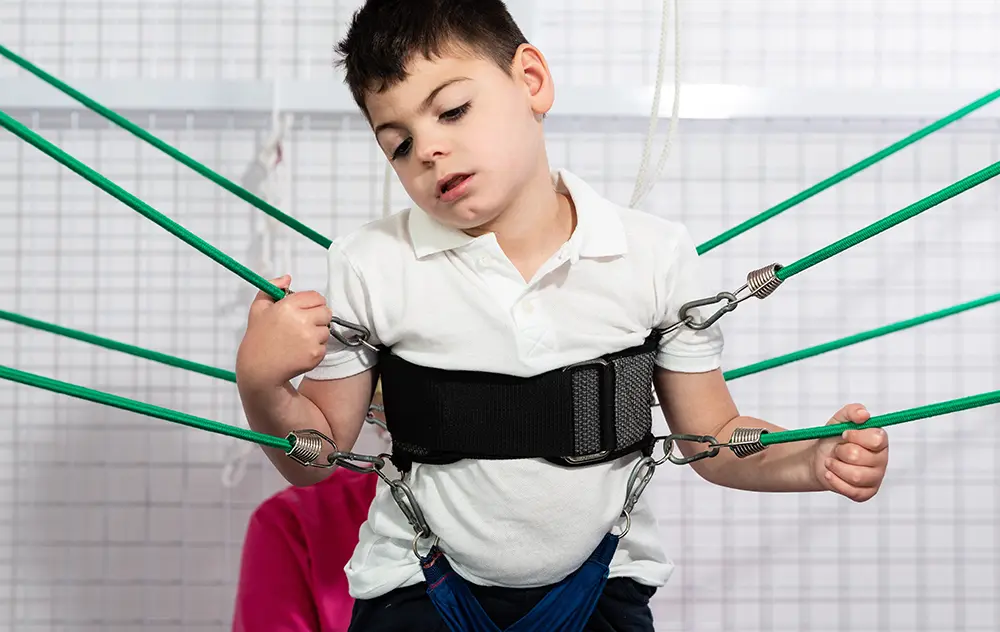
What followed were years of intensive therapy. Beginning at just age two, the family drove thousands of miles from home to undergo months of Constraint-Induced Movement Therapy at a facility called Neuromotor Research Clinic at University of Alabama-Birmingham.
There, doctors fitted her stronger left arm with a cast for a month to encourage strength and use of her weaker right arm.
After the cast was removed, therapists focused on activities from buttoning buttons to tying shoelaces to putting her hair in a ponytail. By learning these basic skills, the small daily victories added up. Against a daunting prognosis, she gained enough strength and coordination to speak, walk, and build a life full of possibilities.
A Mission to Pay Her Experience Forward
Fast‑forward to 2025: Arden, now a senior at Smith College, was studying neuroscience when she noticed an opportunity to serve as a research intern at the very same clinic in Birmingham.
There, she contributed to studies of time-based therapy outcomes for ten weeks this summer.
However, clinicians say her ability to relate to the children undergoing the therapy she had endured as a child made the biggest difference.
“To see her come in as an adult, to be an intern in the clinic, not to receive treatment, was really a full-circle moment,” said Mary Rebekah Trucks, associate director of clinical education, training and implementation at the Neuromotor Research Clinic.
According to Trucks, it helped current patients for Arden “to be able to say to them, ‘Hey, I learned to do this. I know it’s really hard now, but this is something you can do.’”
Arden isn’t stopping at research. Guided by her journey, she plans to apply to medical school. Her goal? To become a pediatric neurologist, working with kids who, much like she once was, face early challenges and big questions.
There’s something undeniably powerful (and comforting) for families navigating a CP diagnosis in knowing that someone who once sat in the therapy chair now wants to be part of the team helping those children. Arden isn’t just inspired by what she received, she’s determined to pay it forward, one child at a time.
CIMT a Significant Benefit for Cerebral Palsy Patients
Once considered an aggressive experimental treatment, Constraint‑Induced Movement Therapy (CIMT) is now rather well accepted. It’s shown significant benefits for children with hemiplegic cerebral palsy, especially in improving hand and arm function and encouraging the use of the affected limb.
High‑dose, concentrated versions of CIMT often produce lasting improvements in upper extremity function. A 2025 analysis confirmed CIMT is effective in a wide range of clinical settings and is feasible over sustained periods. Even modified CIMT, which is less intense but more accessible, offers measurable benefits in upper limb function, although more rigorous trials are still needed.
What does that look like in everyday life? Children who undergo CIMT are encouraged (or required) to use their affected arm while the stronger limb is constrained with a mitt or splint. This helps counter “learned non-use” and taps into the brain’s plasticity, helping to rewire neural pathways so the affected limb becomes more functional, often with benefits that stick.
Evolution of CIMT: From Intensive Protocols to Smarter, Accessible Therapies
CIMT began as an intensive protocol: restraining the unaffected arm for nearly all waking hours (sometimes up to 90%, with 6‑hour daily sessions over two weeks). While effective, the original method’s intensity, cost, and compliance challenges limited its real‑world application.
Enter modified CIMT (mCIMT), a gentler, more practical alternative. These protocols use shorter therapy sessions (think ~30 minutes, 3 days a week over 10 weeks), paired with moderate constraint of the unaffected arm (e.g. a mitt for about 5 hours per weekday).
These modifications aim to keep the benefits while making therapy more sustainable, accessible, and cost‑effective.
Today’s research explores combining CIMT with modern tools, like virtual reality, robotics, brain‑computer interfaces (BCIs), transcranial stimulation, and even home‑based models, to enhance outcomes and flexibility.
A 2025 study found that combining CIMT with a BCI improved real‑life functional use as measured by validated tools. And bibliometric studies from 2024 highlight a vibrant, growing research landscape that still sees vast potential for CIMT’s evolution.
So today, whether through moderate outpatient schedules, telehealth, or tech‑augmented sessions, CIMT is more adaptable, without losing the transformational impact.
Why Researchers, Therapists & Doctors with Lived Experience Matter
When clinicians and researchers themselves have lived experience with disability, it opens doors, both in empathy and in insight. First‑person knowledge can reveal what truly matters to patients, something that traditional top‑down research or clinical models often miss.
Encouraging doctors, therapists, and researchers who have overcome disability themselves helps challenge misconceptions while designing more inclusive, practical, and patient‑centered approaches.
Arden Grim’s story is a living example: the therapies that supported her growth as a child are now tools she studies and will one day deliver as a pediatric neurologist.
Initiatives like increasing access for physicians with disabilities are gaining momentum, amplifying voices that resonate deeply with disabled patients.
These professionals bring authenticity, trust, and relatable empathy, helping families feel heard and seen. As one study puts it, doctors with disabilities are not only increasing diversity, they’re “assets to the medical profession” who promote growth and understanding.
What truly elevates care, though, is connection, and who better to connect with families than someone who’s walked the same path? Arden, and others like her, remind us that healing isn’t just about science: it’s about empathy, lived experience, and the belief that progress is possible.
Our nurses, patient advocates and legal experts are solely focused on bringing you the latest cerebral palsy information, options for financial assistance and access to community support.
Written by
Cerebral Palsy Center
Our nurses, patient advocates and legal experts are solely focused on bringing you the latest cerebral palsy information, options for financial assistance and access to community support.