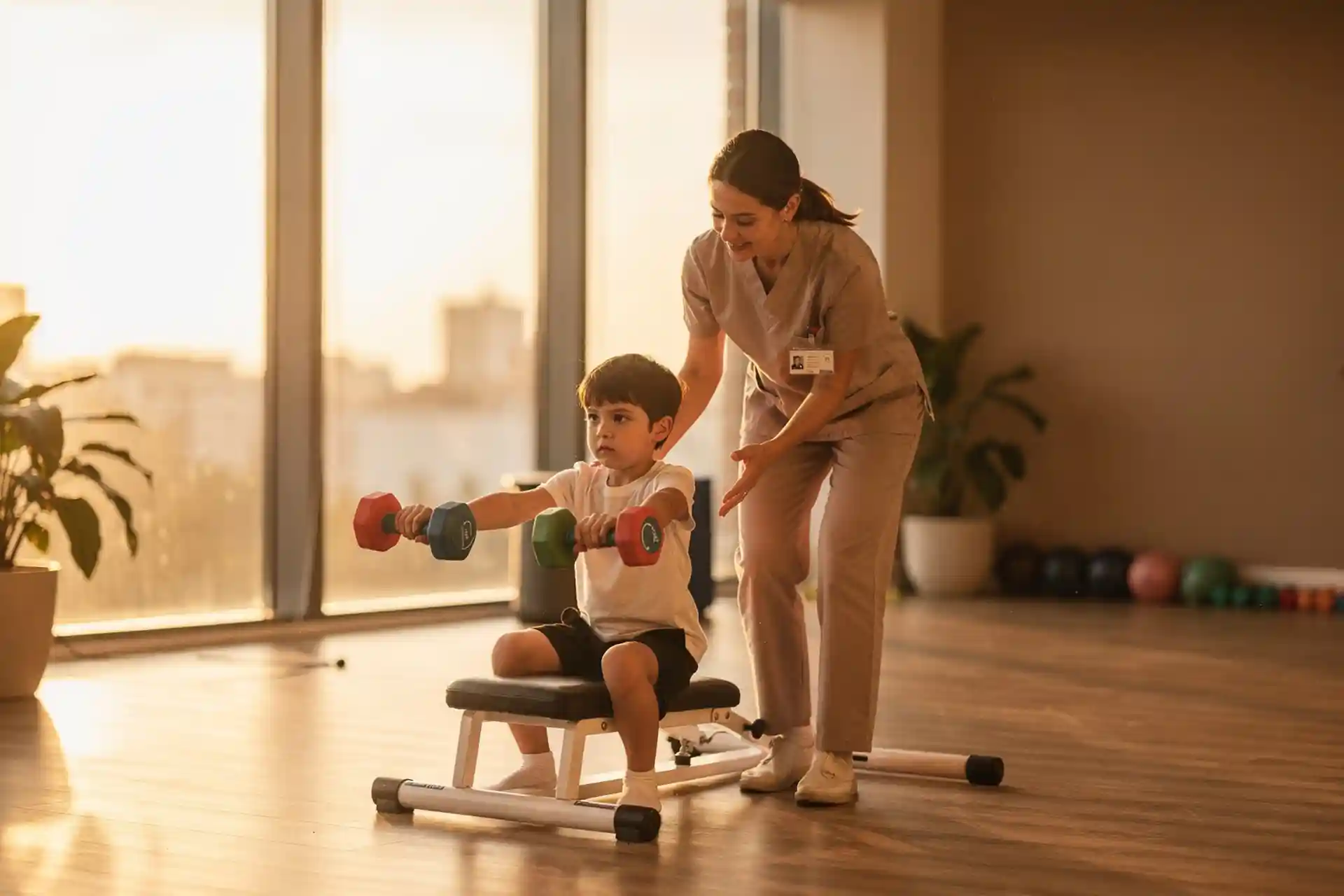
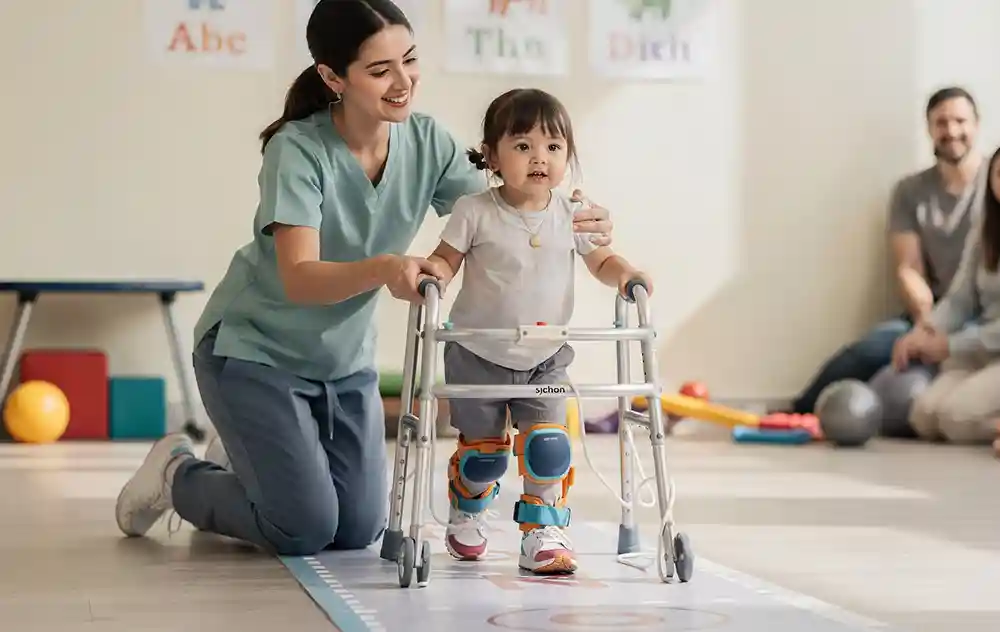
For generations, physical therapy for cerebral palsy has focused on one central goal: helping children move through the world with greater strength, balance, safety, and confidence. The methods have evolved over time: stretching gave way to task-based therapy, treadmills were paired with body-weight support, robotics entered rehabilitation gyms, and wearable devices began assisting movement in real time.
Now a simpler idea is drawing attention: adding small amounts of weight during therapy. Not much weight. The loads under study are typically a small fraction of body mass, placed at the ankle or trunk.
At first glance, the idea sounds almost too simple. But recent research suggests that carefully placed lightweight resistance may help some children with cerebral palsy improve gait mechanics, balance control, and motor coordination. This is not strength training. The loads involved are far too small to build muscle, and that is the point. The proposed mechanism is proprioceptive. A small load gives the nervous system a clearer signal about where a limb is and what it is doing, which may sharpen the brain-to-body communication walking depends on. Whether that produces lasting functional gain, rather than a change measurable only inside a gait lab, is the open question.
The findings are early and should be read that way: this is a research direction, not a treatment to ask for by name, and it has not yet been through the systematic review that would establish it. Still, the study offers another glimpse into how modern cerebral palsy therapy is increasingly focusing on neuroplasticity, sensory feedback, and precision movement training rather than brute-force exercise alone.
“"The work reflects a growing international effort to refine cerebral palsy physical therapy through evidence-based movement science."”
— Kelsey Pabst, R.N.
The research team exploring weighted movement therapy
Some scale first. Cerebral palsy affects about 2.11 children per 1,000 live births and roughly 80% of cases are spastic, so this line of research speaks to the largest group of all. Weighted loading during gait training is an active research question rather than a settled one, and it is worth being precise about how much weight the evidence carries. Individual studies in pediatric rehabilitation journals have reported gait and balance changes with small calibrated loads, but this has not been through the kind of systematic review that would place it alongside established therapy. For comparison, the 2019 evidence review that graded every cerebral palsy intervention published between 2012 and 2019 did find demonstrated effect for treadmill training, partial body weight support treadmill training, task-specific training, strength training and fitness training. Weighted gait training is not yet on that list.
The work in this area focuses on children with spastic cerebral palsy, which accounts for roughly 80% of cases, and asks how small external weights during walking tasks change gait performance. Rather than using heavy resistance, the study examined carefully calibrated lightweight loading designed to influence movement patterns without overwhelming the child. This distinction matters. Traditional strengthening programs often focus on increasing muscle power over time. The weighted gait approach explored here appears to target something slightly different: improving sensory awareness, balance control, and motor coordination while walking.
Researchers studying cerebral palsy increasingly believe that how a child practices movement may be just as important as how much they practice. Small changes in feedback to the nervous system (whether through weights, robotics, vibration, or wearable devices) may help the brain develop more efficient motor patterns.
What the study discovered about gait and balance
Set any gait finding against what the motor development curves already establish. Following 657 children with cerebral palsy through 3,455 assessments to age 21, researchers found no average decline at GMFCS levels I and II, while levels III, IV and V peaked at 7 years 11 months, 6 years 11 months and 6 years 11 months respectively, then lost 4.7, 7.8 and 6.4 GMFM-66 points on the way into adulthood. That is the backdrop. A gait intervention is working against a curve that is already falling for the children who need it most, which is why a small measured gain matters and why a gain that fades is not the same thing.
The findings from the study were encouraging. Researchers observed measurable improvements in gait performance and balance-related outcomes when lightweight resistance was added during walking activities.
Children participating in the intervention demonstrated improvements in aspects of walking efficiency and movement control. The weighted approach appeared to help stabilize movement patterns during gait tasks, potentially by increasing proprioceptive feedback, the body’s awareness of where limbs are positioned in space.
For many children with cerebral palsy, proprioception and motor planning are significant challenges. Walking requires constant communication between muscles, joints, the spinal cord, and the brain. When that communication is disrupted by early brain injury, gait may become unstable, asymmetrical, or inefficient.
The study suggests that carefully applied lightweight loading may enhance the nervous system’s ability to organize movement during walking practice. Researchers believe the weights may encourage the body to activate stabilizing muscles more effectively while improving awareness of limb positioning.
Importantly, these were not dramatic or “miracle” improvements. Instead, they represented meaningful functional changes in movement quality, exactly the kind of incremental gains that often matter most in long-term cerebral palsy therapy.
How this compares to traditional CP physical therapy
Treadmill training and partial body weight support treadmill training both carry graded evidence, as do task-specific training, strength training and fitness training. Weighted loading does not yet. That gap is the honest comparison.
Modern cerebral palsy treatment already includes a wide range of gait-focused interventions. Children may work on treadmill walking, balance training, strength development, stretching, task-specific mobility exercises, aquatic therapy, and functional movement repetition.
The weighted gait approach differs because it combines physical effort with enhanced sensory feedback. Traditional strengthening exercises primarily challenge muscles. Weighted movement training may challenge the nervous system’s movement organization at the same time.
This idea aligns with broader trends in pediatric neurorehabilitation. Current research increasingly emphasizes:
Current research emphasizes task-specific repetition, motor learning principles, sensory-motor integration, real-world movement practice and neuroplasticity-driven therapy. That shift is well supported: goal-directed training and task-specific training both appear among the interventions with demonstrated effect in the 2019 evidence review, while open-ended exercise does not.
In other words, therapy is shifting away from isolated exercises and toward helping the brain learn better movement strategies through meaningful practice.
Researchers are also exploring other tools built around similar concepts, including:
Researchers are exploring several tools built on similar ideas, including robotic gait systems, wearable stimulation devices, constraint-induced movement therapy, balance-feedback systems and virtual reality rehabilitation. Constraint-induced movement therapy is the one that has already arrived: it is established practice with evidence behind it rather than an emerging option.
The weighted therapy findings fit into this larger movement toward smarter (not simply harder) rehabilitation.
Are there risks to using weights in therapy?
Parents should understand that this research does not suggest attaching ankle weights at home without professional guidance.
Improper use of weights can worsen gait mechanics, increase fatigue, strain joints, or reinforce compensatory movement patterns. Children with cerebral palsy already work harder than their peers to move, and excessive resistance can sometimes lead to inefficient or unsafe movement.
Risks may include:
Overfatigue
Increased spasticity in some children
Joint stress
Poor posture compensation
Altered walking mechanics
The key difference in the research setting is precision. Therapists and researchers carefully controlled the amount, placement, timing, and duration of resistance. The weights used were intentionally light and applied within structured rehabilitation sessions.
Children with severe balance difficulties, orthopedic instability, uncontrolled seizures, or significant muscle contractures may not be appropriate candidates for weighted movement interventions.
Like many cerebral palsy therapy techniques, success depends heavily on individualization.
The next frontier in cerebral palsy rehabilitation research
The study raises important questions that researchers are now beginning to explore.
Future investigations will likely examine:
Which children benefit most Ideal weight amounts and placement
Long-term outcomes
Whether improvements persist after training ends
How weighted therapy combines with robotics or wearable devices
Whether home-based programs can safely replicate results
Researchers are also increasingly interested in combining movement therapies with advanced technology. Some rehabilitation teams are pairing gait training with wearable sensors, AI-driven motion analysis, and adaptive stimulation devices that adjust therapy in real time.
The larger trend in cerebral palsy treatment is clear: therapies are becoming more personalized, data-driven, and neurologically targeted.
Weighted movement therapy may end up as one small part of a much broader set of precision rehabilitation tools tools designed to help children move more efficiently and comfortably.
What this could mean for your child with cerebral palsy
For families, the most important takeaway is not that weights are suddenly a breakthrough cure. Instead, the study reinforces a hopeful idea: even relatively small adjustments in therapy strategy may improve outcomes.
Children with cerebral palsy often make progress gradually. Improvements in balance, gait symmetry, endurance, or stability can significantly influence independence, confidence, and participation in daily life.
The findings also reinforce the importance of individualized therapy. What works for one child may not work for another. Modern cerebral palsy treatment increasingly recognizes that rehabilitation should adapt to the child, not force every child into the same model.
For some children, weighted movement practice may eventually become one helpful tool among many.
Should you discuss this research with your child’s therapist?
Yes, especially if your child is already working on gait training, balance, or walking endurance.
Parents do not need to request weighted therapy specifically. Instead, it may be more helpful to ask broader questions such as:
Could sensory feedback improve my child’s gait training?
Are there task-specific strategies we haven’t explored?
Would resistance-based movement training be appropriate?
Are there balance-focused approaches that may help?
Physical therapists specializing in cerebral palsy are trained to evaluate movement quality, fatigue, safety, and readiness for different interventions. They can determine whether concepts from the study might fit your child’s therapy goals.
The research should be viewed as a conversation starter, not a do-it-yourself program.
Safe ways to reinforce these concepts at home
While parents should avoid unsupervised weighted training, some home activities may support the same principles of balance, coordination, and controlled movement.
Examples include:
Obstacle-course walking
Stepping over soft objects
Carrying lightweight household items safely
Balance games
Slow marching exercises
Walking on varied safe surfaces
Controlled stair practice with supervision
The goal is not resistance for resistance’s sake. It is helping the nervous system practice coordinated movement repeatedly and safely.
Consistency matters more than intensity. Small amounts of high-quality movement practice, repeated over time, often produce the greatest long-term gains in cerebral palsy therapy.
A changing future for CP therapy
The newest weighted gait research reflects something larger happening across pediatric rehabilitation: therapists and researchers are learning that movement is not controlled by muscles alone. It is shaped by sensation, feedback, repetition, timing, and the brain’s remarkable ability to adapt.
That shift is changing how cerebral palsy treatment is designed.
In the years ahead, families will likely see more therapies that blend biomechanics, neuroscience, and technology in increasingly personalized ways. Some will involve robotics. Others may involve wearable devices, virtual reality, or sensory-based interventions.
And some, perhaps surprisingly, may involve something as simple as a carefully placed small weight, used at precisely the right moment to help the brain learn movement in a better way.
Sources:
Nehad, A., et al. Efficacy of Adding Lower Extremity Weights on Balance and Gait Disturbances in Children with Ataxic Cerebral Palsy: A Randomized Controlled Trial. NeuroRehabilitation. (May 13, 2026). Retrieved from sagepub.com
Malik, A. Small weights may improve gait in children with cerebral palsy. European Medical Journal. (May 13, 2016). Retrieved from www.emjreviews.com
Kelsey is an experienced surgical nurse with more than 10 years in hospital-based care, including leadership within the operating room. She has worked extensively with pediatric patients, refining her ability to support children and families during critical moments.
Written by
Cerebral Palsy Center
Our nurses, patient advocates and legal experts are solely focused on bringing you the latest cerebral palsy information, options for financial assistance and access to community support.