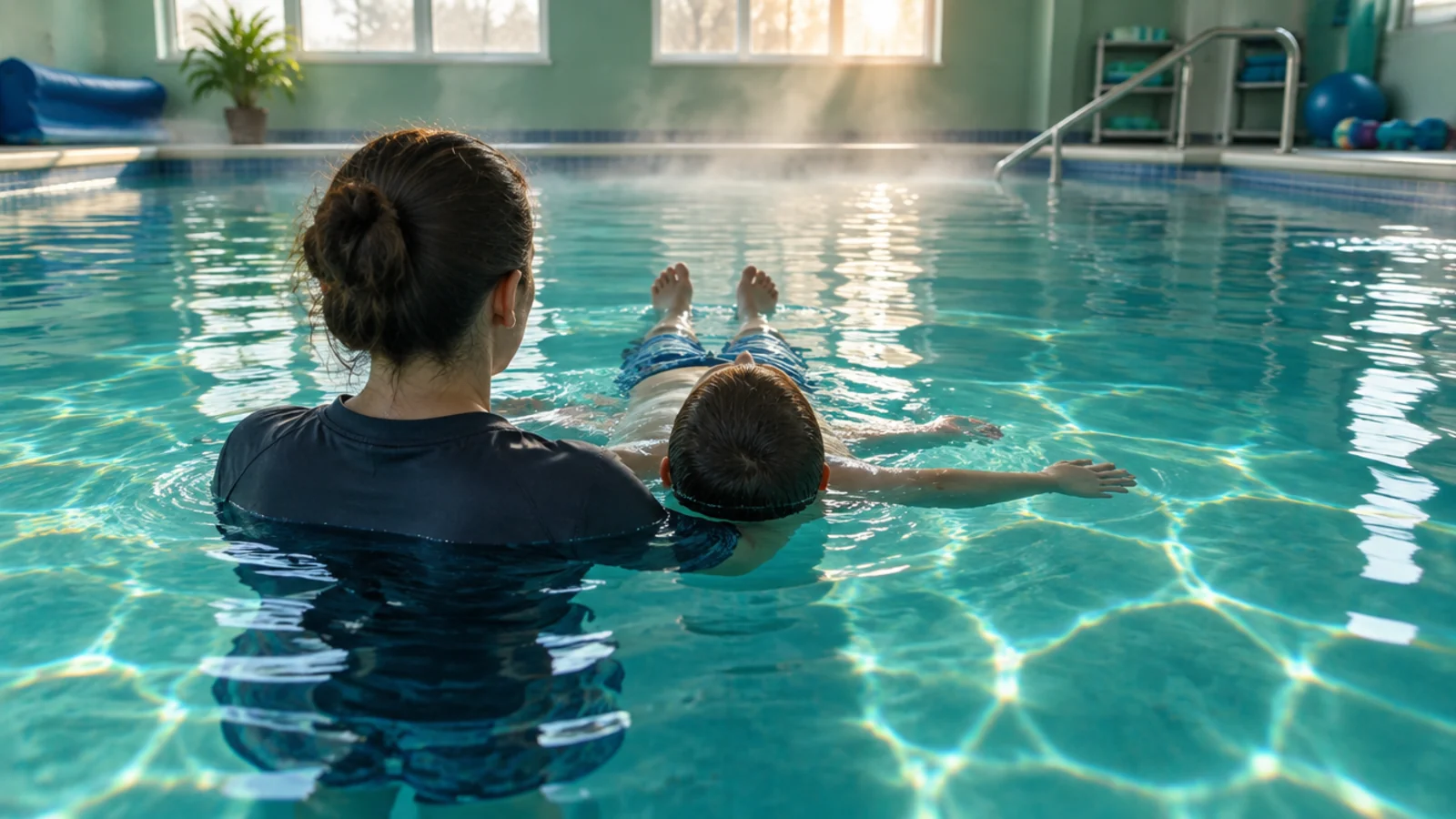
Water does something for a child with cerebral palsy that a gym floor simply can't. It carries weight, slows potential falls and makes movements possible that would be impossible standing up. Parents know this already. What they usually want to know is whether it counts as treatment or just a nice afternoon.
A meta-analysis published in PLOS One in June 2025 pooled 16 randomized trials covering 634 children, 319 in water programs and 315 in conventional training. It gives a clearer answer than any single study, and the answer comes with a condition attached.
“The dose is the finding. Under 10 weeks, pooled results show nothing. Past 10 weeks, the gross motor gain is real and consistent.”
What the pooled evidence found
Gross motor function improved more with water therapy than with conventional treatment, with a standardized mean difference of 0.41 and a confidence interval of 0.15 to 0.68. That is a modest but genuine effect, and it held for children under 6 and over 6 alike.
Fine motor function pointed in the same direction but didn't reach statistical significance. Neither did balance or muscle tone, despite both trending toward benefit. Anyone selling you a pool program as a spasticity treatment is ahead of the evidence.
The part that should change your plan
Split the trials by length and the picture separates cleanly. Programs running longer than 10 weeks produced a standardized mean difference of 0.48, with a confidence interval of 0.31 to 0.66. Programs of 10 weeks or less produced 0.14, and the interval crossed zero.
Six weeks in the pool is a good swim, and there's nothing wrong with a child enjoying the water for its own sake. To be considered a motor intervention, however, takes more time.
What a 2026 review adds
A systematic review in Healthcare on July 23, 2026 looked at 8 randomized trials and 222 participants aged 3 to 29, across cerebral palsy and several other disabilities. Halliwick-based aquatic therapy improved balance and postural control consistently, with reported lower limb strength gains of 15 to 30 percent and walking measures improving alongside.
That review mixes diagnoses, so read it as supporting evidence rather than proof specific to cerebral palsy. Its message matches the larger one: the water is doing real work on balance and postural control.
Practical notes for families
Ask what method the program uses. Halliwick and similar structured approaches are what the trials tested, and an unstructured session in a warm pool is a different thing. Ask how long the block runs, and treat anything under 10 weeks as recreation rather than therapy. Ask about water temperature too, since a cold pool raises tone and undoes much of the point.