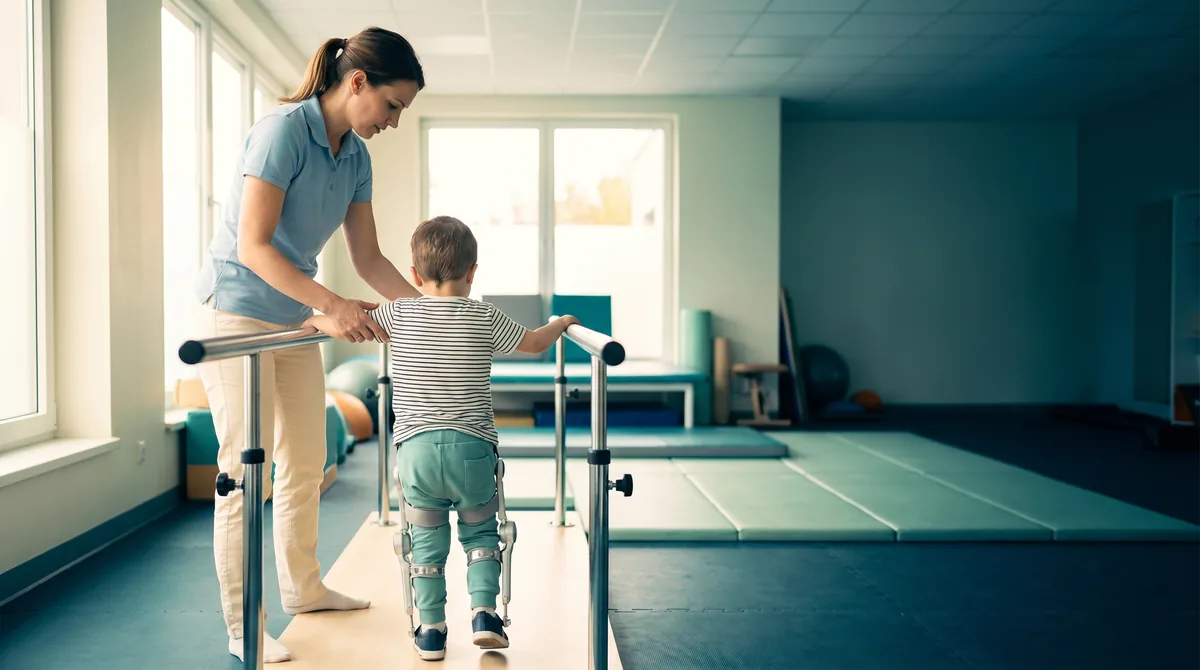
In a 2024 randomized trial published in JAMA Network Open, 90 children with cerebral palsy (78 finished) had 18 sessions of either walking practice in the Angel Legs M20 exoskeleton or standard physical therapy over six weeks. The exoskeleton group gained significantly more gross motor function, and four weeks later showed better balance and a more typical gait. The gains were real but modest: a tool for more practice, not a cure.
Wearable robots are moving from science fiction into the pediatric therapy gym. The idea is simple and hopeful: a powered, lightweight exoskeleton that helps a child practice walking with more repetitions, better alignment, and more confidence than they could manage on their own.
A 2024 randomized trial gives one of the most careful looks yet at what this technology can (and cannot) do for children with cerebral palsy.

“Wearable robots do not replace therapy, but as one tool among many they can add the structured, repetitive practice that helps children build motor skills.”
— Cerebral Palsy Center Editorial Team
What the trial tested
In a randomized clinical trial published in JAMA Network Open in 2024, researchers enrolled 90 children with cerebral palsy (78 completed the study), with an average age of about nine years and a range of mobility levels (GMFCS II to IV). Children in the intervention group trained with the Angel Legs M20, a powered, wearable lower-limb exoskeleton designed to assist walking.
How a wearable exoskeleton works
A powered exoskeleton is a lightweight, motorized frame worn over the legs and hips. Small motors at the joints sense what the child is trying to do and add just enough assistance to complete a step: supporting the hips and knees, keeping the legs in better alignment, and helping the child stay upright and balanced while they do the work of walking.
The goal is not to walk for the child. It is to make practice possible: to let a child take many more well-aligned steps in a session than they could manage unaided, with less fatigue and less fear of falling. That combination of repetition, good alignment, and confidence is exactly what the developing motor system needs to refine a skill.
Why repetition and upright time matter
Decades of rehabilitation research point to the same principle: the brain and muscles learn movement through frequent, active, task-specific practice. Walking is a complex skill, and children with cerebral palsy often cannot accumulate enough quality repetitions through conventional therapy alone, they tire quickly, or their gait pattern reinforces the very habits therapy is trying to change.
Time spent upright and weight-bearing carries benefits beyond walking itself. It can help maintain joint range of motion, support bone and muscle health, aid digestion and circulation, and reduce some of the secondary complications that come with limited mobility. For children with the most significant motor involvement, these “dose of standing and stepping” benefits may be the main goal, even when independent walking is not the realistic target.
What improved
Compared with children given the same number of standard physical therapy sessions, the robot-assisted group showed significantly greater gains in gross motor function (measured by the GMFM) at the end of treatment, and better balance and a more typical gait pattern at the four week follow up. The improvements were real but modest, consistent with how researchers describe these tools: a way to add structured, repetitive, upright practice that can support mobility, help maintain joint range of motion, and reduce secondary complications. For children with the most limited mobility, the goal is often to preserve and build capacity rather than to achieve independent walking. See how this fits alongside physical therapy.
Understanding GMFCS levels
Researchers describe a child’s mobility using the Gross Motor Function Classification System (GMFCS), a five-level scale where level I means walking with few limitations and level V means significant challenges with independent movement. The trial focused on children at levels II through IV, a wide middle range, from children who walk with some difficulty to those who rely on wheeled mobility much of the time.
Knowing a child’s GMFCS level helps set realistic goals. For a child at level II or III, the aim of gait training might be smoother, more confident walking; for a child at level IV, it might be building endurance, maintaining range of motion, and the health benefits of upright time. The right target is individual, and your therapy team can help define it.
The limits worth keeping in mind
A single trial, however well designed, is not the last word. The gains were modest, the children were followed for a limited time, and we do not yet know how long the improvements last once training stops or how well they translate into everyday walking at home and school. The trial compared exoskeleton sessions with the same number of standard physical therapy sessions, so it shows how the two compare over six weeks, not what happens when an exoskeleton is added on top of a full therapy program. It is best understood as one tool within good rehabilitation rather than a replacement for it.
Access is another real-world hurdle. Powered pediatric exoskeletons are still specialized, expensive devices found mostly in research centers and larger rehabilitation clinics, and insurance coverage varies. Whether this kind of training is appropriate (and available) depends on a child’s specific goals, size, and mobility level.
A tool, not a cure
It is worth saying plainly: a robotic exoskeleton does not cure cerebral palsy or repair the underlying brain injury. What it offers is a smarter, more efficient way to practice: a means of delivering more high-quality, upright, weight-bearing repetitions than a child could achieve alone. The skills still belong to the child, built through their own effort.
Seen that way, robotics joins a growing toolbox of technology-assisted rehabilitation, alongside body-weight-supported treadmill training, functional electrical stimulation, and virtual-reality games that make practice more motivating. The best results usually come from a thoughtful blend chosen by a child’s therapy team, not from any single device. The exoskeleton is one promising instrument in that mix, and the 2024 trial gives clinicians better evidence for when and how to use it.
Questions for your child’s care team
If robotic gait training interests you, helpful questions include: Is my child a good candidate given their size and mobility level? What specific goals would we be working toward: independent steps, endurance, range of motion, or something else? Is the equipment available locally, and what would it cost? And how would it fit alongside the therapies my child already receives? Your physical therapist and physiatrist can help weigh whether the time and expense are likely to pay off for your child.
This article is for general education and is not medical advice. Whether robotic gait training is appropriate depends on the individual child; discuss options with their care team.
Sources
- “Overground Gait Training With a Wearable Robot in Children With Cerebral Palsy: A Randomized Clinical Trial.” JAMA Network Open, 2024. ncbi.nlm.nih.gov
- “Protocol for the ‘Stand the Future’ trial: robotic exoskeleton gait training for non-ambulatory children with spastic cerebral palsy.” Frontiers in Neurology, 2025. frontiersin.org