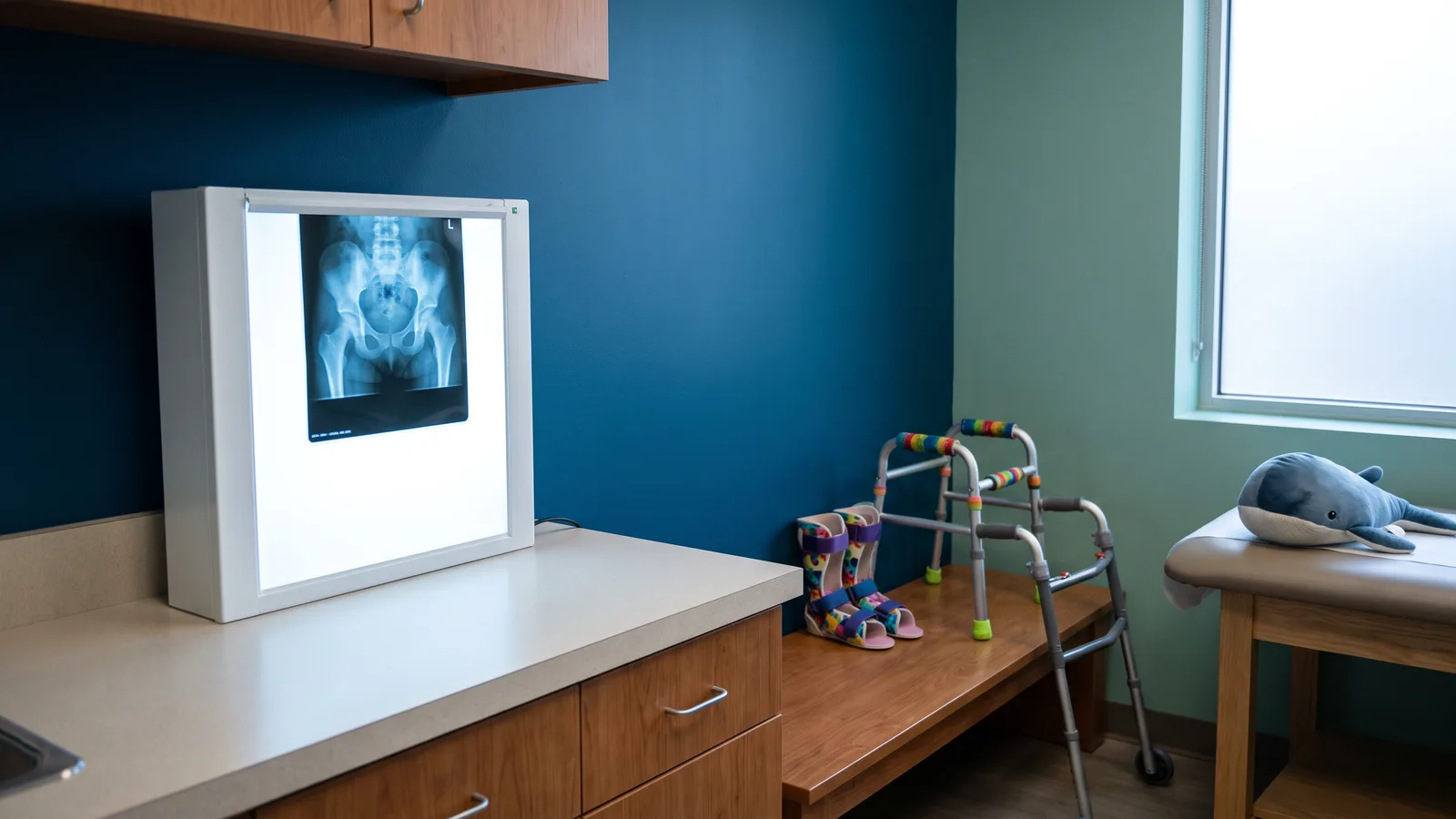
Single event multilevel surgery (SEMLS) and hip surgery are the two orthopedic operations families of children with cerebral palsy hear about most, and they usually serve different children. SEMLS corrects several muscle, tendon and bone problems in both legs under one anesthetic. It is offered mainly to children who walk (GMFCS levels I to III), and most centers plan it from a computerized gait analysis. Hip surgery treats a hip that is drifting out of its socket. The timing is set by an X-ray measurement called the migration percentage, taken during routine hip surveillance.
Both are major operations with long recoveries. This post covers what each one involves, what the only randomized trial and the long-term studies found, and the hip measurements that move a surgeon from watching to operating. Our guide to cerebral palsy surgery covers the other options, including selective dorsal rhizotomy and spinal fusion.
What SEMLS is, and the “birthday syndrome” it replaced
A 2012 systematic review defined SEMLS as two or more soft tissue or bony procedures at two or more levels of the legs during one operation, needing one hospital admission and one period of rehabilitation (McGinley et al., 2012). The levels are the hips, knees, ankles and feet.
Before SEMLS, many children had one fix at a time. The orthopedic surgeon Mercer Rang called this the “birthday syndrome”: one deformity corrected after another as the child grew (Armand et al., 2016). A 2017 instructional review in the Indian Journal of Orthopaedics lists what doing everything at once changes: fewer anesthetics, fewer hospital stays, one major period of rehabilitation instead of several, and less disruption to school (Sharan, 2017).
Who is a candidate for SEMLS
SEMLS is mainly for children who walk, with or without a walker or crutches. On the Gross Motor Function Classification System those are levels I to III, and our guide to cerebral palsy severity levels explains the scale. The only randomized trial enrolled children with spastic diplegia at levels II and III, with a mean age of 9 years 8 months (Thomason et al., 2011). A UK national study of ambulant children with bilateral CP, called CPinBOSS, had a mean age of 12.6 years (Theologis et al., 2025).
Most centers plan the operation from an instrumented gait analysis, a lab session in which cameras and force plates record how each joint moves while the child walks. The gait laboratory at the Royal Children’s Hospital in Melbourne uses it routinely both to plan SEMLS and to measure the results afterward (Thomason et al., 2012). Gillette Children’s in Minnesota says a gait and motion analysis can help decide whether SEMLS makes sense for a particular child (Gillette Children’s).
What the evidence shows
In the Melbourne trial, 11 children were randomized to surgery and 8 to a 12 month program of progressive resistance strength training. The surgical group had a mean of eight procedures each. At 12 months their Gait Profile Score, a summary of how far a child’s walking differs from typical, had improved by 34%, while the training group was slightly worse. Gross motor function did not differ between the groups at 12 months. By 24 months the surgical group’s GMFM-66 score had risen 4.9%, with gains in mobility and in the physical functioning part of a quality of life questionnaire (Thomason et al., 2011).
The gains held. Eighteen of the children were followed for five years, and their improvements in gait and gross motor function were stable over that time (Thomason et al., 2013). In Bristol, England, 26 people reviewed a median of 18 years after SEMLS still walked significantly better than before surgery (Jones et al., 2020).
Many children need more surgery later. In a Swiss series, 9 of 14 patients had further operations within a mean follow-up of two years because problems relapsed or new ones appeared (Rutz et al., 2013). In another group of 13 children, 8 needed further surgery to keep their improvements 10 years on (Visscher et al., 2022). The 2012 review also warned that most SEMLS studies had no control group, which can make a treatment look better than it is.
Recovery and rehabilitation after SEMLS
Gillette Children’s publishes this timeline for families (Gillette Children’s, SEMLS rehabilitation and recovery):
- Most children have their legs in casts and cannot move on their own for about three weeks.
- They need significant help with dressing, eating and the bathroom for at least three weeks.
- If bones were operated on, no weight goes on the legs for at least three weeks.
- A walker or crutches may start three to six weeks after surgery, with physical therapy two to three times a week.
- A second set of casts, if used, comes off about six weeks after surgery.
- Full recovery can take up to one year.
The trial results fit that picture: walking improved by 12 months, but wider function took two years to show. Our pages on physical therapy for cerebral palsy and pain management in cerebral palsy cover the two things that fill most of that year.
Hip surgery: when migration percentage leads to an operation
The migration percentage is the share of the ball of the thighbone that sits outside the hip socket on an X-ray. The American Academy for Cerebral Palsy and Developmental Medicine (AACPDM) care pathway recommends referral to a pediatric orthopaedic surgeon when it is greater than 30%, when the hip opens out (abducts) less than 30 degrees, or both. Hip pain is also a reason for referral (AACPDM). How often children are X-rayed depends on age and GMFCS level, and our post on the hip surveillance screening schedule sets it out.
Referral does not mean surgery. A 2024 review by an international group of hip specialists reproduces one widely used protocol. Up to age 8, a migration percentage of 30 to 60% with tight hips points to soft tissue releases, and above 60% to reconstruction. Over age 8, above 40% with limited abduction points to reconstruction (Howard et al., 2024). The same review says reconstructive surgery is recommended once the percentage passes 50% and the hip is partly or fully out of joint without damage to the ball of the joint.
Soft tissue releases
These lengthen the tight adductor and hip flexor muscles and are used mainly in younger children. How well they work depends on walking ability. In 330 children in Melbourne, success (no further surgery and a migration percentage under 50%) was 94% at GMFCS level II, 49% at level III, 27% at level IV and 14% at level V (Shore et al., 2012). In Sweden’s national program, 43% of children who had this kind of release needed another operation within five years (Kiapekos et al., 2019).
Varus derotation osteotomy and pelvic osteotomy
A varus derotation osteotomy (VDRO) cuts the top of the thighbone and resets its angle and twist so the ball points back into the socket. For some children it is enough by itself. When the socket has become shallow from long-standing displacement, a pelvic osteotomy reshapes it in the same operation, sometimes with an open reduction of the joint. The 2024 review notes that reconstruction done in very young children comes back more often. In the Swedish program, 39% of children who had a femoral osteotomy as their first hip operation had another within five years.
Salvage procedures
Salvage surgery is for a hip that is dislocated, painful and worn, or where reconstruction has failed. Pain and difficulty keeping the groin clean are the two most common reasons. Options include removing the top of the thighbone with soft tissue placed in the gap, fusing the joint, or a hip replacement. The 2024 review calls the results mixed and found no prospective trials. Regular hip X-rays exist largely so that children never need one.
Risks
In CPinBOSS, 25 of 139 children (18%) who had SEMLS had a recorded complication (Theologis et al., 2025). Blood loss is another. At one Australian children’s hospital, 37% of 134 young people having spinal fusion or SEMLS that included bone work received a red blood cell transfusion, and the risk rose with GMFCS level, longer operations and more osteotomies (Lu et al., 2021). Weeks in casts, months of therapy and the real chance of a second operation are part of the decision too, as is cost, which our page on the costs of cerebral palsy treatment covers.
Common questions
What is SEMLS surgery for cerebral palsy?
It is one operation that corrects two or more muscle, tendon or bone problems at two or more levels of the legs, followed by one rehabilitation period. It is mostly used for children at GMFCS levels I to III.
When is hip surgery needed for cerebral palsy?
AACPDM advises referral to an orthopaedic surgeon above a 30% migration percentage. Whether and which surgery follows depends on age, how far the hip has moved, hip range of motion and pain.
How long is recovery from SEMLS?
About three weeks in casts, walking aids from three to six weeks, and up to a year for full recovery, according to Gillette Children’s. In the Melbourne trial, gains in gross motor function appeared at two years.
Which operation, if any, is right for a particular child is a decision for the family and the child’s orthopedic and rehabilitation team.