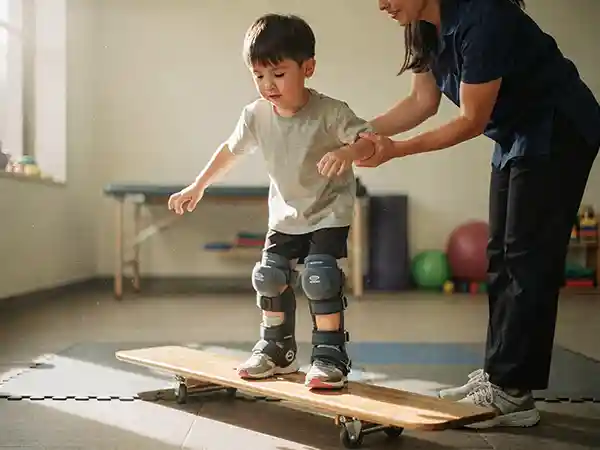
Movement is the most visible part of cerebral palsy. Understanding the different motor patterns (spasticity, dyskinesia, ataxia) and what they mean for daily life is the foundation of every CP treatment plan.
Of CP cases are spastic, the most common motor type
By age 2
Most motor symptoms are recognizable to attentive caregivers
5 GMFCS levels
The standard scale that grades motor function in CP
Motor symptoms are the defining feature of cerebral palsy. They show up in how a child moves (how they sit, walk, reach, grasp), and they vary widely depending on the type of CP and which areas of the brain were affected. Recognizing the patterns helps families understand what therapy is targeting and what realistic progress looks like.
CP’s motor symptoms cluster into a handful of recognizable patterns: spasticity, dyskinesia, ataxia, and the less-obvious problems with posture and muscle tone. Each pattern has different implications for treatment, and most children show some combination of more than one. This guide breaks down the patterns, the early signs, and the standard tools doctors use to grade and manage them.
Motor symptoms in CP fall into three main categories, each tied to a different part of the brain. Most children show a clear primary pattern, sometimes with elements of a second, what doctors call mixed CP. The category drives the therapy.
The three main motor patterns are spastic (stiff, tight muscles), dyskinetic (involuntary writhing or jerky movement), and ataxic (poor balance and coordination). Each comes from injury to a different brain region, and each looks distinctly different to a clinician’s trained eye. For a wider look at how these types are categorized clinically, see our overview of types of cerebral palsy.
Spastic motor symptoms
Spastic CP (by far the most common form) comes from injury to the motor cortex or its connections. Muscles stay abnormally tight and resist being moved, and reflexes fire too easily. In practical terms:
Reaching looks effortful rather than fluid, and joints do not bend smoothly. Held upright, the legs may cross into a scissored posture. Toe walking that persists past age two, usually with tight calves, is a hallmark, and so is a crouched gait where the hips and knees stay bent as though the child is permanently about to sit down. The defining property is that the tone is velocity dependent: a limb moved slowly can feel close to normal, and the same limb moved quickly catches.
Spastic CP is described by which limbs are involved: monoplegia (one limb), hemiplegia (one side), diplegia (both legs), or quadriplegia (all four limbs). The distribution shapes the therapy plan and the long-term outlook.
Athetoid and dystonic movements
Dyskinetic CP (sometimes still called athetoid CP) comes from injury to the basal ganglia. Movement is uncontrolled rather than just tight:
Athetosis produces slow, writhing movements of the hands, feet and face, more pronounced when a child is trying to do something on purpose. Chorea produces quick, irregular movements that come and go. Dystonia produces sustained contractions that pull the body into twisted and sometimes painful postures. Two features identify the group: the movements increase with effort and with emotion, and they disappear in sleep, so a child looks worst at the moment they are trying hardest.
Dyskinetic CP often affects speech, feeding, and fine motor control as much as walking. Children may have well-preserved cognition but tremendous difficulty getting their bodies to do what they want, a frustrating combination that occupational therapy and communication aids can help with significantly.
Ataxic motor symptoms
Ataxic CP (the rarest form, about 5–10% of cases) comes from injury to the cerebellum. The signature is poor balance and shaky, imprecise movement:
The gait is wide-based and unsteady. A tremor appears as a hand approaches its target rather than at rest, which is what makes buttoning, threading and picking up small objects so much harder than expected. Speech is often slow and imprecise. Ataxic CP is also the pattern most often reclassified later, because poor coordination in infancy sometimes resolves into a different type or turns out to be a different diagnosis altogether.
Targeted therapy for ataxic CP focuses on coordination, postural control, and gradual exposure to balance challenges. Many children make significant gains over years.
Early motor signs of cerebral palsy
The first motor signs of CP usually show up in infancy, sometimes obvious, sometimes subtle. Pediatricians watch for them at well-child visits, but parents see their child every day and often catch patterns first.
The earliest motor signs cluster around three things: missed milestones, abnormal reflexes, and unusual muscle tone. Any one of those by itself isn’t a diagnosis. Together, especially with asymmetry, they prompt evaluation. For a fuller infant-stage walkthrough, see early symptoms of cerebral palsy in infants.
Recognizing delayed motor milestones
Motor milestones are the clearest yardsticks. The big ones to track:
By 3–4 months: Lifting head during tummy time, tracking objects with eyes.
By 6 months: Rolling over both directions, reaching for toys, pushing up on arms.
By 9 months: Sitting unsupported, transferring objects between hands.
By 12 months: Pulling to stand, cruising along furniture, picking up small objects with thumb and finger.
By 18 months: Walking independently, scribbling with a crayon.
A single missed milestone isn’t cause for alarm. Persistent delays across multiple milestones, especially when paired with abnormal tone or reflexes, is the pattern that warrants a closer look. For age-stage breakdowns of all the developmental signs, see cerebral palsy symptoms by age.
Identifying abnormal reflexes in infants
Newborns come equipped with primitive reflexes that should fade within the first six months as the brain matures. When they don’t fade, it’s a clue that neurological development isn’t progressing as expected:
Moro (startle) reflex. Should disappear by 4–6 months. A persistent Moro past 6 months is one of the most reliable early CP signs.
Asymmetric tonic neck reflex (ATNR), or “fencing” pose. Should fade by 6 months. When it persists, it can prevent a child from bringing hands to midline.
Palmar grasp reflex. Should fade by 5–6 months as voluntary grasping takes over. A clenched fist that won’t open suggests delayed motor maturation.
Stepping reflex. Normally disappears by 2 months and reappears voluntarily around 12. Persistent involuntary stepping is unusual.
Pediatricians check for these reflexes routinely. Parents who notice them lingering past the typical window should mention it specifically: it’s the kind of detail that gets a workup started.
Early detection and intervention
Catching motor signs early is what unlocks the brain’s plasticity. The first three years are when the brain is most adaptable, and intervention during this window has outsized impact:
Physical therapy for gross motor: sitting, crawling, standing, walking.
Speech therapy for oral motor coordination, communication, and feeding when those are affected.
Family training. Therapists teach parents to extend the work into daily routines. The home is where most therapy actually happens.
Most states fund early-intervention programs that coordinate these services through a single case manager, often before a formal CP diagnosis is made. If a pediatrician suspects CP, ask about a referral immediately, don’t wait for the workup to finish.
What early intervention looks like in practice
The phrase “early intervention” sounds clinical, but the actual work is mostly play disguised as exercise. A typical week might include:
1–2 PT sessions focused on gross motor goals
1–2 OT sessions on fine motor and self-care
Speech therapy if feeding or communication is affected
Daily home practice woven into bath time, mealtimes, and play
The GMFCS in plain language
The Gross Motor Function Classification System (GMFCS) grades a child’s motor abilities from Level I (walks without limits) to Level V (transported in a manual wheelchair). It’s the standard shorthand doctors and therapists use to communicate about CP severity, and it tends to be stable from age 5 onward, meaning a Level II at age 6 is usually still Level II at age 16. Knowing your child’s GMFCS level helps set realistic, individualized therapy goals.
Abnormal posture in cerebral palsy
Posture problems often look like a side effect of CP, but they’re central. Asymmetric muscle pull and unbalanced tone can shape a growing skeleton over years, and managing posture early prevents more invasive treatment later.
The body conforms to whichever forces act on it most consistently. When a child’s muscles pull harder on one side, or when they spend years sitting in a position that compensates for spasticity, the spine, hips, and limbs gradually adapt, sometimes with permanent consequences. That’s why posture monitoring is part of every long-term CP plan.
Common postural abnormalities
The patterns clinicians watch for:
Scoliosis, hip displacement, contractures and pelvic obliquity are the postural problems that compound over time, and their frequency rises steeply with GMFCS level rather than being a general feature of cerebral palsy. Hip displacement makes the point: in a Swedish population study of 212 children followed to ages 9 to 16, it developed in none of the children at GMFCS level I and in 64% of those at level V, first registered at a mean age of four.
Impact of posture on mobility
Postural abnormalities aren’t cosmetic. They actively limit what a child can do:
The consequences are mechanical and they stack. A curved spine reduces the room the lungs have. A hip drifting out of its socket becomes painful, and every child who dislocated in that Swedish cohort reported severe pain, at least periodically. A fixed contracture at the ankle removes the option of a plantigrade foot, which changes what a brace or an operation can achieve later. Posture is not cosmetic here, which is why it gets measured rather than described.
Improvements in posture (through bracing, seating, therapy, and sometimes surgery) often translate into real gains in independence and comfort.
Posture assessment techniques
Posture gets evaluated through a mix of clinical and instrumented methods:
Standardized physical exam. Range of motion, joint angles, spinal curvature measured at every visit.
Hip surveillance X-rays. Repeated annually or more often in moderate-to-severe CP to catch subluxation early.
Spinal radiographs. When scoliosis is suspected, especially during growth spurts.
Gait analysis. Cameras and floor sensors measure exactly how a child walks, revealing inefficiencies and informing surgical or orthotic decisions.
Pressure mapping for seating. Identifies areas at risk for skin breakdown in non-ambulatory children.
These assessments aren’t one-time events. They repeat throughout childhood and adolescence as the body grows.
Concerned about your child’s motor development?
You don’t need a diagnosis to talk through what you’re seeing. Our nurse advocates listen first, then help you connect with pediatric neurologists, developmental specialists, and therapy programs in your area. Get a free, confidential evaluation, no commitment, just answers.
Muscle tone variations in cerebral palsy
Muscle tone is the resistance a muscle has to passive movement, how it feels when you bend the joint for the child. Abnormal tone is one of the most reliable CP signs, and managing it actively is one of the most impactful things a treatment team can do.
Tone abnormalities sit on a spectrum from very low (hypotonia) to very high (hypertonia). Many children with CP show both, in different muscle groups: tight legs but a floppy trunk is a common combination. Knowing where each child sits on the spectrum (and how that changes over time) is core to treatment planning.
Understanding hypertonia and hypotonia
The two extremes:
Hypertonia means muscles that resist being moved, and clinicians grade that resistance on the Modified Ashworth Scale, six grades running 0, 1, 1+, 2, 3 and 4, where 0 is no increase in tone and 4 means the limb is rigid. Hypotonia is the opposite, a floppiness most obvious when an infant is picked up. Many children show both across different parts of the body, and tone in dyskinetic CP fluctuates rather than settling at either end.
Effects of muscle tone on daily activities
Tone problems shape every minute of a child’s day:
High tone in the legs makes walking and sit-to-stand transitions harder and drives the ankle toward a toe-down position. High tone in the arms costs reaching, grasping and anything needing two hands at once. Low trunk tone undermines everything above it, because a body that is not held cannot use its hands well. What a child manages at home on an ordinary day is the measure that matters, not what they can produce once in a clinic.
Adaptive equipment (specialized seating, AFOs, hand splints, communication devices) helps bridge the gap between what tone allows and what the child wants to do.
Management of muscle tone variations
Tone management combines several approaches, layered to fit each child:
The interventions rated effective in the 2019 traffic light review share one shape: the child actively practices a task, repeatedly. Goal-directed training, bimanual training, constraint-induced movement therapy, casting and fitness training all came out green. Botulinum toxin reduces tone in named muscles and buys range that therapy then has to use, oral medication and intrathecal baclofen suit widespread tone, and surgery enters once a contracture is fixed rather than dynamic. How those fit together across the whole plan is covered in cerebral palsy treatment. Running underneath it, hip surveillance took dislocation from 8% to zero across two decades of Swedish birth cohorts.
The combination evolves over time. A toddler may need only therapy and maybe AFOs. A school-age child may add botulinum toxin. A teenager may benefit from a baclofen pump or SDR. Reassessing the plan every 6–12 months is the standard.
Was your child’s CP caused by a birth injury?
The lifetime cost of caring for a child with CP (therapies, equipment, surgeries, lost wages) can run into millions. If your child’s CP was caused by medical mistakes during labor or delivery, those costs may be recoverable. Our birth injury lawyers offer free record reviews. Request a free case review.
Frequently asked questions about motor symptoms of CP
Stiffness, involuntary movement and poor coordination, in three recognizable patterns tied to different brain regions. Spastic CP accounts for around 80% of cases according to the CDC and produces velocity-dependent tone. Dyskinetic CP produces movement that increases with effort and disappears in sleep. Ataxic CP, the rarest, produces a wide-based gait and a tremor that worsens as a hand approaches its target.
Usually in infancy, through missed milestones, abnormal reflexes and unusual tone, especially where there is asymmetry. Cerebral palsy can now be identified before five months corrected age: the 2017 guideline in JAMA Pediatrics puts term-age MRI at 86% to 89% sensitivity, the Prechtl General Movements Assessment at 98% and the Hammersmith Infant Neurological Examination at 90%.
Because the posture is what damages the body over time. Cerebral palsy itself is non-progressive, but a muscle held short for years becomes a contracture and a hip pulled out of position becomes painful. Hip displacement reached 64% at GMFCS level V in one population study, against 0% at level I, which is why surveillance is scheduled by age and level.
On the Modified Ashworth Scale, six grades from 0, no increase in tone, to 4, a limb rigid in flexion or extension. It measures resistance to passive movement, which is a different question from what a person can do, and the two are worth keeping apart when reading a report.
Active, task-specific, repeated practice is the common feature of everything rated effective. Tone management is chosen by distribution: injections for spasticity confined to named muscles, systemic options where it is widespread. Equipment and positioning do the work that stretching alone does not, since holding range depends on duration rather than repetition.
Bounded by GMFCS level rather than open-ended. Five motor development curves were built from 657 children and 2,632 assessments, one per level, describing both the rate of progress and its ceiling. Levels I and II show no average decline through adolescence, while levels III, IV and V peak around age seven and then lose 4.7, 7.8 and 6.4 points respectively.
Yes, and they run for decades: therapy, equipment replaced as a child grows, orthotics, medication and in some cases surgery. Where cerebral palsy followed a preventable event at delivery, those costs are what a claim is calculated on. See the cost of CP treatment.