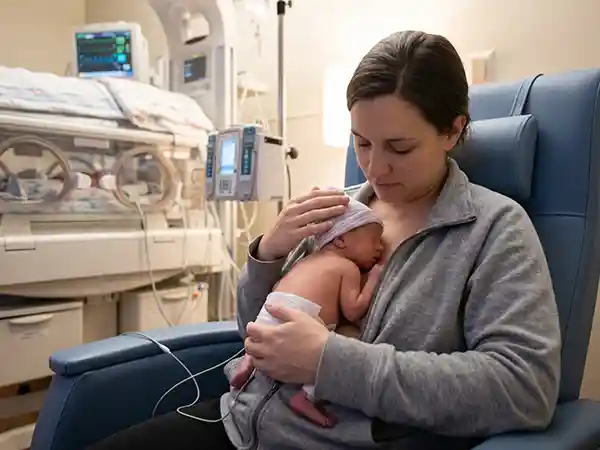
Premature birth is the single biggest risk factor for cerebral palsy. The earlier a baby arrives, the higher the risk, and the more reliant their development becomes on careful neonatal care. Knowing what makes preemies vulnerable, and what helps protect them, is foundational for any family in the NICU.
CP risk reduction from antenatal magnesium sulfate
Of all the risk factors for cerebral palsy, premature birth carries the most weight, and it’s the one most likely to be on a family’s mind during a NICU stay. Around 1 in 10 U.S. babies is born preterm each year, and the risk of CP increases sharply with each week earlier the baby arrives. The good news: modern neonatal care has substantially improved outcomes, and several specific interventions have been proven to reduce CP risk in preterm infants.
This guide walks through how prematurity contributes to CP, the specific neonatal complications that produce the brain injury, what the NICU does to protect a preemie’s developing brain, and what parents can expect for monitoring and follow-up. For the broader context of CP causes, see the pillar; for what happens during labor and delivery itself, see birth complications leading to cerebral palsy.
Preemies face a specific set of brain-injury patterns that aren’t common in full-term babies. Knowing the patterns (and how they happen) helps families understand what the NICU team is monitoring and what each piece of care is designed to prevent.
The brain develops rapidly in the third trimester. A baby born at 26 weeks has missed the wiring, myelination, and vascular maturation that should have happened over the next 14 weeks. That immaturity makes the brain vulnerable to specific kinds of injury that shape long-term outcomes.
Neonatal brain injury and its role
Two specific patterns of preemie brain injury account for most CP in this group:
Intraventricular hemorrhage (IVH). Bleeding into the brain’s fluid-filled ventricles, caused by fragile blood vessels in the germinal matrix, an area that exists only in preemies and disappears around 32–34 weeks. IVH is graded I–IV; grades III and IV carry the highest CP risk. Most IVH happens in the first 72 hours of life.
Periventricular leukomalacia (PVL). White-matter injury in the brain regions surrounding the ventricles. Caused by periods of low oxygen or blood flow that selectively damage the white matter responsible for motor signals to the legs. Strongly linked to spastic diplegia, the most common form of CP in former preemies.
Other patterns matter too: focal stroke, hypoxic-ischemic encephalopathy if a baby has acute oxygen deprivation, and cerebellar injury in extremely preterm infants. But IVH and PVL are the dominant patterns in CP linked to prematurity.
Understanding perinatal complications
Beyond brain injury directly, preemies face a cluster of complications that can compound each other:
Respiratory distress syndrome (RDS). Underdeveloped lungs lacking surfactant. Without treatment, can lead to oxygen deprivation that affects the brain.
Bronchopulmonary dysplasia (BPD). Chronic lung disease developing after prolonged ventilation. Associated with neurodevelopmental problems.
Necrotizing enterocolitis (NEC). Severe intestinal inflammation that can produce systemic illness affecting brain development.
Sepsis. Bacterial bloodstream infections, more common in preemies with central lines and immature immune systems.
Patent ductus arteriosus (PDA). A fetal blood vessel that fails to close after birth, affecting circulation and oxygenation.
Each of these conditions can independently raise CP risk; in combination, the risk multiplies. Modern NICU care is structured to prevent or minimize each.
What modern NICU care does for a preemie’s brain
Specialized neonatal care has substantially reduced CP rates in preemies. Key practices include:
Antenatal steroids before preterm delivery
Magnesium sulfate for neuroprotection
Surfactant therapy for lung development
Kangaroo care, breast milk feeding, careful temperature control
Magnesium sulfate, an underrecognized win
One of the most important advances in preventing CP in preemies is magnesium sulfate given to the mother before very preterm delivery. Major trials have shown about a 30% reduction in CP risk among very preterm infants whose mothers received it. It’s now standard of care for women in preterm labor before 32 weeks, but isn’t always given in time, which is one of the things lawyers look for when reviewing preterm-delivery records.
Risk factors and the gestational-age gradient
CP risk doesn’t step up uniformly with prematurity. It climbs sharply at the lowest gestational ages. Understanding where on the gradient a baby falls helps families gauge what to expect and what to ask for.
The medical categories for prematurity matter clinically. They map onto different risks, different NICU experiences, and different long-term outcomes:
Late preterm (34–36 weeks). Most common preemie category. CP risk is modestly elevated but most babies do well. NICU stays often short or not needed.
Moderately preterm (32–33 weeks). Higher complication rate; usually NICU stay of weeks. CP risk roughly 2–3x term babies.
Very preterm (28–32 weeks). Substantial risks. Many weeks in NICU. CP risk increases markedly.
Extremely preterm (under 28 weeks). Highest-risk category. Months-long NICU stays. CP risk can be 60–100 times higher than term babies in the lowest gestational ages.
Birth complications that contribute
Specific events around the time of preterm delivery raise risk further:
Cord prolapse or compression — can cause acute oxygen deprivation
Placental abruption — cuts off oxygen and nutrients
Chorioamnionitis — intrauterine infection that often triggers preterm labor and adds inflammation
Difficult delivery — preemies are physically more fragile, so delivery trauma carries more weight
Resuscitation needs at birth — signal that the baby experienced significant stress
Very low birth weight (VLBW): under 3.3 lbs (1,500 g). Substantially elevated risk.
Extremely low birth weight (ELBW): under 2.2 lbs (1,000 g). Highest risk category, often in babies under 28 weeks.
Birth weight matters separately from gestational age: a small-for-age baby at 36 weeks may face risks more like a 32-weeker due to growth restriction during pregnancy. Intrauterine growth restriction (IUGR) is one such pattern, often linked to placental insufficiency.
How premature birth affects development
Even when premature birth doesn’t cause CP, it shapes development for years. Understanding what’s typical for a preemie (and what needs closer attention) helps families and pediatricians distinguish ordinary catch-up from delays that warrant intervention.
Most preemies catch up on their developmental milestones over the first 1–2 years, especially when adjusted age (gestational age corrected for prematurity) is used. But some don’t catch up the same way, and that gap often becomes the first signal that CP or another developmental concern is in play.
Developmental delays in preterm infants
Areas where preemies most often show delays:
Gross motor. Sitting, crawling, walking. Typically the most visible early indicator of CP if present.
Fine motor. Grasping, transferring objects, pincer grip.
Language. Babbling, first words, vocabulary growth.
Cognitive. Problem-solving, attention, working memory, often most apparent in school years.
Sensory regulation. Tolerating loud sounds, bright lights, certain textures.
Adjusted age (chronological age minus weeks born early) is the standard for evaluating preemie development through about age 2–3. A baby born at 30 weeks is functionally 6 weeks “younger” than the calendar suggests for the first couple of years.
Neurological disorders in infants
Beyond CP, preemies face elevated rates of several neurological concerns:
Vision impairment. Retinopathy of prematurity (ROP) and cortical visual impairment are both more common in former preemies.
Hearing loss. Both sensorineural and conductive types occur at higher rates.
ADHD and learning differences. Often appear in school years.
Autism spectrum disorder. Modestly elevated rates compared to term babies.
Cognitive differences. Range from subtle processing differences to significant intellectual disability.
NICU follow-up clinics are designed to monitor for all of these. Most extremely preterm and very preterm infants are referred to follow-up programs that continue surveillance through age 2–3 or longer.
Diagnosing cerebral palsy in premature infants
Catching CP early in a preemie can be tricky because some delays are normal for prematurity. Knowing what crosses the line into “needs evaluation” matters, for families and for the pediatrician deciding when to refer to a neurologist.
Because preemies start out behind on milestones by definition, distinguishing typical preemie catch-up from CP-related delays requires a nuanced eye. Most NICU graduates are followed in dedicated developmental clinics specifically to make that distinction.
Early signs of cerebral palsy in preterm infants
Specific patterns that suggest CP in a preemie, beyond ordinary prematurity catch-up:
Persistent or asymmetric muscle tone abnormalities. Stiffness or floppiness that doesn’t resolve with age, or one side notably different from the other.
Persistent primitive reflexes. Moro and asymmetric tonic neck reflexes that linger past 6 months adjusted age.
Strong hand preference before 12 months. Unusual; suggests one side isn’t working as well.
Delayed gross motor milestones beyond what adjusted age explains. Not sitting unsupported by 9 months adjusted, not pulling to stand by 12 months adjusted.
Persistent fisting. Clenched fists past 4–5 months adjusted.
Feeding difficulties. Especially when paired with motor concerns.
Some preterm deliveries result from medical errors: missed signs of preeclampsia, untreated infection, or failure to use cervical cerclage when indicated. Others involve failure to give magnesium sulfate or antenatal steroids in time when preterm labor was unavoidable. Both can be grounds for a medical malpractice claim. Our birth injury lawyers offer free record reviews. Request a free case review.
Navigating life after the NICU?
Whether you’re still in NICU or years past it, our nurse advocates can help connect you with resources: early intervention programs, NICU follow-up specialists, parent support groups, and legal options if applicable. Get a free, confidential evaluation.
Frequently asked questions about premature birth and CP
Premature birth is the single biggest risk factor for CP. Babies born before 28 weeks have up to a 60–100x higher CP risk than full-term babies; even babies born at 32–36 weeks have meaningfully elevated risk. The reason is straightforward: preemies have underdeveloped brains, fragile blood vessels, and immature lungs and circulation, all of which make brain injury more likely.
Several mechanisms. Preemies are prone to bleeding in the brain’s ventricles (intraventricular hemorrhage, or IVH) because their blood vessels are fragile. They’re prone to white-matter injury (periventricular leukomalacia, or PVL) from periods of low oxygen or blood flow. Their immature lungs may not deliver oxygen reliably. Infections and inflammation are also more likely. Each of these can damage the developing brain.
The brain develops rapidly in the third trimester, and being born early cuts that development short. Critical processes (neuronal migration, white-matter myelination, blood vessel maturation) are still in progress. The earlier a baby is born, the more development has been interrupted, and the more vulnerable the brain is to the stresses of being outside the womb.
A baby is considered premature if born before 37 weeks gestation. Within that, gestational age categories matter: extremely preterm (under 28 weeks), very preterm (28–32 weeks), moderately preterm (32–34 weeks), and late preterm (34–37 weeks). CP risk drops dramatically with each additional week, which is why preventing preterm delivery whenever possible is so valuable.
Symptoms in preemies with CP look much like CP in any child: abnormal muscle tone (stiff or floppy), missed motor milestones, asymmetric movement, persistent fisting, and difficulty with feeding or speech. The challenge is that some delays are normal in preemies due to their adjusted age, so distinguishing typical preemie development from CP requires watchful pediatric monitoring over the first 1–2 years.
Yes, several. Antenatal corticosteroids, given to mothers in preterm labor, accelerate fetal lung development and reduce IVH risk. Magnesium sulfate, given before very preterm delivery, has been shown to reduce CP risk by about 30%. Modern NICU advances (gentler ventilation, careful temperature control, kangaroo care, breast milk feeding) all reduce complications. Preventing preterm labor itself, when possible, is the most direct intervention.
Early-intervention services in every state provide therapy and developmental support for preemies and their families starting in infancy, usually free or low-cost. NICU follow-up clinics monitor preemies for signs of CP and other developmental concerns. Parent support groups, both in person and online, connect families navigating similar experiences. For families whose CP resulted from preventable medical errors, legal options may also be available.