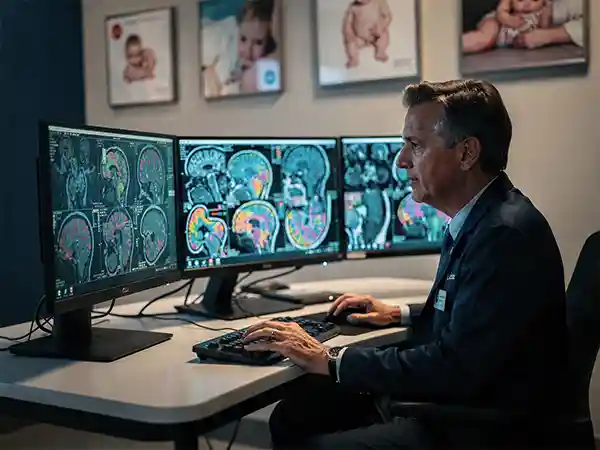
Brain MRI is the gold standard imaging test for cerebral palsy. It shows the injury directly: where in the brain, how extensive, and often when it happened. The pattern on MRI usually maps to the type of CP a child will have, making the imaging report one of the most important pieces of the diagnostic puzzle.
Of children with CP have detectable findings on MRI
No radiation
Uses magnetic fields, safe for repeat imaging in children
When pediatric neurologists confirm a cerebral palsy diagnosis, brain MRI is almost always part of the picture. About 80% of children with CP have detectable abnormalities on MRI, and the specific pattern usually does more than confirm the diagnosis. It often shows when the injury occurred, what type of CP to expect, and what other concerns might come along with the motor problems. For many families, the MRI report is the first concrete information they get about their child’s injury.
MRI is unique among imaging tools because it shows brain tissue in detail without radiation. For children (especially infants whose brains are still developing) that combination of safety and detail is exactly what CP diagnosis requires.
The reason MRI sits at the center of CP imaging isn’t mystique: it’s physics. Magnetic fields and radio waves can produce images that distinguish white matter from gray matter, identify millimeter-sized lesions, and reveal subtle structural malformations. CT and ultrasound, while useful in specific situations, simply can’t match that resolution. And because MRI uses no ionizing radiation, it can be repeated as needed without cumulative exposure concerns.
Why MRI is crucial for cerebral palsy assessment
MRI contributes five distinct things to a workup, and only the first is the one families expect.
It shows where the brain was damaged, which examination and history can only infer. It recognizes patterns, and the patterns map onto types: periventricular injury to spastic diplegia, basal ganglia injury to dyskinetic cerebral palsy, watershed injury and cortical malformation to their own presentations. It gives timing, because different injuries belong to different developmental windows, and a cortical malformation could only have formed while the cortex was forming. It carries prognostic weight, since extent and location shape what to expect for movement, cognition, seizures, vision and hearing. And it supports the differential, because several look-alike conditions have characteristic findings, or a characteristically normal scan. Across the studies meeting full inclusion criteria in a systematic review, MRI was abnormal in 334 of 388 children with cerebral palsy, 86%, and pointed toward a pathogenesis in 83%.
Impact of MRI on treatment planning
Past the diagnosis itself, the scan changes decisions.
Where one hemisphere is more affected, therapy can push the affected side while the unaffected side compensates, which is the logic behind constraint-induced movement therapy. Cortical malformations and certain injury patterns carry higher seizure risk, so they prompt closer monitoring rather than waiting for a first seizure. Damage patterns influence whether a procedure like selective dorsal rhizotomy is likely to help, which matters before anyone operates. Injury near the visual cortex predicts vision problems and injury along the auditory pathways predicts hearing problems, both of which get screened for rather than discovered late. And some findings point at an underlying genetic condition with implications for future pregnancies, which is when genetic testing enters the picture.
MRI vs other diagnostic tools for cerebral palsy
MRI isn’t the only imaging tool used in CP diagnosis. CT scans, cranial ultrasounds, and EEGs each have specific uses. Knowing which tool does what clarifies why MRI is usually the destination, even when other tests come first.
The choice between imaging tools comes down to what question is being asked. In an unstable newborn, cranial ultrasound at the bedside answers whether there’s acute bleeding. In an emergency, CT answers quickly whether there’s a stroke or skull fracture. For characterizing the chronic pattern of injury that produced CP, MRI is what the field reaches for.
Comparing MRI with CT scans for cerebral palsy
Against CT, the clinically relevant differences come down to five.
MRI separates white matter from grey matter cleanly, where CT renders bone beautifully and soft tissue poorly, and white matter injury is the most common finding in cerebral palsy. CT delivers ionizing radiation, which weighs more heavily in a child whose remaining lifespan compounds the cumulative dose; MRI uses magnetic fields and delivers none. CT takes seconds and MRI takes 30 to 60 minutes, so in an acute emergency, a suspected stroke or head trauma, speed decides it. Both usually need sedation in a young child, though CT is sometimes quick enough to avoid it. CT still earns its place for acute trauma, suspected acute hemorrhage, calcifications, bone abnormalities, and any situation where MRI is unavailable or unsafe.
Advantages of MRI over ultrasound in diagnosis
Cranial ultrasound is the workhorse in the NICU, and its limits are structural rather than incidental.
It works by looking through the open fontanelle, so once that closes, mostly by 12 to 18 months, the window is gone. Its resolution catches large structural abnormalities and major hemorrhages and misses smaller injuries and subtle white matter change, which is precisely the category that matters most here. Image quality also varies with the operator more than MRI does. None of which makes it the wrong tool: for bedside imaging of an unstable NICU baby, for screening preterm infants for intraventricular hemorrhage, and for tracking a known abnormality over days, it is exactly right.
For most NICU babies at risk for CP, the workflow is cranial ultrasound for monitoring during the NICU stay, then MRI at term-equivalent age (40 weeks corrected) for definitive imaging before discharge.
What an MRI for CP actually involves
In practice, an MRI for a young child means a pre-procedure consultation with anesthesiology when sedation is needed, specific sequences chosen for brain anatomy and injury patterns, 30 to 60 minutes in the scanner, one to three hours of recovery from sedation before discharge, and a radiology report within one to three days.
The sedation is what most parents worry about, and it is worth asking whether a feed-and-wrap protocol could work instead. For young infants it often can.
How MRI helps diagnose cerebral palsy
An MRI doesn’t hand back a diagnosis: it shows brain anatomy, and the radiologist describes findings. The pediatric neurologist then connects those findings to the clinical picture. Knowing what the report is looking for helps families read it.
Understanding the workflow demystifies the wait. The MRI is performed by a technologist following specific pediatric protocols. The images are reviewed by a radiologist (often a pediatric neuroradiologist), who dictates a report describing findings. The pediatric neurologist then integrates that report with examination findings to confirm the diagnosis and characterize it.
Identifying brain abnormalities through MRI
The findings sort into seven categories.
White matter injury, damage to the myelinated tracts carrying signals between regions, is the most common finding of all, and in that systematic review periventricular white matter lesions accounted for 56% of everything seen. Deep grey matter injury to the basal ganglia and thalamus is the classic pattern after severe hypoxic-ischemic encephalopathy and after kernicterus, and grey matter lesions made up 18%. Cortical injury, often from prenatal stroke or watershed injury, produces focal patterns matching the region involved. Cortical malformations, lissencephaly, polymicrogyria and schizencephaly, accounted for 9% and point to first or second trimester disruption. Cerebellar injury is common in extremely preterm infants and produces ataxic presentations. Atrophy means tissue that was injured long enough ago to have shrunk. And old hemorrhage leaves characteristic signal that can be dated.
Role of MRI in evaluating neurological damage
Beyond naming a finding, the scan helps size it.
Whether the damage is focal or diffuse matters, because diffuse injury usually predicts more global impairment. Whether it is bilateral or unilateral matters more: damage on both sides typically produces quadriplegic or diplegic patterns, damage on one produces hemiplegic. Which structures are involved determines what else is affected, since injury near the motor cortex hits movement most directly while injury in associated areas reaches vision, hearing and language. Diffusion tensor imaging can show how intact the connecting tracts are, which has real predictive value. And volumetric comparison against age-matched norms can quantify differences too subtle to see.
MRI findings in cerebral palsy patients
Specific MRI patterns appear consistently in children with CP, and each pattern tells a story about what happened and when. Recognizing these patterns is what allows the imaging report to become a roadmap for understanding a child’s CP.
The findings below cover most of what radiologists describe in pediatric brain MRI reports for CP. They’re organized by frequency and clinical significance, with notes on what each typically means.
Common MRI patterns in cerebral palsy
A handful of named patterns account for most of what a report will say.
Periventricular leukomalacia, white matter injury near the lateral ventricles, is the classic former-preterm pattern and the single most common finding in cerebral palsy. Basal ganglia and thalamic injury follows severe perinatal hypoxic events and kernicterus. Watershed injury damages the border zones between arterial territories, the regions least tolerant of a drop in blood pressure. Focal arterial infarcts are discrete strokes that usually produce one-sided weakness and can often be dated to the perinatal period. Cortical malformations indicate that something went wrong while the cortex was being built. Hemorrhagic injury varies by timing and grade. And roughly 15% of children with cerebral palsy have a normal-appearing MRI, which is not a negative result so much as a redirection: it is one of the clearest reasons to pursue genetic testing.
Interpreting white matter lesions
White matter findings deserve separate attention, because they are both the most common and the most consequential.
Bright signal in the white matter near the ventricles on T2 sequences usually represents periventricular leukomalacia. Ventricles that look larger than expected because the surrounding white matter has shrunk indicate injury old enough to have caused volume loss. Thinning of the corpus callosum, the bridge between the hemispheres, tends to correlate with reduced connectivity between the two sides. Myelin laid down behind schedule shows up in children with broader developmental concerns. Damage spread across multiple regions rather than concentrated in one usually accompanies a more severe clinical picture. And findings worse on one side predict an asymmetric presentation, which is to say hemiplegic cerebral palsy.
The radiology report’s description of white matter findings often ends up being the most actionable piece of information for understanding a child’s CP type and prognosis.
What a normal MRI does and doesn’t mean
About 15 to 20% of children with CP have normal MRI scans. A normal MRI doesn’t rule out CP; it just means the cause didn’t leave a visible structural mark. The most common explanations for CP with normal imaging are genetic conditions affecting brain function rather than structure, very mild injury below imaging resolution, and metabolic disorders. A normal MRI usually prompts genetic testing as the next step.
When the imaging pattern points to a perinatal event
Specific MRI patterns (basal ganglia and thalamic injury, watershed pattern damage, certain hemorrhagic findings) often establish that the brain injury happened during or right around delivery. When that’s the case, reviewing whether the perinatal event itself was preventable becomes central. Medical malpractice reviews of HIE-pattern MRI findings frequently find missed signs of fetal distress, delayed cesareans, or failure to start therapeutic hypothermia within the 6-hour window. Our birth injury lawyers offer free record reviews. Request a free case review.
Need help reading an MRI report?
Imaging reports use technical terminology that’s hard to interpret without medical training. Our nurse advocates can walk through what specific findings mean and connect you with pediatric specialists if you want a second opinion. Get a free, confidential evaluation.
Frequently asked questions about MRI and CP
It establishes that a brain abnormality exists, identifies its pattern, and dates it approximately. In a systematic review of MRI studies in children with cerebral palsy, the scan was abnormal in 86% of patients and gave clues to pathogenesis in 83%. It does not make the diagnosis on its own, which stays clinical, and a normal scan does not rule cerebral palsy out.
It sees what the others cannot. CT renders bone well and soft tissue poorly, and delivers ionizing radiation, which matters more in a child. Cranial ultrasound works only while the fontanelle is open and misses subtle white matter change, which is the category that matters most here. MRI resolves white matter against grey matter cleanly and uses no radiation, at the cost of 30 to 60 minutes and usually sedation.
Because of accuracy and timing together. Term-age MRI has a sensitivity of 86% to 89% for detecting risk before 5 months corrected age, which is early enough to matter, and it is the only test that indicates roughly when the injury occurred. Combined with a standardized neurological examination, it is what makes diagnosis before 6 months possible at all.
For preterm infants, at term-equivalent age, which is standard practice in many units. For a child presenting later with motor concerns, as part of the initial workup rather than after months of watchful waiting. In an acute emergency where speed decides the outcome, CT comes first and MRI follows once the child is stable.
It confirms a structural cause, identifies the pattern and therefore the likely type, indicates timing, predicts which associated problems to screen for, and informs surgical decisions such as whether selective dorsal rhizotomy is likely to help. It also flags the cases that warrant genetic investigation, both by showing a malformation and by showing nothing at all.
The scan itself uses magnetic fields rather than radiation, so it carries no radiation risk. The real consideration is sedation, which most young children need to stay still for 30 to 60 minutes, and which carries its own small risks worth discussing with anesthesiology. For young infants a feed-and-wrap protocol sometimes avoids sedation entirely, and it is worth asking about. Implanted metal is a separate contraindication that gets screened for beforehand.
Cost and access shape when it happens more than whether it happens. MRI plus sedation is expensive, requires scheduling and often pre-authorization, and in some settings the wait is months. That delay matters, because the value of early diagnosis lies in starting intervention while neuroplasticity is highest. Where MRI is genuinely unavailable, the standardized neurological examinations carry more of the diagnostic weight.