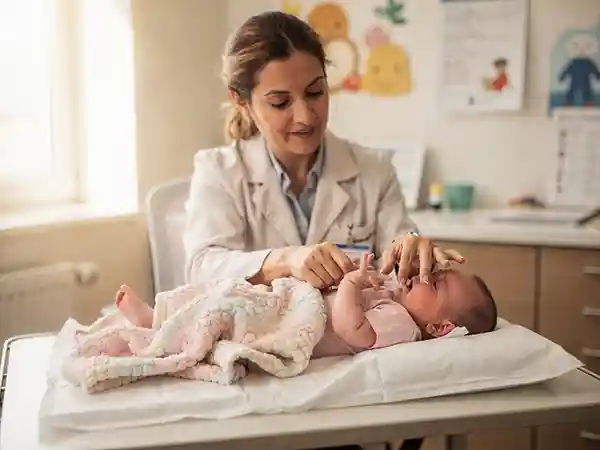
The earliest signs of cerebral palsy in infants are often subtle: a baby who feels too floppy when you pick them up, a fist that won’t open, a milestone that just isn’t coming. Knowing what to watch for in the first year is the foundation of early diagnosis, and early diagnosis is the foundation of better outcomes.
Age window when most early CP signs become noticeable
First 3 years
When the brain is most plastic, therapy works best
GMA & HINE
Standardized tools used to evaluate at-risk infants
For most families whose child ends up with a cerebral palsy diagnosis, the first signal isn’t a doctor’s appointment: it’s a parent noticing something. A baby who feels floppy, a fist that stays clenched, a milestone that doesn’t arrive when you expected it. The earliest signs are subtle, but they cluster in recognizable patterns. This guide is the field guide for that first year of watching, with what to look for, when to bring it up, and what happens next.
For the broader picture of how cerebral palsy is diagnosed, see the parent guide. This page focuses specifically on the infant period: what cerebral palsy looks like before a child can sit, crawl, or walk, and what an early evaluation actually involves.
The first signs of CP in infants cluster around three things: how a baby’s muscles feel (tone), how they react to stimuli (reflexes), and how they move spontaneously. Each of these gives a window into what the developing nervous system is doing.
None of these signs alone confirms CP. Babies vary, milestones come at different ages, and many concerning signs in infancy resolve as the brain matures. What matters is the pattern: signs that persist, signs that cluster together, and signs that don’t fit a baby’s adjusted age. That’s when an evaluation makes sense.
Common muscle tone issues in infants
Muscle tone (the resistance you feel when bending a baby’s arm or leg) is one of the most reliable early signals, and tone problems sit on a spectrum.
Muscle tone runs in four patterns and all four are informative. Hypotonia, where a baby feels limp when picked up, head control lags, and they seem to slip through your hands. Hypertonia, where limbs resist being bent or straightened and fists stay clenched past four or five months. Mixed tone, which is common: tight legs with a floppy trunk, a combination that makes sitting unstable. And asymmetric tone, where one side feels different from the other. That last one is among the strongest red flags there is, because healthy infants are largely symmetric.
For a fuller picture of how tone problems show up across the first months and years, see our overview of cerebral palsy symptoms.
Recognizing abnormal infant reflexes
Babies are born with primitive reflexes, automatic responses that should fade as the brain matures and voluntary movement takes over. When they don’t fade, it suggests neurological development isn’t progressing normally.
Five reflexes have timetables worth knowing. The Moro or startle reflex, where the arms fling out and retract, should fade by four to six months. The asymmetric tonic neck reflex, the fencing pose, follows a similar schedule. The palmar grasp reflex should fade by five or six months as voluntary grasp takes over. The stepping reflex normally disappears by two months. And deep tendon reflexes that seem unusually brisk or trigger too easily point the same direction. A reflex that outstays its window is pointing at the nervous system rather than the muscles.
Pediatricians check these reflexes at well-child visits, but parents who notice them lingering past the typical window should mention it specifically. It’s the kind of detail that can prompt a referral.
What an infant exam actually checks
A neurological exam in infancy is mostly observation.
At an examination a clinician is watching four things: whether arms and legs move symmetrically, whether limbs resist gentle movement through their range, whether primitive reflexes are fading on schedule, and what posture looks like during tummy time and when the baby is held upright.
Trust your gut
Parents often notice subtle differences before pediatricians do, simply because they’re with the baby every day. If something feels off (the way they’re held, the way they reach, the way they move), bring it up. Specific dated observations carry more weight than general worries: “On March 12 (5 months) I noticed his right hand stays clenched even when he’s reaching with the left” gets a different response than “something seems off.” Bring video clips when you can.
Identifying cerebral palsy in newborns
Identifying CP in the newborn period requires both vigilant developmental monitoring at home and the trained eye of a pediatric specialist. Some babies show clear signs in the first weeks; others reveal the picture only as motor demands increase over months.
Newborn diagnosis of CP isn’t the standard pathway for most kids. The picture usually clarifies between 6 and 24 months. But for babies at high risk (prematurity, NICU stays, complicated deliveries) and for those with obvious early signs, a workup can begin in the first weeks of life. The earlier the workup, the earlier therapy can start.
Early detection through developmental monitoring
In practice, developmental monitoring has real structure behind it.
Five structures support early detection and most families never hear them described. Well-child visits, which the American Academy of Pediatrics schedules at 1, 2, 4, 6, 9 and 12 months across the first year. Standardized developmental screening at 9, 18 and 24 or 30 months, using tools such as the Ages and Stages Questionnaire. Specific assessment for high-risk infants, meaning those born premature, in the NICU, or after a complicated delivery. Parent-completed milestone tracking, for which the CDC publishes free checklists. And therapy referrals, which good pediatricians make when concerns cluster rather than waiting for a definitive diagnosis.
Don’t skip well-child visits in the first year, especially the 9-month visit, when many subtle signs first become apparent.
The role of pediatric neurologists
When a pediatrician suspects CP, the next step is usually a pediatric neurologist or developmental pediatrician. What that specialist evaluates is broader than the referral suggests.
The workup has five parts. A detailed history covering pregnancy, delivery, NICU time, feeding and family history of neurological conditions. A full neurological examination of tone in each limb, deep tendon and primitive reflexes, posture and spontaneous movement. Standardized assessment, where the General Movements Assessment is highly predictive in infants up to five months corrected age, with a sensitivity around 98%, and the Hammersmith Infant Neurological Examination reaches around 90%. Brain imaging, usually MRI, which is the most informative single test and abnormal in roughly 86% of children with cerebral palsy. And targeted follow-up covering hearing, vision, genetic evaluation where appropriate, and therapy referral.
A pediatric neurologist consultation often kicks off the formal diagnostic process and the path to early intervention. For more on imaging, see our deeper guide on the role of MRI in cerebral palsy diagnosis; for the broader picture of all the tests involved, see cerebral palsy screening tests.
Cerebral palsy infant milestones
Motor milestones are the clearest yardsticks parents have for development in the first year. CP doesn’t prevent kids from reaching milestones; it changes the timing and the pattern. Knowing what’s typical helps parents recognize when something needs a closer look.
Every baby develops at their own pace, and ranges are wide. But persistent delays, especially across multiple milestones, deserve attention, not panic, just a conversation with the pediatrician. The earlier the conversation, the earlier any needed therapy can begin.
Delayed crawling and other motor skills
Certain motor milestones are delayed far more often than others.
The milestones that carry the most signal, with their windows: head control at three to four months, where the concern is not lifting the head during tummy time or letting it lag when pulled to sitting. Rolling at four to six months, either not rolling at all by six months or rolling only one way. Reaching and grasping at four to six months, including a consistent hand preference before age one. Sitting unsupported at six to nine months. Crawling at six to ten months, where dragging one leg or hopping on the knees matters as much as timing. Pulling to stand and cruising at nine to twelve months. And walking at ten to eighteen months, where walking only on toes or scissoring the legs is as significant as not walking at all.
Clinicians read milestone data with several qualifiers in mind.
Five principles keep this in proportion. Use adjusted age for premature babies, since a baby born at 32 weeks is functionally eight weeks younger than the calendar suggests. Pattern matters more than any single delay, so a child slightly late on rolling but on time everywhere else is in a different position from one late across several domains. Quality matters as much as timing: a child walking at 14 months on tiptoes with rigid legs raises more concern than one walking at 17 months normally. Asymmetry is a red flag in its own right, and classic for hemiplegic cerebral palsy. And regression is always concerning, because losing an acquired skill is not typical of cerebral palsy, which is non-progressive by definition, and points somewhere else entirely.
Developmental delay and cerebral palsy
Developmental delay is the umbrella term for a child not reaching milestones on schedule. Cerebral palsy is one of many causes, not the only one, and not even the most common. Understanding the link helps families ask the right questions during evaluation.
Most babies with delays don’t have CP. Some delays resolve on their own; others reflect specific developmental conditions; some signal CP. The job of evaluation is to sort out which is which, and to start any needed therapy regardless of the eventual diagnosis. Therapy doesn’t require a confirmed diagnosis to help.
Understanding risk factors in infants
Certain prenatal, perinatal, and neonatal factors raise the likelihood that a developmental delay is due to cerebral palsy.
Nine risk factors warrant closer watching. Premature birth is the largest, with babies born before 32 weeks at particularly elevated risk, and prevalence reaching 111.80 per 1,000 live births among those born before 28 weeks against 2.11 per 1,000 overall. Low birth weight raises risk under 5.5 pounds and substantially under 3.3. Birth complications including oxygen deprivation, traumatic delivery and cord problems. Maternal infections such as cytomegalovirus, toxoplasmosis and rubella. Extended NICU stays with ventilator support. Newborn brain hemorrhage or stroke found on ultrasound or MRI. Severe untreated jaundice, which causes kernicterus and dyskinetic cerebral palsy. A family history of cerebral palsy, neurodevelopmental disorders or unexplained neonatal seizures. And genetic factors, which account for more than was once assumed.
Babies in any of these categories are typically referred to neurodevelopmental follow-up clinics that monitor closely through age 2 or 3, catching early signs sooner than routine pediatric care alone might.
Importance of early intervention
Early intervention isn’t just “therapy that starts early.” It’s a specific, federally funded program available in every state for kids under 3 with developmental concerns or established conditions like CP.
Physical therapy builds gross motor skills from head control through walking. Occupational therapy covers fine motor and self-care: reaching, grasping, feeding, dressing. Speech therapy handles oral motor coordination, communication and feeding. Developmental specialists coordinate across the team and connect families to community resources. Family training runs through all of it, because daily routines are where the repetitions accumulate. And a service coordinator helps with insurance, school transitions and equipment, which is a job in itself.
To enroll, families contact their state’s early-intervention program directly or get a referral from their pediatrician. Most services are free or low-cost for kids under 3, regardless of family income or insurance.
Worried about something you’re seeing?
You don’t need a diagnosis to talk it through. Our nurse advocates listen first, then help you connect with pediatric neurologists, developmental specialists, and early-intervention programs in your area. Get a free, confidential evaluation, no commitment, just answers.
Was your child’s CP linked to a birth injury?
If you suspect medical errors during labor or delivery contributed to your child’s condition, the lifetime cost of CP care may be recoverable through a birth injury claim. Our birth injury lawyers offer free record reviews. Statutes of limitation apply, so don’t wait. Request a free case review.
Frequently asked questions about early signs of CP
Early signs include unusual muscle tone (very floppy or unusually stiff), persistent infant reflexes that should have faded, missed motor milestones, asymmetric movement (favoring one side), strong hand preference before age 1, and difficulty with feeding or head control. Most parents notice something subtle between 3 and 12 months, even before pediatricians do, because parents see the baby every day.
Diagnosis isn’t a single test. It combines a detailed pediatric history, neurological exam (muscle tone, reflexes, posture), standardized assessments like the General Movements Assessment (GMA) and Hammersmith Infant Neurological Examination (HINE), and brain imaging, usually MRI. The picture comes together over months as the baby develops, with definitive diagnosis often confirmed between 12 and 24 months.
The first three years of life are when the brain is most plastic, capable of rewiring around injury. Therapy started during this window builds motor circuits and self-care skills more effectively than the same therapy delivered later. Children who start early intervention as infants often have meaningfully better long-term mobility, communication, and independence than those who start at age 3 or 4.
Talk to your pediatrician any time something feels off. Trust your gut. Specific concerns that warrant a conversation: persistent fisting past 4 months, lingering Moro reflex past 6 months, missed milestones (no rolling by 6 months, no sitting by 9 months), strong hand preference before 12 months, or feeding difficulties. You don’t need a confirmed diagnosis to get a referral; pediatricians take parental observations seriously.
CP in infants comes from brain injury or unusual brain development that happened before, during, or shortly after birth. The most common causes are oxygen deprivation around delivery (HIE), prematurity-related complications (IVH, PVL), prenatal infections (CMV, toxoplasmosis), maternal health conditions, prenatal stroke, and sometimes genetic factors. About 85–90% of CP is congenital, the injury happened before or around birth. For more, see our overview of cerebral palsy causes.
Early diagnosis opens the door to early-intervention services in your state: therapy, developmental support, and family education that’s usually free or low-cost for kids under 3. It connects you to specialists, special education planning, and adaptive equipment when needed. It also gives families time to absorb the emotional and practical realities before academic and social demands intensify.
Birth complications (cord prolapse, placental abruption, prolonged labor, oxygen deprivation) can produce the brain injury that leads to CP. Some of these are unpreventable; others result from missed signs of fetal distress, delayed cesareans, or other medical errors. When CP is linked to a preventable birth complication, families may have legal options to recover lifetime care costs.