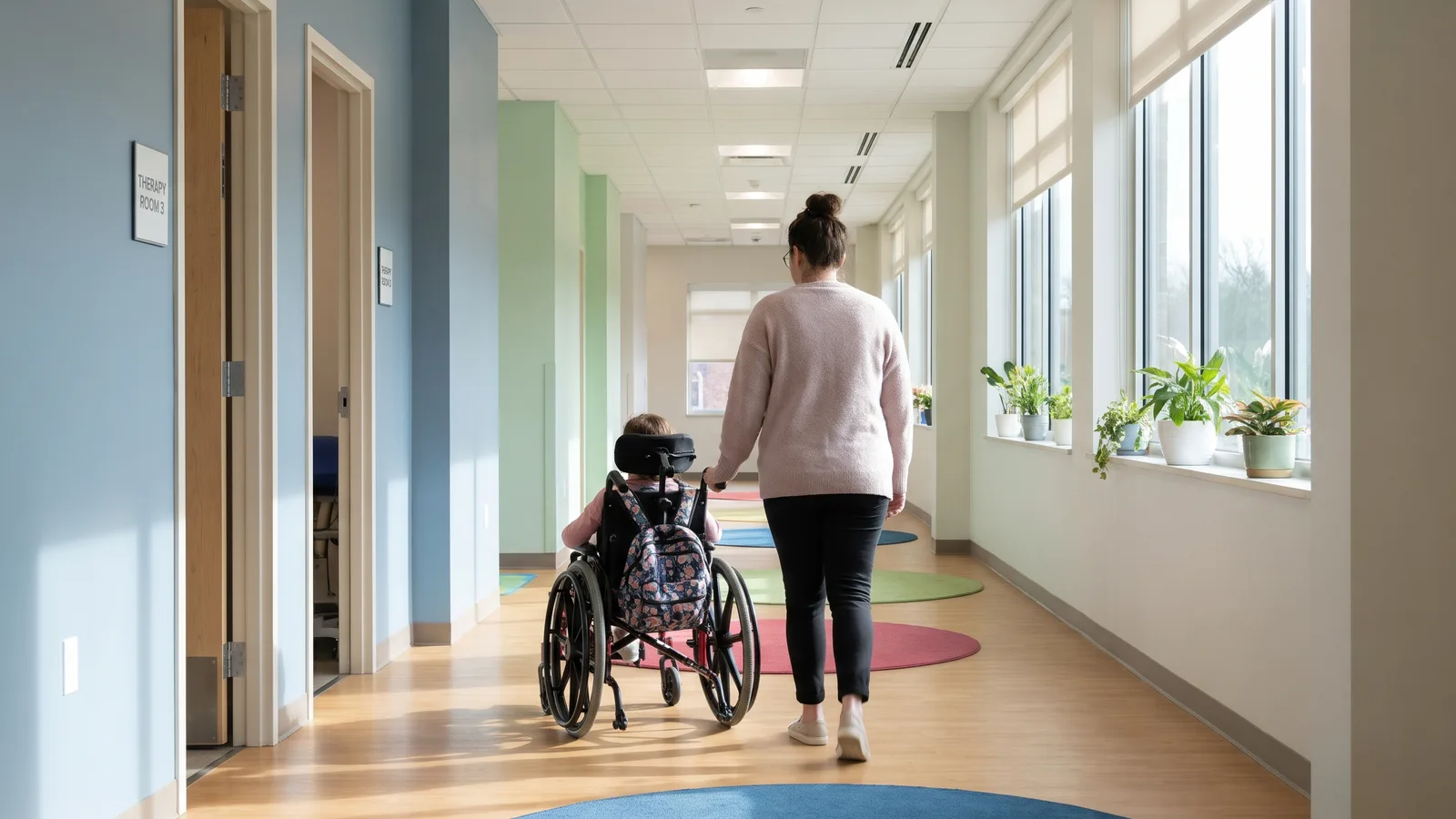
A cerebral palsy specialist is usually a team rather than one doctor. Most children with CP are followed in a multidisciplinary cerebral palsy clinic, often based at a children’s hospital, where a pediatric neurologist or developmental pediatrician, a rehabilitation physician (physiatrist), an orthopedic surgeon and physical, occupational and speech therapists can see the child in one place. The usual way in is a referral from your child’s pediatrician, and you can ask for one as soon as you are worried, before there is any diagnosis.
Below: who is on that team, how referrals work, what to look for and ask at a first visit, what hospital rankings actually measure, and how adults with CP find care once they leave pediatrics.
“Parent concern is a valid reason to trigger formal diagnostic investigations and referral to early intervention, as eighty-six per cent of parents suspect their child has cerebral palsy before the clinical diagnosis is made.”
— AACPDM, Early Detection of Cerebral Palsy care pathway
Who is on a cerebral palsy care team
Treatment for cerebral palsy “requires a team approach,” according to the National Library of Medicine’s MedlinePlus entry on cerebral palsy. Its list includes a primary care provider, a dentist, a social worker, nurses, and occupational, physical and speech therapists, along with specialists such as a neurologist, a rehabilitation physician (physiatrist), a pulmonologist and a gastroenterologist. Which of these a child needs depends on the type of CP and how it affects movement, eating, breathing and speech.
The doctors parents meet most often:
- Developmental-behavioral pediatrician. A pediatrician with extra subspecialty training after a three-year pediatric residency. The American Academy of Pediatrics names cerebral palsy among the conditions these doctors evaluate and care for (AAP, HealthyChildren.org).
- Pediatric neurologist. Often involved in the diagnosis. The AACPDM’s early detection care pathway is written first for neurologists, pediatricians, neonatologists and pediatric rehabilitation specialists.
- Physiatrist. A physician in physical medicine and rehabilitation. Pediatric physiatrists specialize in “the rehabilitation care and medical management of children,” and many run CP clinics with therapists, neurologists and orthopedic surgeons on the same team (University of Pittsburgh, Division of Pediatric Rehabilitation Medicine).
- Pediatric orthopedic surgeon. Watches the hips, spine and joints. AACPDM recommends that hip surveillance start by age 2, or when CP is diagnosed or suspected, so that displacement is caught early enough for “referral for assessment and/or management” (AACPDM hip surveillance pathway).
- Therapists. Physical, occupational and speech therapists provide the hands-on therapy between doctor visits. Our guide to physical therapy for cerebral palsy explains what sessions involve, and the cerebral palsy treatment overview covers medications, surgery and other options.
How to get a referral
The CDC’s advice is to raise movement concerns with your child’s doctor or nurse and, if the concern remains, to ask for a referral to a specialist who can do a fuller evaluation (CDC, Treatment and Intervention for Cerebral Palsy). The same page says you do not need a doctor’s referral or a diagnosis to call your state or territory’s early intervention program, and that early intervention can start before a CP diagnosis is made.
Timing matters more than it used to. A 2017 review in JAMA Pediatrics by Iona Novak and colleagues found that CP, historically diagnosed between 12 and 24 months, can now be diagnosed before 6 months’ corrected age (Novak et al., 2017). Before 5 months, the most predictive tools were the General Movements Assessment (98% sensitivity), the Hammersmith Infant Neurological Examination (90%) and term-age MRI (86% to 89%). If a specialist suggests “wait and see” despite clear warning signs, it is reasonable to ask whether these tests have been done. Our pages on how cerebral palsy is diagnosed and the three early diagnosis tests go into each one.
Before booking, check whether your health plan needs a written referral, and ask the clinic which records to send: birth and NICU summaries, any brain imaging, and therapy notes.
What to look for in a CP clinic
A clinic name alone tells you little. A few things are worth checking:
- Whether several specialists see your child at the same visit, or whether you will be sent to separate appointments across the system.
- Whether the clinic follows a hip surveillance schedule. AACPDM’s pathway says X-ray frequency rises with GMFCS level, the five-level scale explained in our CP classification systems page. Our post on the hip surveillance screening schedule sets out the intervals.
- Whether the team uses the AACPDM care pathways, which are short, evidence-based summaries for clinicians. There are currently seven: central hypotonia, dystonia, early detection, hip surveillance, osteoporosis, respiratory health and sialorrhea (drooling).
- Whether the clinic works with early intervention or your child’s school. For children under 3, the CDC notes that the family service plan is built by a team that includes the parents and every provider who works with the child.
Questions to ask at the first visit
- Who will coordinate my child’s care between visits, and how do I reach them?
- Which specialists are part of this clinic, and which would be separate referrals?
- How often will my child be seen, and when are hip X-rays due?
- What is my child’s GMFCS level, and what does it mean for the plan?
- Which therapies do you recommend now, and how will we know they are working?
- Does this clinic see patients into adulthood? If not, when do you start planning the move to adult care?
What hospital rankings measure
People searching for the best cerebral palsy hospitals often land on U.S. News & World Report’s Best Children’s Hospitals. The 2026-2027 edition ranks the top 50 centers in 11 pediatric specialties, according to the methodology report published by RTI International on September 15, 2026. None of the 11 is cerebral palsy or rehabilitation. The closest are Neurology & Neurosurgery and Orthopedics.
In those two specialties the score is split equally between structure (staffing, programs, technology), process and outcomes. A survey of pediatric specialists, averaged over 2024, 2025 and 2026, counts for 10% of the total. Cerebral palsy shows up in a handful of line items. A multidisciplinary CP and spasticity program is worth 1 of 19 points for specialized clinics in Neurology & Neurosurgery, a spasticity clinic is 1 of 11 in Orthopedics, and the orthopedic outcomes include readmissions and reoperations after scoliosis surgery in children with CP at GMFCS levels IV and V.
So a ranking describes a hospital’s whole neurology or orthopedic service. It does not measure the CP clinic itself, the wait for a first appointment, or whether the hospital sees adults. Of 199 eligible hospitals, 91 ranked in at least one specialty, and U.S. News now displays data for hospitals that fall short of the top 50. Use the list to find candidates nearby, then ask the questions above.
Finding care as an adult with CP
Care often thins out after age 18. A 2023 systematic review of 27 studies by Mitchell and colleagues found that use of rehabilitation services fell with age regardless of GMFCS level, that hospital use rose among people of transition age, and that a top barrier was a shortage of adult providers willing to accept patients with CP (Mitchell et al., Childs Nervous System, 2023).
Some adults stay in pediatric systems as a result. A 2025 study at a Colorado pediatric health system looked at 280 adults with CP still seen in pediatric rehabilitation medicine. Together they saw more than 30 types of specialists, and only 21 (7.7%) had any documented transition planning (Sarmiento et al., 2025).
Got Transition, a program of the National Alliance to Advance Adolescent Health, sets out six core elements for moving from pediatric to adult care, with planning at ages 14 to 18 and transfer at 18 to 21 (Got Transition). For adults already past that point, MedlinePlus advises continued follow-up with a neurologist to reduce the risk of late complications. A physiatrist is often the closest adult equivalent of the pediatric CP clinic lead. Our page for adults with cerebral palsy covers aging, pain and day-to-day support.
Common questions
What kind of doctor treats cerebral palsy?
Usually several. A pediatric neurologist or developmental pediatrician often leads diagnosis, a physiatrist leads rehabilitation care, and an orthopedic surgeon monitors the hips and spine. Physical, occupational and speech therapists provide the hands-on therapy.
How do I find a cerebral palsy clinic near me?
Ask your child’s pediatrician for a referral to the nearest children’s hospital with a CP or spasticity clinic. For children under 3, contact your state’s early intervention program at the same time; the CDC says no referral or diagnosis is needed.
Do I need a diagnosis to see a cerebral palsy specialist?
No. AACPDM’s early detection pathway treats parent concern as a valid reason to start diagnostic testing and early intervention referral.
Which hospitals are best for cerebral palsy?
No national ranking scores cerebral palsy care on its own. U.S. News ranks pediatric neurology and orthopedics, which include a few CP measures, but the fit of a specific clinic matters more than a hospital’s overall rank.