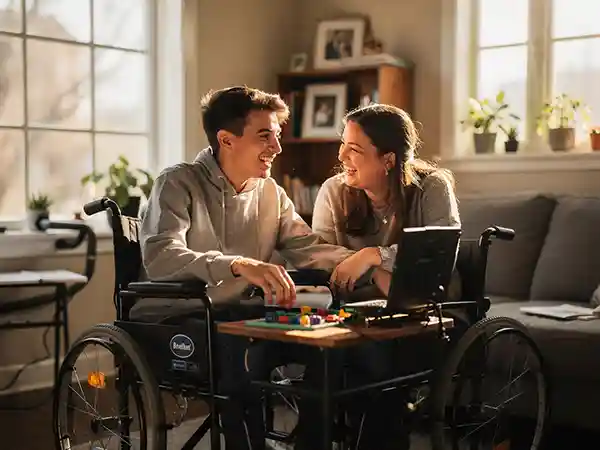
Young adulthood is the stage where childhood support systems end and adult ones often haven’t replaced them. Treatment, mental health, housing, transportation, and work all need to come together at once. The good news: most of the work is already known, it just needs to be done deliberately.
The transition deserves real planning, not a default ending
Building autonomy
Skills, technology, and supports compound across the 20s
Workplace rights
ADA accommodations, vocational rehab, and meaningful work
Something changed in cerebral palsy after 1990, and it makes this stage of life more important than it used to be. Among the most severely affected, mortality shifted out of early childhood and into early adulthood.
The Western Australian register makes the shift concrete. In the 1981 to 1990 birth cohort, 20% of the most severely impaired had died by age four. For those born later, that same 20% mark was not reached until age fifteen, and by age twenty the mortality of the most severely impaired born in the 1990s exceeded every earlier cohort. Children who would once have died young now reach adulthood, which is an achievement. The risk did not disappear. It moved to the exact age at which pediatric services stop.
Most of the treatment carries over. What does not carry over is the system delivering it, and losing the system is how the treatment stops.
Two things are worth starting in the twenties rather than the forties. Chronic pain arrives earlier in cerebral palsy than most people expect: in a study of adults with spastic bilateral cerebral palsy at a mean age of 36, three quarters reported pain lasting longer than three months, against 39% of healthy reference samples. And the causes of death that are actually raised in adults with cerebral palsy are respiratory disease, at a standardized mortality ratio of 13.59, and cardiovascular disease at 3.19, in a cohort of 958 adults followed through English primary care records. Cancer mortality was not raised.
Both of those are prevention problems, and prevention started at 22 works better than prevention started at 45. Asking a new adult provider to put respiratory and cardiovascular screening on a schedule is a small request with a large amount of evidence behind it.
Innovative therapies
Physical and occupational therapy continue, with the emphasis moving from acquiring function to keeping it, and they work better delivered in defined episodes aimed at a specific problem than as an open-ended weekly appointment nobody will fund. Botulinum toxin continues where spasticity is driving pain or blocking a particular function. An intrathecal baclofen pump remains an option for severe generalized spasticity, and selective dorsal rhizotomy, which is mostly a childhood procedure, is occasionally considered in carefully selected young adults.
Orthopedic review changes character rather than stopping: the priorities in adulthood are function and pain rather than the alignment goals that drive pediatric surgery. Adaptive sport belongs in this list too, and not as a nice extra, since fitness training is among the interventions with the best evidence in cerebral palsy and it is the one that most easily disappears when school ends.
Role of medication
Medication review is the highest-value, most easily dropped item in adult care. Antiepileptics need adjusting as body weight and metabolism change through the late teens and twenties. Oral antispasticity drugs get carried forward from childhood without anyone asking whether they are still earning their side effects. Reflux and bowel regimens need rethinking against adult eating patterns, and bone protection deserves an adult assessment rather than a pediatric assumption, given how much of adult fracture risk traces back to a lifetime of reduced weight-bearing.
Antidepressants and anxiolytics are the other half of that review, and they are underused here for reasons covered further down this page.
The pediatric-to-adult care cliff
Most pediatric CP programs end care between ages 18 and 21. Adult-focused CP programs are far rarer than pediatric ones, particularly outside major academic medical centers. This creates a real gap that families need to plan around: identifying adult providers should ideally start by age 16, with formal transition planning by the senior year of high school. Families who treat this as a deliberate project (transferring records, identifying adult specialists, securing insurance continuity) avoid the common scenario of a young adult going months or years without specialty care. Our nurse advocates can help walk through what this planning looks like. Get a free, confidential consultation.
Supporting independence in young adults with CP
Independence is built in two layers at once: the skills a person has, and the environment that lets those skills be used. Working on one without the other produces less than either promises.
The skill layer is ordinary and specific. Managing a medication schedule. Booking and attending an appointment without a parent in the room. Handling money, a bank account and a benefits review. Directing a personal care attendant, which is a management skill nobody teaches and everyone needs. Knowing how to say what accommodation is required and why, in a sentence, to someone who has not met a person with cerebral palsy before.
The environment layer is where most of the leverage sits. Accessible transport decides whether a job is reachable. Housing decides whether attendant care is workable. Equipment that fits decides how much of the day is spent on the mechanics of moving rather than on anything else. A young adult with excellent self-advocacy and no accessible transit is still stuck, which is why plans that address only the person tend to disappoint.
What independence looks like in practice
Usually a combination of:
Directing personal care rather than performing every task alone
Transport that works without a fortnight of planning
Housing modified once, properly, rather than repeatedly worked around
Equipment reviewed as the body and the job change
A benefits and insurance position that survives starting work
Mental health resources for young adults with CP
The raised risk here is measured rather than assumed, and the gap between how often it is diagnosed and how often it is treated is the actual problem.
A cohort study in JAMA Neurology compared 1,705 adults with cerebral palsy against 5,115 adults matched for age, sex and general practice, adjusting for chronic conditions and how often people saw their doctor. The hazard of depression was 1.28 and the hazard of anxiety was 1.40, both significant. In the Dutch cohort cited earlier, depressive symptoms were present in 25% against 12% of reference samples, and chronic pain and severe fatigue occurred together with depressive symptoms in 16% of the group.
Emotional well-being
What sits underneath those numbers is mostly ordinary and mostly addressable. Pain that has never been treated as its own problem. Fatigue that gets read as low motivation. The loss of a school-based social structure with nothing built to replace it. A dating culture that largely excludes disabled people. Family relationships that have to convert from parent-and-child into two adults, which takes deliberate work. And for many, a history of medical procedures in childhood that meets any reasonable definition of trauma and has never been named as one.
Each of those has a treatment. None of them is a personal failing, and a clinician who understands disability will not spend the first six sessions treating the disability as the problem.
Accessing services
Telehealth has done more for access in this population than any policy change, since it removes transport from the equation entirely. Mental health parity rules mean most insurance now covers therapy at a usable frequency, though enforcement varies. State vocational rehabilitation programs often fund mental health support as part of an employment package, which is a route people rarely think to use. University disability services connect students to campus resources. The 988 Suicide and Crisis Lifeline runs 24 hours a day, and local mobile crisis teams exist in most areas.
Finding help is rarely the hard part. Navigating to the right help is, and a care coordinator, a vocational rehabilitation counselor or a disability-aware primary care provider will shorten that considerably.
Mental health is widely under-treated in young adults with CP
Adults with cerebral palsy are diagnosed with depression and anxiety at higher rates than the general population, with adjusted hazard ratios of 1.28 and 1.40 in a cohort of 1,705 adults matched against 5,115 without CP, and they are treated at lower rates. That gap reflects access barriers, screening missed at appointments that are about something else, and the assumption that distress is normal given the circumstances. It is neither inevitable nor untreatable. If you are experiencing depression or anxiety, that is a treatable medical condition and good help exists.
Employment opportunities for young adults with CP
The legal and funding scaffolding for disabled employment is stronger than most families realize, and it is largely free to use.
Every state runs a vocational rehabilitation agency that funds assessment, training, job coaching, equipment and placement support, at no cost to the participant. Pre-employment transition services under the Workforce Innovation and Opportunity Act reach students with disabilities while they are still in high school, which is the right time to start rather than the year after graduation.
Rights and accommodations in the workplace
The Americans with Disabilities Act requires employers with 15 or more employees to provide reasonable accommodation unless doing so would impose undue hardship, and the accommodations that matter in cerebral palsy are usually cheap: a modified schedule around fatigue, a workstation set at the right height, speech recognition software, remote work, or additional time for tasks that a keyboard makes slow.
Two practical points. Accommodation has to be requested, and the request is what triggers the employer's obligation, so knowing how to make one in writing matters more than knowing the statute. And benefits do not simply vanish on the first paycheck: work incentive programs exist specifically so that trying employment is not a bet on losing health coverage. Ask a benefits counselor before turning down a job for that reason.
Funding adult independent life
The cost of meaningful adult independence with CP (accessible housing, adapted vehicles, ongoing therapy, durable medical equipment, personal care attendants, assistive technology) can run into hundreds of thousands of dollars across a lifetime, often far beyond what insurance and benefits programs cover. When CP was caused by a preventable birth injury, a successful claim can fund the lifetime of supports that produces the meaningful adult life this page describes. Request a free, confidential case review.
Frequently asked questions about managing CP in young adults
Treat it as a project rather than a default. Pediatric CP programs end between 18 and 21 and adult equivalents barely exist outside academic centers, so identifying adult providers should start around age 16, with records transferred and insurance continuity settled before the last pediatric appointment.
Mostly the same treatments, aimed differently: therapy shifts from acquiring function to keeping it and works better in defined episodes than as an open-ended weekly slot, botulinum toxin continues where spasticity drives pain, and orthopedic review switches its priorities from alignment to function and comfort.
Because the risks that matter in adult cerebral palsy are preventable ones and prevention started at 22 beats prevention started at 45. Respiratory disease carries a standardized mortality ratio of 13.59 in adults with CP and cardiovascular disease 3.19, while cancer mortality is not raised, so chest and heart screening should be scheduled rather than left to chance.
Higher, and measurably so. A cohort study comparing 1,705 adults with cerebral palsy against 5,115 matched adults found adjusted hazard ratios of 1.28 for depression and 1.40 for anxiety. Diagnosis rates run above the general population while treatment rates run below it, which is an access problem rather than a personal one.
Every state runs a vocational rehabilitation agency funding assessment, training, job coaching, equipment and placement at no cost to the participant, and pre-employment transition services reach students with disabilities while they are still in high school. The Americans with Disabilities Act requires reasonable accommodation from employers with 15 or more employees.
It builds in two layers at once. The skills, including managing medication, directing a personal care attendant and asking for an accommodation clearly, and the environment, meaning accessible transport, workable housing and equipment that fits. Strong skills with no accessible transit still leave a person stuck.