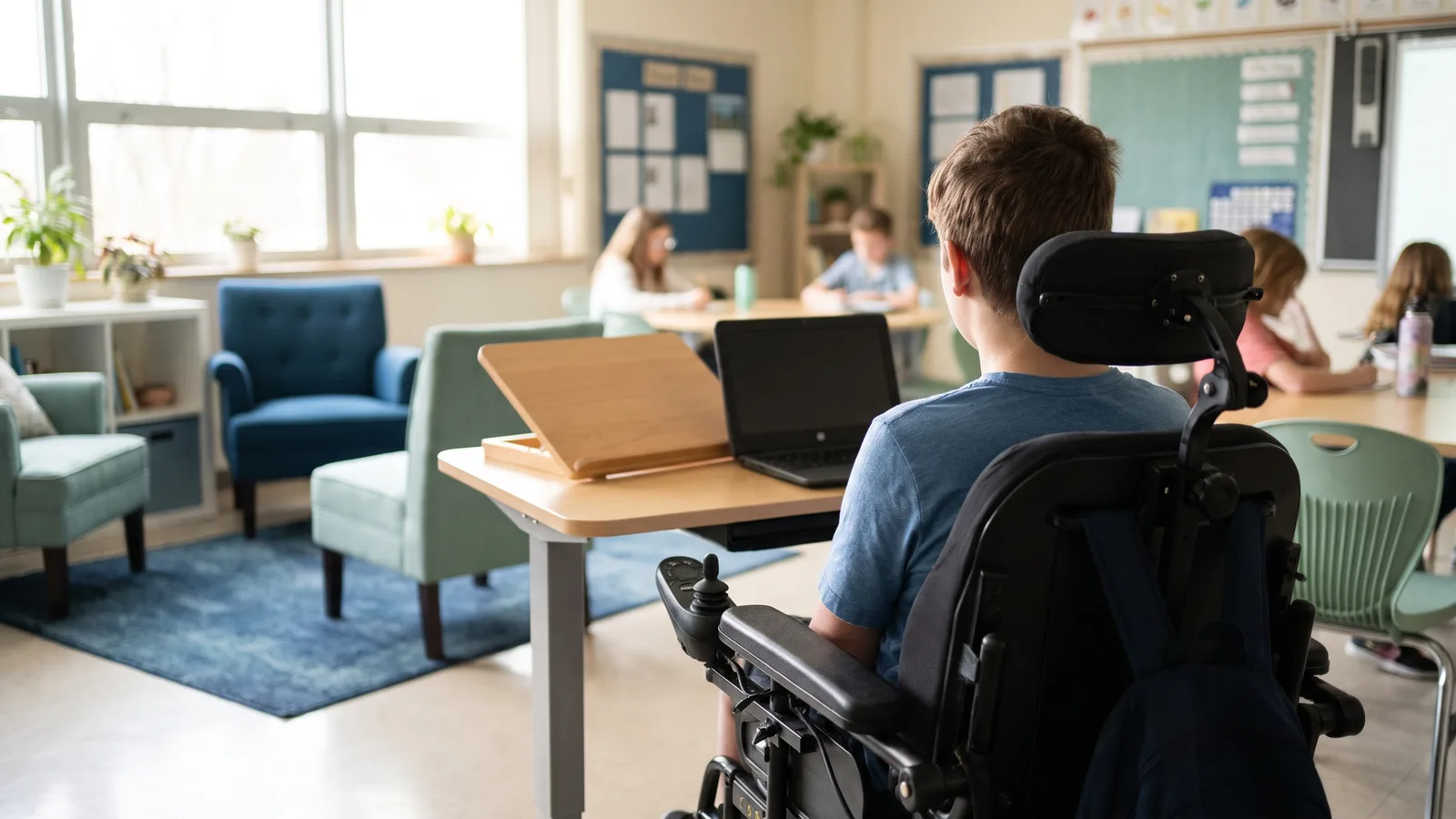
Accommodations for cerebral palsy at school usually come through one of two plans. An IEP (individualized education program) under the Individuals with Disabilities Education Act (IDEA) is for a child who needs special education. A 504 plan under Section 504 of the Rehabilitation Act is for a child whose disability substantially limits walking, writing, speaking, learning or another major life activity, and who can learn in a regular class with changes such as extra test time, a scribe or an accessible desk. After high school the rules shift. In college the student has to ask for help, and at work the Americans with Disabilities Act (ADA) lets an employee request reasonable accommodation.
Below is what each law covers, who qualifies, and accommodations that fit the movement, speech and fatigue issues common in cerebral palsy. This is general information, not legal advice about any one child or job.
“Unlike your school district, your postsecondary school is not required to identify you as having a disability or to assess your needs.”
— U.S. Department of Education, Office for Civil Rights (2011)
IEP or 504 plan: what is the difference?
IDEA names cerebral palsy directly. Its definition of “orthopedic impairment” includes impairments caused by cerebral palsy, provided the impairment adversely affects the child’s educational performance (34 CFR 300.8). The diagnosis is not enough on its own. A child qualifies for an IEP only if, because of the disability, the child needs special education and related services. Under the same rule, a child who needs only a related service and no special education is generally not covered by IDEA, although state standards can change that answer. IDEA services must be available to eligible children from ages 3 through 21 (34 CFR 300.101).
An IEP is a written program of specially designed instruction plus related services. For children with CP, related services often include physical therapy, occupational therapy and speech-language therapy, provided at no cost to parents (Center for Parent Information and Resources). Our page on occupational therapy for children with cerebral palsy explains what school-based OT usually works on.
Section 504 casts a wider net. A student is covered if they have a physical or mental impairment that substantially limits one or more major life activities. The U.S. Department of Education’s Office for Civil Rights (OCR) lists walking, performing manual tasks, speaking, learning, standing, lifting, reading and communicating among them (OCR Section 504 FAQ). Since January 1, 2009, a school may not count the helping effect of mobility devices or assistive technology when it decides whether a student is limited. OCR also says a medical diagnosis does not automatically qualify a student; the limitation has to be real.
The two overlap. If a child qualifies under IDEA, the school does not have to write a separate 504 plan, because carrying out the IEP is one way to meet Section 504. Regular classroom teachers must follow a 504 plan when it applies to their students.
Classroom accommodations that fit cerebral palsy
Every plan is individual, but these come up often. Most are drawn from the Job Accommodation Network’s fact sheet on accommodating students with cerebral palsy and the Nemours KidsHealth factsheet for schools:
- Extra time to move between classes, finish assignments and take tests, plus extra bathroom breaks.
- A note taker or a copy of the teacher’s notes, a scribe for tests, writing and grip aids, and a laptop with alternative input or word prediction software.
- An accessible route and entrances, clear hallways and aisles, lightweight doors or automatic door openers, and classrooms close to an accessible restroom.
- An accessible desk or portable wheelchair desk, with seating arrangements checked and changed if they are not working.
- A communication aid with speech output, or communication software on a laptop.
- A plan for making up class time and tests missed for medical appointments.
Two IDEA rules back these up. When writing an IEP, the team must consider the child’s communication needs and whether the child needs assistive technology devices and services (34 CFR 300.324). IDEA defines an assistive technology device broadly, as any item or piece of equipment used to increase, maintain or improve a child’s functional capabilities (34 CFR 300.5). Our guides to communication devices for cerebral palsy and assistive devices for mobility cover the equipment itself.
Physical education is not optional for students on an IEP. IDEA requires PE, specially designed if necessary, for every child receiving special education, and a child takes part in regular PE unless the IEP prescribes adapted PE (34 CFR 300.108).
Transition planning starts by age 16
IDEA sets a firm age for planning life after high school. Beginning no later than the first IEP in effect when the student turns 16, or younger if the IEP team decides, the IEP must include measurable goals for training, education, employment and, where appropriate, independent living, plus the services needed to reach them. Those goals are updated every year. At least one year before the student reaches the age of majority under state law, the IEP must also note that the student has been told which rights will transfer to them (34 CFR 300.320). For what comes next, see our page on help for adults with cerebral palsy.
College: the student has to ask
IDEA and IEPs do not apply to colleges. Section 504 and Title II of the ADA still protect students, but OCR’s guide for students heading to college lists real differences (OCR, Students with Disabilities Preparing for Postsecondary Education):
- Telling the school about a disability is voluntary, but a student who wants an academic adjustment must identify themselves and follow the school’s request procedure.
- The school may ask for current documentation. An old IEP or 504 plan can help show what worked but is generally not enough on its own, and neither the high school nor the college has to pay for a new evaluation. A state vocational rehabilitation agency may provide one at no cost to eligible students.
- Examples of adjustments include priority registration, a reduced course load, note takers, recording devices, extended test time and voice recognition software on school computers.
- Colleges do not have to provide personal attendants, individually prescribed devices or personal services such as tutoring and typing.
Accommodations for cerebral palsy at work
Title I of the ADA applies to employers with 15 or more employees, including state and local governments (ADA.gov). According to the EEOC, an employee can ask in “plain English” and does not need to mention the ADA or use the phrase “reasonable accommodation.” The request starts an informal, interactive process between the employee and the employer. An employer can refuse an accommodation that would cause undue hardship, meaning significant difficulty or expense for that particular employer (EEOC enforcement guidance).
The Job Accommodation Network, a free and confidential service, keeps a cerebral palsy accommodation list. Its examples include alternative keyboards and mice, keyguards, speech recognition software, a scribe or note taker, periodic rest breaks, a flexible schedule, telework, an accessible parking space, adjustable workstations, ramps and automatic door openers. JAN also notes that many people with CP need only a few accommodations, and some need none. Rules on how earnings affect SSI and SSDI are separate from the ADA; our disability benefits guide covers them.
Where families can get help
Every state has at least one Parent Center. Nearly 100 Parent Training and Information Centers and Community Parent Resource Centers serve the U.S. and its territories, and they explain rights under federal and state law and how to work with schools (find your Parent Center). If a family and school disagree about an IEP or 504 plan, OCR says the dispute can go to a due process hearing under IDEA or Section 504. More family resources are on our cerebral palsy support page.
Common questions
Does cerebral palsy qualify for an IEP?
It can. IDEA lists cerebral palsy as a cause of orthopedic impairment, but the child must also need special education because of it. A child with CP who does not need special education may still qualify for a 504 plan.
Can a child with cerebral palsy have a 504 plan instead of an IEP?
Yes, if the CP substantially limits a major life activity such as walking, writing or speaking. A 504 plan often fits a child who learns at grade level but needs physical access, extra time or assistive technology.
Does an IEP carry over to college?
No. IEPs end with high school. The student must contact the college’s disability services office, request adjustments and usually provide current documentation.
What accommodations can an adult with cerebral palsy ask for at work?
Common examples include adapted computer input, speech recognition software, rest breaks, a flexible schedule, telework and an accessible workstation or parking space. The request does not need to use legal terms.