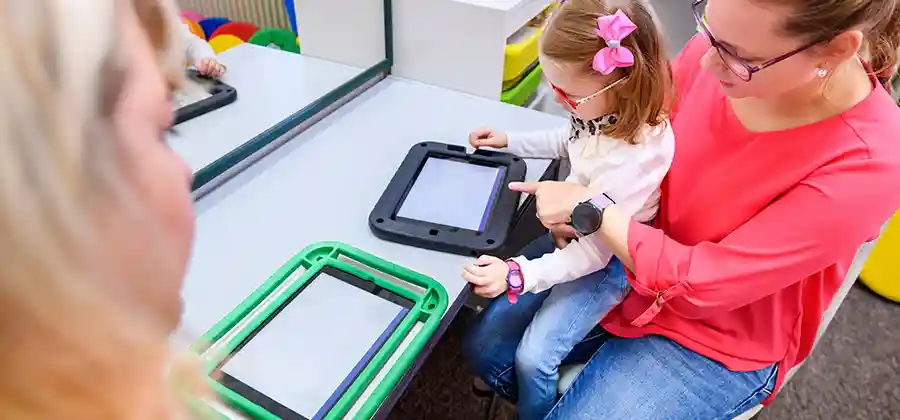
Occupational therapy for children with cerebral palsy
A child with CP can see an occupational therapist at home as a baby, at school from age 3, and in a clinic at any age. Each setting follows different rules and a different payer. Here is how each one works, from the first referral to the move into adult care.
Referral to first early intervention plan meeting (34 CFR 303.310)
Ages 3 to 21
Span of free public education under IDEA (34 CFR 300.101)
Age 16
Latest point the IEP must add transition goals (34 CFR 300.320)
Occupational therapy for children with cerebral palsy runs on three tracks: early intervention under IDEA Part C from birth to age 3, school based OT under an IEP or 504 plan from 3 to 21, and clinic OT paid by Medicaid or private insurance at any age. It starts with a referral to your state’s Part C program, which has 45 days to evaluate your baby and hold the first planning meeting.
CDC’s monitoring network counted about 1 in 345 children with CP in its 2010 data, and one child can be in two of these tracks at the same time. The tracks answer to different questions, which is where families get stuck: a school therapist asks what your child needs to benefit from education, while a clinic therapist asks what is medically necessary. Our guide to occupational therapy for cerebral palsy covers what OT is and the evidence behind it. This page follows the child through each setting and shows who pays.
Babies and toddlers get OT through their state’s Part C early intervention program, usually at home or in child care. A confirmed CP diagnosis is not required to qualify.
Federal rules define infant OT by what it is for. Under 34 CFR 303.13, it addresses “adaptive development, adaptive behavior, and play, and sensory, motor, and postural development.” In practice that means reaching for a toy, bringing two hands together, holding a bottle, and sitting well enough to use both hands. Services are supposed to happen in natural environments, meaning the home or a child care setting, and move elsewhere only when the family and team agree the goals cannot be met there (34 CFR 303.126).
Eligibility does not wait for a label. A child under 3 qualifies with a measured delay, or with a diagnosed condition that has a high probability of causing one, under 34 CFR 303.21. That matters because CP can now be identified before 6 months corrected age. A 2017 review in JAMA Pediatrics found the General Movements Assessment 98% sensitive and the Hammersmith Infant Neurological Examination 90% sensitive for detecting risk before 5 months corrected age, and it told clinicians to refer promptly to early intervention.
The clock starts at referral. The evaluation, the assessments and the first meeting to write the Individualized Family Service Plan (IFSP) must all be finished within 45 days. The IFSP is then reviewed every six months, or sooner if you ask (34 CFR 303.342).
What good infant OT looks like
Expect the therapist to coach you more than treat the baby. One tested model is built that way. In the GAME trial, 30 infants at high risk of CP were randomized to a program of parent set goals, task specific motor training and an enriched home environment, or to standard care, for 16 weeks. At 12 months the GAME group scored higher on motor skills, on the cognitive scale of the Bayley test, and on parent satisfaction with their goals. The trial was small. Its shape is the useful part: goals the family picked, practiced daily at home. Our page on OT home programs covers how to build that routine.
Who pays in early intervention
Some of it is always free. Under 34 CFR 303.521, child find, evaluation and assessment, service coordination, and developing and reviewing the IFSP carry no fee. States may adopt a sliding fee scale for the services themselves, including OT, and may bill your insurance with your consent. A family that meets the state’s definition of inability to pay must get every Part C service at no cost, and inability to pay cannot delay or deny services.
Turning 3: the handoff to preschool services
On the third birthday, OT moves from the early intervention system to the local school district. The law builds in a planning window so services do not stop on the birthday.
The early intervention agency must notify the school district at least 90 days before your child turns 3 if they may be eligible for preschool special education, and, with your approval, hold a transition conference between 90 days and 9 months before the birthday (34 CFR 303.209). Ask for that meeting early.
Three things change. The plan becomes an Individualized Education Program (IEP) instead of an IFSP. The focus shifts from the family to the child’s participation in preschool. And the service is free: the school must provide a free appropriate public education, with no sliding fee. CP is named in the federal definition of orthopedic impairment, one of the qualifying disability categories (34 CFR 300.8(c)(8)), so eligibility turns on whether the impairment affects educational performance, not on whether CP is present.
School based OT: IEP or 504 plan
At school, OT is a related service: it exists to help a child benefit from special education. That single rule decides whether your child gets OT through an IEP, a 504 plan, or neither.
IDEA lists occupational therapy among related services and defines it as improving, developing or restoring function, improving the ability to perform tasks for independent functioning, and preventing further loss of function (34 CFR 300.34). At school those tasks are concrete. Holding a pencil or using a keyboard, opening a lunch container, managing a coat and backpack, getting through the bathroom routine, and using any assistive devices the IEP team decides your child needs.
The rule that surprises families
A child who needs only OT and no special education is not eligible for an IEP under 34 CFR 300.8(a)(2), unless your state counts OT as special education. A child with mild hemiplegia who reads at grade level can be turned down for an IEP for exactly this reason. Section 504 is the fallback: its regulation (34 CFR 104.33) requires regular or special education plus “related aids and services” for any qualified student, with no special education requirement.
An IEP carries more protection than a 504 plan. It has written annual goals, it must be reviewed at least once a year (34 CFR 300.324), and your child must be reevaluated at least every 3 years unless you and the school agree it is unnecessary (34 CFR 300.303). If the school proposes a 504 plan, ask what special education your child was evaluated for and why each area was ruled out. Get the answer in writing. Then check that the 504 plan names OT, how often, and for how long, because a plan that says only “OT consult as needed” can mean a therapist who never sees your child.
Bring these to the IEP meeting
Each one turns a vague plan into one you can check:
The clinic OT’s latest report, with the standardized scores
A list of the school tasks your child cannot do alone yet
Minutes per week of OT, and whether it is direct or consult
A goal you can measure, such as dressing for recess without help
Any device the child uses at home that school should match
School OT does not replace clinic OT. The school only has to address what affects education, so a goal like bathing or tying shoes for a sleepover may fall outside it. Many children see both, and the therapists work best when they share reports. Our pages on self care skills and fine motor skills cover the goals that usually sit on the clinic side.
Clinic OT and who pays
Outside school, OT is billed to Medicaid or private insurance as a medical service. For a child on Medicaid, the EPSDT benefit sets a broader coverage rule than adults get.
Medicaid’s Early and Periodic Screening, Diagnostic and Treatment benefit covers beneficiaries under 21. Federal law requires it to cover necessary treatment “to correct or ameliorate” conditions found in screening, “whether or not such services are covered under the State plan” (42 U.S.C. 1396d(r)(5)). A visit limit in the state plan is therefore not the final word for a child whose OT is medically necessary. If a Medicaid plan denies OT for a child with CP by pointing to a visit limit, cite EPSDT in the appeal and ask the OT for a letter tying each goal to function. For the income routes into Medicaid, see disability benefits for cerebral palsy.
Schools can bill Medicaid too. 34 CFR 300.154 requires your written consent before the first claim. It also bars the school from requiring you to enroll, from passing on a copay or deductible, and from using your child’s benefits in a way that reduces lifetime coverage or leaves you paying for therapy outside school. You can refuse consent and your child still gets the services in the IEP.
Private insurance varies by plan, and a plan may set a yearly visit limit for therapy. Ask the insurer for your plan’s limit in writing before the first appointment. Then ask the OT to schedule around it.
Teens and the move to adult care
Two supports end around 21: school services under IDEA and Medicaid’s EPSDT benefit. OT in the teen years should prepare for that date.
No later than the IEP in effect when your child turns 16, the IEP must add measurable goals for life after school in training, education, employment and, where appropriate, independent living, and the services to reach them (34 CFR 300.320(b)). This is where OT earns its place in high school. Cooking a simple meal, managing medication, using transit, handling a phone and a bank card, and setting up a workstation all fall inside it. Your child’s GMFCS level shapes which of these are realistic, and the IEP team should say so in the goals.
The handoff to adult care often goes badly. A 2023 systematic review of 27 studies linked the move out of pediatric care with housing instability, unemployment, more hospital admissions and less use of rehabilitation services. Three things were tied to better outcomes: family involvement, building the young person’s own confidence in managing care, and meeting the adult team before the switch. Book a first visit with an adult OT while the pediatric one can still send records and talk to them. Keep the physical therapy plan in the same handoff, so both therapists hand over at the same time.
Frequently asked questions about OT for children with CP
It works on the tasks a child needs to do at their age: play and feeding for a baby, dressing and pencil or keyboard use for a school child, cooking and managing money for a teenager. Federal early intervention rules describe infant OT as addressing adaptive development, adaptive behavior, play, and sensory, motor and postural development.
No. Under 34 CFR 303.21, a child under 3 qualifies with a measured developmental delay or with a diagnosed condition that has a high probability of causing one. Once the state’s Part C program receives a referral, the evaluation, the assessments and the first family plan meeting must be finished within 45 days.
Evaluation, service coordination and writing the family plan are always free under 34 CFR 303.521. States may charge sliding scale fees for the services themselves, but a family that meets the state’s definition of inability to pay must receive all Part C services at no cost, and inability to pay cannot delay or deny services.
Under IDEA, occupational therapy is a related service, and a child who needs only a related service and no special education is not eligible under Part B (34 CFR 300.8(a)(2)) unless state standards count that service as special education. Section 504 has no such requirement, so it can cover a child with mild CP who keeps up in class but needs help with handwriting or the school building.
Yes, but only with your written consent before the first claim. Under 34 CFR 300.154 the school cannot require you to enroll in Medicaid, cannot pass a copay or deductible on to you, and cannot use your child’s benefits in a way that reduces lifetime coverage or leaves you paying for therapy outside school hours.
Two supports end around 21. School services under IDEA run from 3 through 21, with state law allowed to set the edges, and Medicaid’s EPSDT benefit covers children under 21. The IEP must include transition goals no later than the IEP in effect at 16, so use those years to find an adult OT and meet them before the switch.