When speech is limited, the right communication device opens the world. From picture boards to eye-gaze systems and tablet-based AAC apps, choosing the right tool is the single most consequential decision in many CP care plans.
Medically reviewed
Updated September 2026
9 min read
Spectrum of tech
Low-tech picture boards through eye-gaze systems
Personalized
SLP-led fitting matched to abilities and goals
Insurance covers
Many plans cover devices when SLP-prescribed
CP often significantly impacts the ability to communicate. Communication devices bridge the gap between the desire to communicate and the physical ability to do so, ranging from simple tools to advanced technologies. These devices give users a route to be understood and meaningfully improve quality of life by facilitating interaction and social inclusion.
This page covers the major categories of devices, how to choose them, and how they fit into a broader speech therapy plan. For the broader picture, see speech therapy for cerebral palsy.
Assistive communication devices for cerebral palsy
Start with the fact that should govern every decision on this page. In high-income countries roughly 3 in 4 people with cerebral palsy will talk, and about 1 in 2 have entirely typical intelligence. A child whose motor impairment prevents intelligible speech is very often a child with ordinary things to say and no reliable way to say them. Assistive communication devices, from a laminated picture board to an eye-gaze system, exist to close that specific gap.evices) tailored to varying degrees of speech and language impairment.
Selecting the right device depends on individual needs and abilities, emphasizing personalized assessment and guidance from speech therapy professionals. Incorporating these devices into daily routines significantly improves interaction with family, friends, and caregivers.
Introduction to assistive communication devices
The category covers everything from paper to eye-tracking. Low-tech means communication boards and books built from pictures and symbols, requiring no power and no setup. High-tech means speech-generating devices driven by touch screen, switch or eye gaze. Neither tier is a step up from the other, and most people who use AAC well use both, because a device that needs charging is no help in a swimming pool or during a power cut. A speech-language pathologist runs the assessment that matches the tool to the person.
Benefits of using assistive technology
What changes is not only vocabulary. Being able to state a need rather than wait for someone to guess it changes the balance of a household. Children who can object, choose and ask questions participate in decisions about their own lives, which is also a safeguarding matter: a child with no way to report pain or mistreatment is more vulnerable than one who can. Access to education broadens, since classroom participation depends on being able to answer. And isolation falls, which shows up in mood and behavior long before it shows up on any assessment.
Speech therapy tools for cerebral palsy
Speech therapy is central to managing communication challenges. It combines physical exercises, alternative methods, and communication apps and devices for cerebral palsy to address speech and language difficulties.
Effective speech therapy exercises
Direct speech work runs alongside the devices rather than in competition with them. Oral sensorimotor therapy, which a 2019 systematic review of the evidence lists among the interventions with genuine support, targets the muscles used in speech. Breath control and articulation get worked directly. Picture cards drill specific sounds. Apps give structured practice between sessions. Our page on ST benefits for CP covers what that work achieves. And voice amplifiers help where speech is intelligible but too quiet to carry across a room.
Role of speech therapy in language development
Therapy addresses receptive and expressive language together, because understanding usually runs ahead of production in cerebral palsy and that gap is easy to misread as not understanding. Sessions build vocabulary and sentence structure, teach alternative routes such as sign or symbol systems, and give a low-stakes place to practise. Worth knowing what the evidence actually supports here: a 2018 Cochrane review of parent-mediated communication interventions found only two small randomised trials covering 38 children, and rated the quality of evidence very low across every outcome. Mothers became more responsive after training; the effect on the children’s own communication was not demonstrated. Our page on language development covers what that means in practice.
High-tech and low-tech communication aids
Aids are broadly categorized into high-tech and low-tech, each with distinct advantages. The choice depends on the user’s specific needs, preferences, and the context where the device will be used.
Tech spectrum at a glance
The range runs roughly like this.
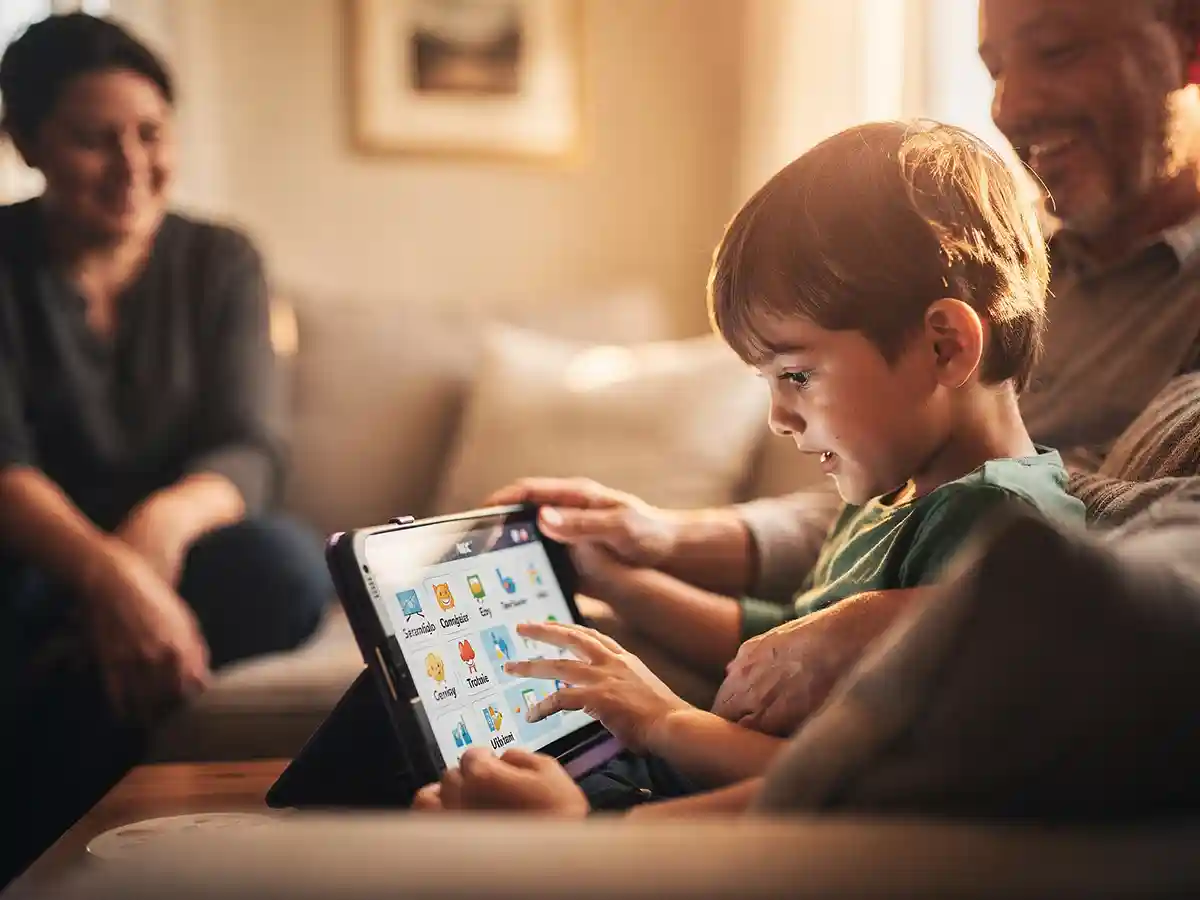
Picture boards need no power and work instantly. Letter and alphabet displays suit anyone who can spell and point, and they are frequently underestimated. Tablet apps such as Proloquo2Go and TouchChat turn a consumer device into a speech generator at a fraction of the cost of dedicated hardware. Dedicated speech-generating devices are built for durability, mounting and funding eligibility rather than for price. And eye-gaze and switch-controlled systems serve people with very limited voluntary movement, which in practice means they serve people at GMFCS levels IV and V who have the most to gain.
Exploring high-tech communication aids
High-tech systems turn text or symbol selections into audible speech, driven by touch, switch or eye tracking, with interfaces that can be reorganized as vocabulary grows. The pace of hardware improvement has been genuine: eye-tracking that required a dedicated cart a decade ago now runs on a mounted tablet. What matters more than the specification is that the device gets used, which depends on positioning, mounting and whether the people around the user know how to wait.
Understanding low-tech communication strategies
Low-tech systems earn their place on reliability. A symbol chart costs almost nothing, needs no charging, survives being dropped, and works in the bath, on a beach and in an ambulance. It takes minutes to teach a new carer. Every person who relies on a high-tech device should also have a low-tech backup, because devices fail and repairs take weeks.
Customized communication solutions for cerebral palsy
Customized solutions are what actually address the diverse communication challenges of CP. Each person has unique needs, necessitating personalized approaches involving adaptive equipment, tailored therapy, and innovative tools.
Tailoring communication devices to individual needs
Choosing well starts with an assessment of what the person can physically do, what they want to say and where they need to say it. A speech-language pathologist normally runs it alongside the family and an assistive technology specialist. From there the work is configuration: simplifying navigation so a target can be reached in fewer selections, loading vocabulary and symbols that match this person’s life rather than a generic set, and choosing hardware with room to grow, since a system that fits a four-year-old exactly will not fit them at nine.
Adaptive communication equipment options
Access method is where most of the engineering sits. Eye-gaze suits people with very limited motor control. Switches offer an alternative route for those with a reliable movement somewhere, a head turn or a knee press. Mounting matters more than families expect, because a device that cannot be positioned consistently will not be used consistently. Audio feedback and tactile input support users with visual impairment, which is common enough in this population to be worth screening for before any device is specified.
Funding communication devices long-term
Advanced AAC devices can run into thousands of dollars, with ongoing replacement costs as children grow. When CP resulted from preventable medical events, a birth injury claim can fund a lifetime of communication tools and care. Request a free case review.
Frequently asked questions about CP communication devices
Tools that give a person a way to communicate when speech alone is not enough. They range from picture and letter boards costing almost nothing to speech-generating devices driven by touch, switch or eye gaze. The category is usually called AAC, for augmentative and alternative communication, and the word augmentative matters: most people use these alongside whatever speech they have, not instead of it.
By separating what a person wants to say from what their muscles can produce. Cerebral palsy affects motor control, and speech is a motor act, so a person may know exactly what they mean and be unable to articulate it. About half of people with cerebral palsy have typical intelligence, which means for a large share of users the device is not compensating for a cognitive difference but for a physical one.
Because intelligible speech depends on fine coordination of breath, larynx, tongue and lips, and that coordination is precisely what cerebral palsy disrupts. Roughly 3 in 4 people with cerebral palsy will talk, so AAC is not universal. For the remaining quarter, and for the many whose speech is intelligible to family but not to strangers, a device is the difference between being understood at home and being understood anywhere.
Physical access first, since a device that cannot be operated reliably is not a device. Then vocabulary and interface, which should reflect this person’s life rather than a stock configuration. Then setting, because school, home and outdoors make different demands. Then durability and mounting. And finally growth, because a system chosen to fit a child exactly will need replacing rather than adapting.
Dedicated speech-generating devices commonly run into thousands of dollars, while a tablet running an AAC app costs a fraction of that and a laminated board costs almost nothing. Funding routes exist for the expensive tier: many insurers and Medicaid cover speech-generating devices as durable medical equipment when a speech-language pathologist documents medical necessity, and school districts fund devices needed for education under IDEA. Replacement as a child grows is the cost families most often fail to plan for.
Independence, safety and participation, in that order of underappreciation. A person who can state a need does not have to wait to be understood. A person who can report pain or mistreatment is safer. And a person who can answer a question in class is a participant rather than an observer. The gains show up in mood and behavior as much as in measured language.
Earlier than most families are told, and the fear behind the question is worth addressing directly. Introducing AAC does not delay or replace speech development; the evidence points the other way, and it is standard practice to introduce symbol systems alongside speech therapy rather than after it fails. Waiting to see whether speech emerges costs a child years of communication they will not get back, which is why ST for toddlers with CP starts symbol systems early.