Surgery is not the only path forward. For many children with cerebral palsy, non-surgical interventions (early intervention, physical and occupational therapy, and assistive technology) do the most to build independence and ease daily life. This guide walks through the therapies used most often, how they fit together, and why starting early matters so much.
Intervention soon after diagnosis maximizes developmental gains
Therapy
Physical and occupational therapy build strength and daily skills
Independence
Assistive technology opens up mobility and communication
Cerebral palsy is a complex neurological condition that affects movement and muscle coordination, often diagnosed in early childhood. While surgical options exist, many families opt for non-surgical interventions for cerebral palsy to manage symptoms and improve quality of life. These interventions focus on maximizing a child’s independence and abilities through various therapeutic and technological means.
The useful question is not whether therapy helps but which therapy has evidence behind it. A 2019 systematic overview graded every cerebral palsy intervention published between 2012 and 2019 and produced a named list. Among the allied health interventions with demonstrated effect: goal-directed training, bimanual training, constraint-induced movement therapy, task-specific training, strength training, fitness training, treadmill training, partial body weight support treadmill training, mobility training, casting, weight-bearing, home programs, hippotherapy, environmental enrichment and oral sensorimotor therapy. Those names are worth taking to an appointment, and they sit inside a wider treatment strategy.
Early intervention matters for a biological reason rather than a motivational one: neuroplasticity peaks in the first three years, so therapy delivered inside that window builds motor circuits that identical therapy at six does not fully replicate.
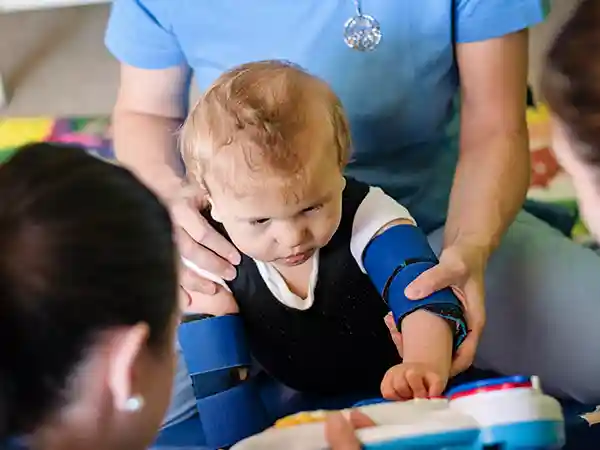
Therapeutic exercises and neurological rehabilitation can significantly enhance a child’s motor skills, communication, and overall development. By starting interventions at a young age, families can help their children achieve important developmental milestones and improve their quality of life. These early efforts often work hand in hand with physical therapy techniques tailored to a child’s stage of growth.
Importance of early diagnosis
The diagnostic tools now allow this far earlier than most families are told. Cerebral palsy was historically identified between 12 and 24 months; it can now be diagnosed before 6 months corrected age using term-age MRI at 86% to 89% sensitivity, the Prechtl General Movements Assessment at around 98%, and the Hammersmith Infant Neurological Examination at around 90%. The constraint is usually referral rather than technology. Our page on the benefits of early diagnosis covers what that buys.
Steps in early intervention programs
In the United States these services are federally funded under Part C of the Individuals with Disabilities Education Act for children under three, regardless of family income, and families can self-refer without a physician order. A team of physical, occupational and speech therapists works to an Individualized Family Service Plan, usually at home or at daycare rather than in a clinic. The parent training built into those visits does more of the work than the visits themselves, since an hour of therapy a week is an hour and the other 167 belong to the family.
Physical therapy for cerebral palsy
Physical therapy has moved away from general motor work toward training aimed at specific goals the family chose, and the evidence favors that shift. Goal-directed training and task-specific training both appear among the interventions with demonstrated effect; open-ended exercise does not.
Expectations are worth setting against real data. Longitudinal work following 657 children through 3,455 assessments to age 21 found no average decline in gross motor function at GMFCS levels I and II, while levels III, IV and V peaked around age seven and then lost ground, by 4.7, 7.8 and 6.4 GMFM-66 points respectively. Therapy is doing different work at different levels: building function at one end, defending it at the other.
Therapeutic exercises for motor skills
Therapeutic exercises tailored to enhance motor skill development are fundamental in physical therapy for cerebral palsy. They are designed to improve balance, coordination, and posture:
Stretching to maintain range of motion
Strengthening to build muscle control
Functional training for everyday movements
Balance and posture work to support mobility
By focusing on these areas, children can develop better control over their movements and enjoy a more active lifestyle.
Managing muscle tone through therapy
Tone management runs alongside the medical options rather than instead of them. Serial casting appears on the evidence list, as does botulinum toxin combined with casting and botulinum toxin combined with occupational therapy, which outperform the injection used alone. The point of reducing tone is to create a window in which therapy can achieve something, so the two are scheduled together rather than sequentially.
Therapies work best together
No single therapy does it all. Pairing physical therapy with occupational therapy and other treatment options consistently produces better functional outcomes than any one approach on its own.
Occupational therapy for cerebral palsy
Occupational therapy targets the skills that decide how much of adult life a person manages alone: dressing, feeding, writing, using a phone. Bimanual training and constraint-induced movement therapy, both on the evidence list, are the two named approaches for building use of an affected hand.
By incorporating assistive technology, therapists help children manage daily tasks more effectively. The Cerebral Palsy Center offers guidance on selecting the right occupational therapy strategies to match individual needs and achieve the best possible outcomes.
Enhancing daily living skills
Constraint-induced movement therapy was developed for adult stroke and adapted for children with hemiplegic cerebral palsy: the stronger hand is restrained so the affected one has to work. Bimanual training takes the opposite approach, using tasks that require both hands together. Both have support, and which one fits depends on the child rather than on the clinic’s preference.
Tools and techniques for independence
To facilitate independence, occupational therapists often introduce tools and techniques such as adaptive equipment for cerebral palsy. This may include specially designed utensils, writing aids, or communication devices. These tools are tailored to meet the unique needs of each child, promoting greater autonomy. Through pediatric therapy, children learn to use these tools effectively, significantly enhancing their ability to perform everyday tasks.
Assistive technology for cerebral palsy
Assistive technology for cerebral palsy encompasses a wide range of devices designed to support communication, mobility, and daily activities. These tools are an integral part of individualized treatment plans for cerebral palsy, aiming to improve quality of life and increase independence.
Whether through high-tech communication devices or simple adaptive equipment, assistive technology offers innovative solutions to overcome the challenges faced by individuals with cerebral palsy. Many families pair these devices with hands-on physical therapy techniques so that gains in the clinic carry over into everyday life.
Types of assistive devices available
Equipment spans mobility, communication and access. Powered and manual wheelchairs, walkers and standing frames on the mobility side, where pressure care also belongs, since seating that prevents a pressure injury is doing medical work rather than convenience work. On the communication side, everything from a laminated symbol board to an eye-gaze system, covered on our page about communication devices. And on the access side, switches, mounts and the accessibility features now built into ordinary phones and laptops.
Incorporating technology into daily life
Whether equipment gets used comes down to unglamorous details: whether it is positioned consistently, whether the people around the child know how to operate it, and whether it still fits after a growth spurt. A device that is right on paper and wrong on the mount is a device that sits in a cupboard. Reviewing fit at least annually catches that before it becomes abandonment.
Questions about your child’s therapy plan?
Building the right mix of therapies and assistive devices is rarely straightforward, and the cost of long-term care adds up quickly. Our nurse advocates can help you understand the options and connect you with the right specialists. Get a free, confidential consultation, no cost, no commitment.
Frequently asked questions about non-surgical interventions
Everything that improves function without an operation: physical therapy, occupational therapy, speech therapy, orthotics and casting, assistive technology, and the medications used to manage tone and seizures. A 2019 evidence review naming the interventions with demonstrated effect listed goal-directed training, bimanual training, constraint-induced movement therapy, task-specific and strength training, treadmill training, casting, hippotherapy and home programs among them.
By building and defending the functions that everything else depends on. Joint range and muscle length prevent the contractures and hip displacement that end in pain and lost mobility. Trunk strength and chest mobility feed cough strength, which feeds pneumonia risk. And goal-directed training aimed at a specific outcome the family chose outperforms general exercise on both motivation and measured progress.
Because they are less invasive, reversible, and in many cases sufficient. They are also not an alternative to surgery so much as the thing that makes surgery work: an operation corrects a structure, and therapy is what converts that correction into function. Where surgery is indicated, skipping the therapy around it wastes the operation.
As soon after diagnosis as possible, and diagnosis can now happen before 6 months corrected age. Neuroplasticity peaks in the first three years, so the same therapy delivered at eighteen months and at six years produces different results. Services for children under three are federally funded under Part C of IDEA regardless of income, and families can self-refer.
It builds the daily-living skills that determine independence: dressing, feeding, grooming, handwriting, using a device. For a child with one affected side, the two named approaches with evidence behind them are constraint-induced movement therapy, which restrains the stronger hand, and bimanual training, which uses tasks needing both. Occupational therapists also specify and fit the adaptive equipment.
They answer different questions rather than competing. Therapy improves function and prevents complications; surgery corrects a structural problem that therapy cannot reach, such as a dislocating hip or a spine curve compressing the lungs. Most children need both at different points, and therapy is what determines whether a surgical correction translates into anything useful.
They convert a limitation into a workaround. A powered wheelchair turns a child who cannot walk into a child who can cross a playground unaided. A communication device gives access to intelligence that is often entirely typical, since about half of people with cerebral palsy have normal intelligence. Specialized seating prevents pressure injuries. The gains are practical rather than incremental.