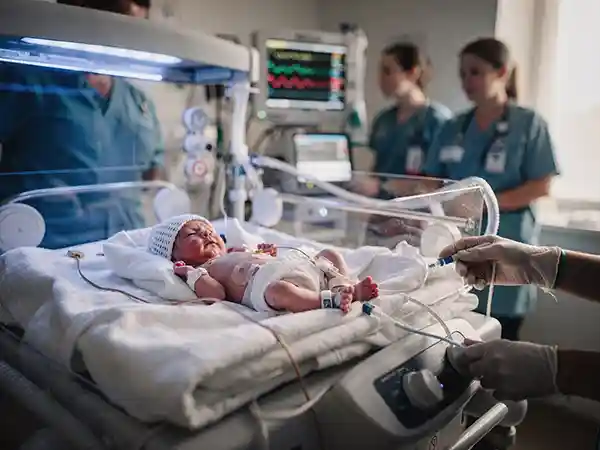
Hypoxic-ischemic encephalopathy (HIE) is one of the most consequential preventable causes of cerebral palsy. The window for limiting the damage is narrow: about 6 hours from birth to start therapeutic cooling. Knowing what HIE looks like, how it’s graded, and what should happen next is essential for any family whose delivery raised oxygen-related concerns.
Term newborns affected by HIE annually in the U.S.
6 hours
Window to begin therapeutic cooling after HIE
72 hours
Standard duration of therapeutic hypothermia treatment
When parents are told their baby experienced “lack of oxygen at birth,” they’re usually being introduced to one of the most consequential clinical conditions in newborn care: hypoxic-ischemic encephalopathy, or HIE. HIE is a leading cause of cerebral palsy, and unlike most CP causes, it has a defined treatment window, about 6 hours from birth to start cooling. Whether that window was met often determines both medical outcomes and, in some cases, legal consequences.
This guide covers what oxygen deprivation actually does to the developing brain, how HIE is identified and graded, what therapeutic hypothermia (cooling) involves, and what families can expect afterward. For broader context on perinatal events, see birth complications leading to cerebral palsy; for the biology of how brain injury produces CP, see brain injury as a cause of cerebral palsy.
The brain consumes oxygen at a rate disproportionate to its size. When the supply drops (even briefly), the most metabolically demanding regions begin to fail first. Those happen to be the regions that control movement.
The link between oxygen deprivation and CP is one of the most direct in medicine. The brain’s energy needs are constant, and when blood flow or oxygen content falls, cells in the most active regions can’t make enough ATP to maintain themselves. Within minutes, cellular damage begins; within longer windows, the damage becomes permanent. Different brain regions tolerate this stress differently, which is why specific CP patterns emerge from oxygen deprivation events.
Understanding neonatal brain injury
Neonatal brain injury from oxygen deprivation affects predictable regions rather than the brain evenly.
Oxygen deprivation does not damage the brain evenly. The basal ganglia and thalamus, being the most metabolically active deep structures, go first, and damage there produces the involuntary movements of dyskinetic cerebral palsy. The watershed zones of the motor cortex, where major blood supply territories meet, are most vulnerable to a drop in blood pressure. The hippocampus is memory-related and affects cognition long term. And in severe cases the brainstem is involved, which reaches breathing, swallowing and basic reflexes.
The pattern of damage on MRI correlates closely with the type and severity of oxygen deprivation. A “deep gray matter” pattern (basal ganglia and thalamus) suggests brief but severe deprivation; a “watershed” pattern suggests prolonged but less severe deprivation; mixed patterns suggest both.
How birth complications lead to oxygen deprivation
A handful of complications produce most perinatal oxygen deprivation.
Seven events account for most acute oxygen deprivation at birth. Cord prolapse or compression, where the baby’s only oxygen supply gets kinked or squeezed. Placental abruption, where the placenta detaches before delivery and cuts off supply suddenly. Uterine rupture, rare and catastrophic, where oxygen collapses within minutes. Prolonged or obstructed labor, particularly a long second stage. Shoulder dystocia, where the shoulders lodge after the head delivers. Maternal hemorrhage or shock, which drops the pressure the placenta needs to work. And maternal cardiac or respiratory arrest, which stops fetal oxygen immediately.
The standard of care during labor includes continuous fetal heart rate monitoring specifically to catch these complications early. Failure to recognize and respond to abnormal heart rate patterns is one of the most common claims in HIE-related malpractice cases.
Birth asphyxia and cerebral palsy
“Birth asphyxia” is the clinical term for severe oxygen deprivation at birth. When asphyxia is severe enough to produce identifiable brain dysfunction, it’s called HIE. The progression from asphyxia to HIE to CP is what drives both treatment urgency and long-term outcomes.
Not every baby who experiences a brief drop in oxygen develops HIE, and not every baby with HIE develops CP. The clinical question is always: how severe was the deprivation, and how is the baby responding now? That’s answered through specific physical findings, lab values, and imaging in the hours after birth.
The role of perinatal asphyxia
No single finding establishes asphyxia; several together do.
Five findings establish that significant deprivation occurred. Apgar scores at one, five and ten minutes, where persistently low scores at five and ten, generally under five to seven, carry the weight rather than the one-minute reading. A need for resuscitation, particularly chest compressions or epinephrine. Cord blood gas abnormalities, specifically severe metabolic acidosis with a pH below 7.0 and a base deficit greater than 12 to 16. Encephalopathy within the first hours, meaning abnormal consciousness, tone, reflexes or seizures. And multi-organ dysfunction, since asphyxia reaches the kidneys, liver and heart as well as the brain.
Hospitals have specific protocols for identifying babies who meet criteria for therapeutic hypothermia (cooling) within the 6-hour window. The timeline matters because cooling started later doesn’t produce the same benefit.
Impact of infant hypoxia on development
The long-term consequences of significant infant hypoxia depend heavily on severity.
Outcome tracks severity closely. Most babies with mild hypoxic-ischemic encephalopathy recover fully with normal long-term neurological outcomes. In moderate cases, roughly 30% to 50% develop some long-term disability without cooling, and cooling reduces that rate substantially. In severe cases most children have significant long-term consequences even with optimal treatment, including cerebral palsy, intellectual disability and epilepsy.
Severity is graded using the Sarnat classification (mild, moderate, severe), based on neurological exam findings in the first 24 hours. The grade guides treatment decisions and predicts outcomes.
What therapeutic hypothermia involves
Cooling treatment requires specialized NICU capability and follows a strict protocol.
Therapeutic hypothermia runs to a strict protocol: started within six hours of birth, body temperature held at about 33.5 degrees Celsius for 72 hours, continuous EEG and physiological monitoring throughout, then slow controlled rewarming over six to twelve hours. Pooled across 11 randomized trials of 1,505 term and late preterm infants, cooling reduced death or major neurodevelopmental disability at 18 months with a relative risk of 0.75 and a number needed to treat of 7. The six-hour window is why a missed diagnosis at delivery matters so much.
Why cooling works
HIE damages the brain in two phases. The primary injury happens during the oxygen deprivation itself. But a secondary phase of damage unfolds over hours afterward, driven by inflammation, oxidative stress, and abnormal cell signaling. Therapeutic hypothermia interrupts this secondary cascade by slowing down the brain’s metabolism and inflammation. The result: less of the secondary damage that would otherwise compound the initial injury. The 6-hour window matters because that’s when the secondary cascade is starting; cooling later doesn’t catch enough of it to make a difference.
Hypoxic-ischemic encephalopathy (HIE)
HIE is the diagnosis given when oxygen deprivation has been severe enough to produce identifiable brain dysfunction. The diagnosis triggers specific protocols and decisions, and it’s the clinical entity at the center of most modern birth-asphyxia care.
Diagnosing HIE in the first hours of life is one of the highest-stakes clinical judgments in newborn care. Every hour of delay in starting cooling reduces the treatment’s benefit. Every hour of inappropriate cooling exposes a baby unnecessarily to the side effects. Getting this right requires experienced NICU teams, specific protocols, and rapid imaging when possible.
Diagnosis of hypoxic-ischemic encephalopathy
HIE diagnosis in the first hours of life rests on several elements at once.
Six tools establish severity and predict outcome. Sarnat staging grades the encephalopathy as mild, moderate or severe on a standardized neurological exam. Cord blood gas values, where a pH below 7.0 with a base deficit above 12 to 16 is among the strongest indicators. Apgar scores at five and ten minutes. The extent of resuscitation required at delivery. Continuous EEG, sometimes amplitude-integrated, which detects subclinical seizures. And brain MRI, usually on day four to seven after rewarming, where the injury pattern both confirms the diagnosis and predicts outcome.
Babies with moderate or severe HIE who are at least 36 weeks gestation and within 6 hours of birth are candidates for therapeutic hypothermia. The decision to cool isn’t always straightforward in borderline cases, but the standard of care is to err on the side of treatment when criteria are met.
Link between HIE and motor disorders
The relationship between severity and cerebral palsy is well established.
By stage: mild encephalopathy usually carries no long-term consequence and minimal cerebral palsy risk. Moderate encephalopathy without cooling produces cerebral palsy, intellectual disability or epilepsy in roughly 30% to 50% of cases, and cooling lowers that considerably. Severe encephalopathy leaves most surviving children with significant disability even when cooling is delivered correctly.
The CP that develops after HIE is often spastic quadriplegic (when the watershed zones are most affected) or dyskinetic (when basal ganglia damage predominates). The pattern on MRI helps clinicians anticipate the type and guide therapy planning.
Was the 6-hour cooling window missed?
Failure to identify HIE in time to start therapeutic hypothermia is a recognized cause of preventable severe disability. Common breakdowns: failure to recognize fetal distress, delayed cesarean, inadequate newborn assessment, missed cooling-eligibility criteria, or transfer delays to a cooling-capable hospital. If your child had HIE and was not cooled (or cooling started too late), a medical malpractice review may be warranted. Request a free case review.
Treatment for cerebral palsy after HIE
Once HIE-related CP is established, treatment focuses on therapy and supports that maximize function. Because HIE often produces specific patterns of injury, therapy can be tailored to the patterns: building strength where weakness is greatest, managing tone where it’s most disruptive, and supporting the cognitive areas often affected.
The therapy approach for CP from HIE is similar to CP from other causes, but a few patterns are common enough to call out. Many children with HIE-related CP have feeding issues alongside motor problems, often requiring early speech therapy involvement. Seizures are more common after HIE than after other causes, so antiepileptic management is often part of the care plan. Cognitive effects often co-exist with motor effects, requiring developmental support.
Pediatric neurology interventions
Several specialists are usually involved.
Follow-up spans five specialties. A pediatric neurologist coordinates seizure management, MRI follow-up and neurodevelopmental concerns. A pediatric physiatrist oversees rehabilitation and tone management with medication, botulinum toxin or a baclofen pump. A pediatric orthopedist runs hip surveillance, manages contractures and operates when indicated. A developmental pediatrician coordinates assessment and early-intervention referral. And ophthalmology and audiology monitor vision and hearing, both of which are commonly affected after hypoxic-ischemic encephalopathy.
Many academic medical centers run dedicated HIE follow-up clinics that coordinate this care across specialties. If your child had HIE, ask whether such a clinic is available in your region.
Therapies for managing developmental delays
The therapies that build function are the same ones used across cerebral palsy.
Physical therapy covers gross motor skills and is the foundation of care. Occupational therapy handles fine motor, self-care and sensory regulation, which matters particularly where there is cognitive involvement. Speech therapy is especially valuable where feeding or oral motor weakness is present, as it commonly is after basal ganglia injury. Augmentative and alternative communication opens a route where speech does not develop typically. Vision and hearing services adapt the environment where impairment is found. And special education services come through an Individualized Family Service Plan or an Individualized Education Program.
Early intervention (ideally starting in the first few months) has the largest impact. The brain’s plasticity is greatest in the first 3 years, when therapy can build alternative circuits that compensate for injured ones. For a fuller picture, see our overview of cerebral palsy treatment.
Trying to make sense of your delivery records?
If your child had HIE and you’re trying to understand whether anything could have been done differently, our nurse advocates can help you read your records and identify questions worth asking. Get a free, confidential evaluation.
Frequently asked questions about birth oxygen deprivation and CP
Cerebral palsy is a movement and posture disorder caused by damage to the developing brain. Lack of oxygen at birth, clinically called birth asphyxia or hypoxic-ischemic encephalopathy (HIE) when severe, is one of the most well-known causes of CP. When a baby’s brain doesn’t get enough oxygen during labor or delivery, the resulting injury can affect motor control areas and produce the lifelong motor problems that define CP.
Brain cells need a constant supply of oxygen to stay alive and function. When that supply is interrupted (from cord compression, placental abruption, prolonged labor, or other complications), cells in the most metabolically active brain regions (motor cortex, basal ganglia, thalamus) start to fail within minutes. The longer the deprivation lasts, the more cells die and the more permanent the resulting damage.
Birth asphyxia is concerning because the developing brain is uniquely vulnerable to oxygen deprivation, and the consequences can be permanent. Even relatively short periods of significant oxygen loss can produce damage, and some of the damage continues to evolve over hours after the initial event, which is why prompt recognition and treatment matter so much.
Some effects appear immediately: low APGAR scores, the need for resuscitation, abnormal cord blood gases, seizures within hours of birth, and abnormal muscle tone. Other effects unfold over weeks and months, with motor delays, abnormal movement patterns, and missed milestones. Some children show very few signs at first and only later get a CP diagnosis as motor concerns become clearer.
The long-term effects depend heavily on the severity and duration of the oxygen deprivation. Mild HIE may produce no lasting effects. Moderate HIE often results in some degree of CP, learning differences, or seizures. Severe HIE can produce profound disability or, in the most severe cases, infant death. Therapeutic hypothermia (cooling) within 6 hours of birth significantly improves outcomes when started in time.
There’s no cure for the underlying brain injury, but treatment focuses on therapy and support to maximize a child’s function and quality of life. Physical, occupational, and speech therapy build motor and communication skills. Medications help manage spasticity and seizures. Surgery can address contractures or hip subluxation. Most importantly, early intervention (ideally starting in the first months of life) produces the best long-term outcomes.