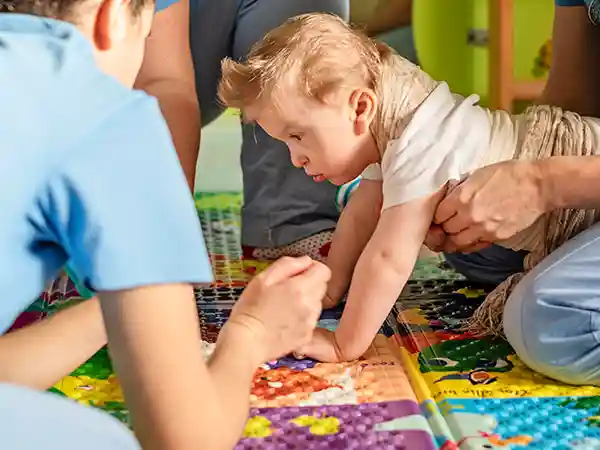
Occupational therapy assessments for cerebral palsy come in two kinds: classifications such as the five level Manual Ability Classification System (MACS), which describes how a child aged 4 to 18 handles objects day to day, and tests such as the Assisting Hand Assessment, which scores hand use from 0 to 100 so it can be measured again after therapy. Most evaluations add a goal measure, the COPM or GAS, built around up to five activities the family picks.
No evaluation uses all of them. The therapist chooses according to the child’s age, whether one side of the body or both are affected, and what the family wants to change. For what therapy itself involves, start with our guide to occupational therapy for cerebral palsy.
MACS is a classification, not a test. Nobody times anything or hands over a kit; the level comes from someone who knows how the child handles objects in ordinary life.
The system was published in 2006 by Ann-Christin Eliasson and colleagues in Stockholm. It rates how the two hands work together on everyday objects, and it rates the child’s typical performance rather than their best effort on a good day. In the validation study of 168 children aged 4 to 18, two therapists rating the same child agreed with an intraclass correlation of 0.97, and parents agreed with therapists at 0.96. In plain terms, a parent can place their own child about as reliably as a professional can. The Cerebral Palsy Alliance summarizes the five levels this way:
MACS level
How the child handles objects
Level I
Handles objects easily and successfully.
Level II
Handles most objects, with some reduced quality or speed.
Level III
Handles objects with difficulty and needs help to prepare or modify activities.
Level IV
Handles a limited selection of easily managed objects and always needs some help.
Level V
Does not handle objects and cannot complete even simple actions.
Younger children get the Mini-MACS, which keeps the first sentence of each level and rewrites the rest for toddlers. Its 2017 study covered 61 children aged 12 to 51 months, and parent and therapist ratings agreed at 0.90. Babies at risk of CP can be seen even earlier with the Hand Assessment for Infants, built for ages 3 to 12 months, where a score more than 2 standard deviations below the mean for the baby’s age signals atypical hand use. That can happen alongside the diagnostic workup rather than after it.
MACS does for the hands what the GMFCS does for walking and sitting, and a child often has one level on each. Our page on CP severity levels explains the GMFCS side. Five broad bands are too coarse to show a few months of progress, which is why the tests further down this page exist.
COPM and GAS: measuring the goals your family picks
Both tools start with a conversation instead of a box of toys. The family names up to five activities that matter, and the scores follow those activities and nothing else.
The Canadian Occupational Performance Measure was developed by Mary Law and five co-authors, and its publisher reports that it is used in more than 50 countries and over 40 languages. It is a semi-structured interview. According to the Cerebral Palsy Alliance, the therapist helps the family pick up to five daily activities, then the family rates each one twice on a 10 point scale: once for how well the child does it and once for how satisfied they are with that. It takes 20 to 40 minutes. For children under 8, and for older children with communication difficulties or intellectual disability, a family member often gives the answers. The interview is repeated after a block of therapy and the ratings are compared.
Goal Attainment Scaling began in 1968 as a way to evaluate community mental health programs. Each goal gets its own five point ladder, written before therapy starts. The child’s current level is usually scored minus 2, the expected result after therapy is 0, partial progress is minus 1, and plus 1 and plus 2 mean better than expected. A goal like buttoning a school shirt might run from “cannot start the top button” at minus 2 to “does all buttons in under two minutes” at plus 2. The Cerebral Palsy Alliance puts the setup at 20 to 40 minutes.
The two are not interchangeable. A 2006 Australian trial gave both to 41 children with hemiplegic CP, mean age 3.9, and found that each detected change and that they measured different things; the COPM was quicker to learn and to run. A 2007 review judged GAS responsive to change but found its reliability with children too little studied to settle. Goals matter for a reason beyond paperwork. The 2019 State of the Evidence review by Iona Novak and colleagues listed goal-directed training among the effective allied health interventions for CP, and our page on what OT changes for children with CP covers that evidence.
Write your goals down before the appointment
The COPM and GAS only measure what the family names, so vague goals give vague scores. “Better hand use” cannot be rated. “Opens the lunchbox at school without help” can. Bring a list of the five tasks that cause the most trouble in a normal week, ranked, with a note on who currently helps.
Hand function tests: AHA, Melbourne 2, QUEST and Box and Block
These are the standardized tests that produce a score an OT can compare before and after therapy. Which one your child gets depends mostly on whether one hand or both are affected.
Assisting Hand Assessment (AHA)
The AHA is built for children with one sided CP or brachial plexus palsy, and it asks a narrow question: how well does the affected hand help the other one during two handed play. The child spends 10 to 15 minutes playing with a set kit of toys that need both hands. The session is filmed, and the therapist scores it afterward on 20 items, each rated on a four point scale, which convert to a result between 0 and 100 AHA units. The current version covers ages 18 months to 18 years. Certification takes a two and a half day course plus six scored practice cases.
Because the child is simply playing, the score reflects what the hand does on its own, without being asked. That is exactly what constraint therapy and bimanual training try to change, which is why the AHA appears in so many trials of them. See fine motor skills in cerebral palsy for those therapies.
Melbourne Assessment 2
The Melbourne tests each arm on its own. The revised version described in a 2014 analysis of 163 children has 14 tasks and 30 movement scores across four subscales: range of movement, accuracy, dexterity and fluency. It is valid for children aged 2 years 6 months to 15 years. A 2019 reliability study of 30 children found the subscales scored consistently between raters and between sessions, with intraclass correlations of 0.90 to 1.00. A 2022 review of 12 systematic reviews, named the AHA, the Melbourne Assessment and the ABILHAND-Kids parent questionnaire as the most suitable choices for children aged 6 to 12 with unilateral CP.
QUEST
The Quality of Upper Extremity Skills Test has 36 items in four domains: dissociated movement, grasp, weight bearing and protective extension, the reflex of putting the arms out to catch a fall. It takes 30 to 45 minutes. It was originally validated for children 18 months to 8 years, and a 2012 study showed reliable scoring up to age 12. A second paper by the same team, a construct validity study of 94 children, advised against using the QUEST total score and recommended reporting each domain and each arm separately. If a report gives your child one QUEST number, ask for the domain scores.
What happens on assessment day
Most of it looks like play:
A parent interview for MACS, the COPM or GAS, often done first
A filmed play session with a toy kit if the AHA is used
Set reaching and grasping tasks for the Melbourne 2 or QUEST
A one minute block transfer for the Box and Block Test
A parent questionnaire such as the PEDI-CAT, sometimes sent home
Box and Block Test
The quickest test on this page. The child moves as many of 150 wooden 2.5 cm cubes as possible, one at a time, over a partition in 60 seconds, and the score is the number carried across. Each hand is tested separately, in 2 to 5 minutes. Norms for ages 6 to 19 were published by Mathiowetz and colleagues in 1985; typically developing 6 year olds move around 44 to 49 blocks. In that 2022 study of 162 children aged 6 to 13 with bilateral CP, block scores tracked PEDI self-care scores closely (r = 0.8). A 2019 study found the test reliable over short gaps of about two weeks but weak over gaps of about four months, so a long-term comparison should be read against age norms.
PEDI-CAT: what your child does across the whole day
The hand tests show what a child can do at a table in a clinic. The PEDI-CAT asks what they actually do at home, and it is usually answered by a parent.
The Pediatric Evaluation of Disability Inventory Computer Adaptive Test covers birth through 20 years in four domains: daily activities, mobility, social and cognitive, and responsibility. It runs on a tablet or computer and picks each question from the last answer, so parents answer fewer items. A clinician or teacher who knows the child can complete it instead of a parent. The 2011 development study drew on 2,205 parents of typically developing children and 703 parents of children with disabilities, and scores from short versions agreed with the full item banks at 0.95 or better. The daily activities domain is where dressing, eating and hygiene show up, which our page on self-care skills in cerebral palsy covers in detail.
Which assessment fits which child
Age and the side of the body affected narrow the list quickly. This table uses the age ranges from each instrument’s published studies or manual.
Instrument
What it measures
Ages
Who completes it
Mini-MACS
Everyday hand use, 5 levels
1 to 4 years
Parent or therapist who knows the child
MACS
Everyday hand use, 5 levels
4 to 18 years
Parent or therapist who knows the child
COPM
Family rated performance and satisfaction on chosen tasks
All ages
OT interview; family answers for under 8s
GAS
Progress on up to 5 written goals
All ages
Therapist with the family
AHA
How the affected hand helps in two handed play
18 months to 18 years
Certified rater, from video
Melbourne 2
Movement quality of each arm
2.5 to 15 years
Therapist
QUEST
Movement quality in 4 domains
18 months to 8 years (reliable to 12)
Therapist
Box and Block
Speed of gross hand dexterity
Norms 6 to 19 years
Therapist, no special training
PEDI-CAT
Daily activities, mobility, social skills, responsibility
Birth to 20 years
Parent, or a clinician or teacher
Children with CP on both sides of the body are less well served. A 2019 systematic review of upper limb measures for 5 to 18 year olds with bilateral CP found 48 candidates, and only eight met its standards for reliability and validity. It named the Both Hands Assessment (BoHA) as the best observational test and the ACTIVLIM-CP parent questionnaire as the best report measure. If your child has bilateral CP and the report shows only the AHA, ask why.
Reading your child’s OT assessment report
A number in a report means little until you know which kind of number it is. There are three kinds, and they behave differently.
Levels, such as MACS, describe where a child sits and are not built to show short term change. Goal ratings, such as the COPM and GAS, belong to your child alone, so a COPM score of 6 cannot be compared with another child’s 6. Test scores, such as AHA units, Melbourne percentages or blocks per minute, can be compared over time, and some can be compared with age norms. Each test also has a margin of error. In a 2008 study of 21 children with hemiplegic CP, the smallest change that could be told apart from scoring noise was 8.9% on the Melbourne Assessment and 13.8% on the QUEST for the affected side. A 5% gain on the QUEST sits inside that margin.
Even the COPM’s familiar 2 point rule is softer than it looks. A 2025 systematic review found only four studies that calculated the minimal important change, with values from 0.20 to 3.20 points for performance, and the official COPM site now says a single fixed threshold is not considered plausible. Ask the therapist which result they expect to move, and by how much, before therapy starts. Keep every report. Physical therapists run their own measures of sitting and walking, covered on our physical therapy page, and a school team planning support may ask to see the OT findings too.
Frequently asked questions about OT assessments
Common instruments in an OT report include the Manual Ability Classification System (MACS) for everyday hand use from age 4 to 18, the Canadian Occupational Performance Measure (COPM) and Goal Attainment Scaling (GAS) for family goals, the Assisting Hand Assessment for one sided CP, the Melbourne Assessment 2 and QUEST for quality of arm movement, the Box and Block Test for dexterity, and the PEDI-CAT for daily function from birth through age 20.
MACS sorts children with cerebral palsy aged 4 to 18 into five levels by how they handle objects in daily life. At level I a child handles objects easily and successfully; at level V the child cannot handle objects or complete even simple actions. In the 2006 validation study of 168 children, parents and therapists agreed closely (intraclass correlation 0.96).
It depends on which tools the therapist picks. The COPM and GAS each usually take 20 to 40 minutes, the Assisting Hand Assessment play session runs 10 to 15 minutes before it is scored from video, the QUEST takes 30 to 45 minutes, and the Box and Block Test takes 2 to 5 minutes.
Yes, and for several tools the parent is the main source. A MACS level can be given by anyone who knows how the child handles objects day to day, the PEDI-CAT is usually answered by a parent, and for children under 8 the COPM is often completed by family members.
The COPM has traditionally treated a rise of 2 points on its 10 point performance or satisfaction scale as a clinically important change. A 2025 systematic review found published thresholds from 0.20 to 3.20 points for performance, so treat 2 points as a rough guide rather than a pass mark.
For one sided (unilateral) CP, the usual choice is the Assisting Hand Assessment, which rates how well the affected hand helps the other in two handed play, often paired with the Melbourne Assessment 2 for movement quality in each arm. A 2022 review of 12 systematic reviews rated the AHA, the Melbourne Assessment and ABILHAND-Kids the most suitable tools for children aged 6 to 12 with unilateral CP.