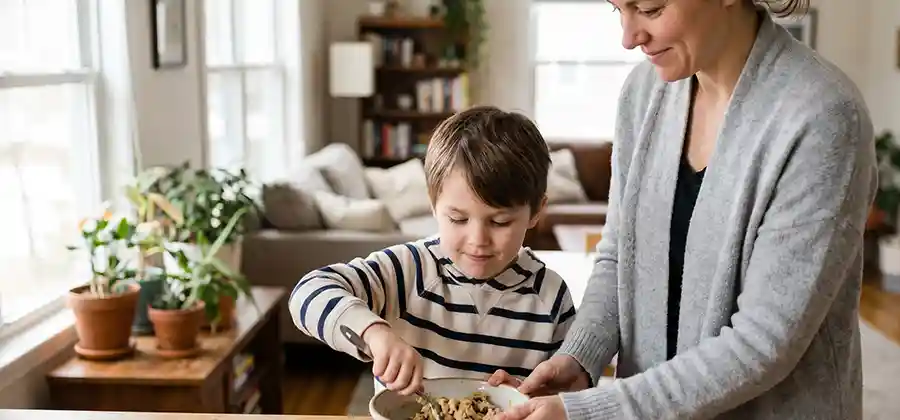
Dressing, bathing, toileting, eating and grooming, and how occupational therapy, practice at home and the right equipment move a child with CP toward doing each one alone.
Of the variation in self-care skills explained by hand function (MACS)
5.4 years
Median age of daytime continence in bilateral CP, vs 2.4 in controls
551 children
Tracked to build self-care growth curves by GMFCS level
Self-care in cerebral palsy means dressing, bathing, toileting, eating and grooming, and the best single predictor of how much a child will do alone is hand function, not walking. In a Swedish study of 195 children, the Manual Ability Classification System (MACS) explained 66% of the variation in self-care skills. Occupational therapy works on these tasks by practicing them whole, in real settings, and adding equipment where practice alone falls short.
This page covers the tasks themselves, one at a time, and the equipment that goes with each. For what occupational therapy is, how often it happens and how Medicaid covers sessions, start with occupational therapy for cerebral palsy. Feeding safety, meaning chewing and swallowing, belongs to the speech-language pathologist, and nutrition has its own page on the cerebral palsy diet.
Two classifications do most of the predicting. MACS describes how a child handles objects in daily life, and the Gross Motor Function Classification System (GMFCS) describes sitting and walking. For self-care, the hands matter more.
MACS has five levels and applies from age 4 to 18; a version called Mini-MACS covers ages 1 to 4, according to CanChild. The Swedish study that tied MACS to self-care followed 195 children aged 3 to 15 and scored them on the Pediatric Evaluation of Disability Inventory (PEDI). Children at MACS levels I and II gained self-care skills steadily with age, and many became independent, later than typically developing children. Children at levels III to V made minimal progress with age. That is not a verdict on a single child. It is a reason to set goals that fit the level, which is where an honest therapist starts. Our page on CP severity levels explains how GMFCS and MACS are assigned.
A larger study built growth curves. Researchers in the Netherlands and Canada tracked 551 children and young people with CP, aged 1 to 21, using 1,754 PEDI assessments. Children at GMFCS level I reached an average self-care ceiling of 91.8 out of 100, meaning most or all of the tasks on the scale. The ceilings dropped at each higher level, ranging from 83.0 down to 23.6 across mobility and self-care for levels II to V. The detail parents should hold on to is the spread: within a single GMFCS level, children varied widely, and more in self-care than in mobility. Learning ability, motivation and practice at home all move the result.
How OT teaches self-care
The child practices the actual task, chosen by the child and family, in the place it normally happens. Putting on a coat is trained by putting on a coat, at the front door, before school.
That approach has formal backing. A 2021 international clinical practice guideline in Developmental Medicine & Child Neurology made 13 recommendations from 30 randomized trials and other evidence. For functional goals it recommends client-chosen goals, whole-task practice within real-life settings, support for families and a team approach. For self-care specifically, it found that whole-task practice combined with assistive devices can increase independence and reduce caregiver burden. The 2020 State of the Evidence review by Novak and colleagues rated goal-directed training and home programs green, its highest rating. Neurodevelopmental therapy in its original passive format and sensory integration were rated red, meaning the evidence says they do not work.
Older children can also be taught to solve the problem themselves. In the Cognitive Orientation to daily Occupational Performance (CO-OP) approach, the child finds their own way to do a task using problem-solving strategies, instead of copying the therapist. A Swedish randomized trial of 38 children aged 7 to 16 found CO-OP beat usual treatment on both the goals that were trained and a goal that was never practiced. The children in that trial had CP at MACS levels I to III or spina bifida, without intellectual disability, so it fits some families and not others.
Writing a self-care goal that works
Name one task, one setting and one measure. “Puts on her own jacket and closes the zipper before school, with no more than one prompt, 4 mornings out of 5” can be practiced and checked. “Become more independent” cannot. One way therapists rate goals like this is the Canadian Occupational Performance Measure, among the tools covered on OT assessments for cerebral palsy.
Therapy sessions alone rarely carry the dose. The practice happens at breakfast and bath time, which is why the therapist should leave you with a short written routine. Our guide to occupational therapy at home covers how to set one up and track it.
Dressing and grooming
Dressing combines balance, two-handed coordination and a sequence of steps, and a child can fail at any of the three. The therapist’s first job is working out which one is breaking down.
Balance comes first. A child who needs a hand to stay upright has only one hand left for the sock. Sitting on the floor against a wall, on a low bench with feet flat, or in a corner chair frees both hands, and often solves more than any gadget. For a child with unilateral CP, dressing the affected arm or leg first and undressing it last lets the stronger hand do the pulling.
Clothing does a lot of the work. Pull-on waistbands, a size up for tops, front-opening shirts, magnetic or hook and loop closures in place of small buttons, and elastic no-tie laces remove the steps that need fine finger control. Tools fill the rest: a button hook, a loop or ring on a zipper pull, a sock aid, and a long-handled shoehorn. Grooming follows the same logic. A built-up foam handle on a toothbrush or hairbrush widens the grip; an electric toothbrush does the brushing motion; a suction-base nail brush holds still for a one-handed user.
Where self-care practice fits in a day
The routines already happening are the practice slots:
Morning dressing, with one step handed over to the child each week
Breakfast, with the utensil and plate the therapist chose
Tooth brushing twice a day, the easiest daily repetition there is
Bath time, seated safely, washing one body part alone
Undressing at night, which is usually easier than dressing
Eating and using utensils
The occupational therapist handles getting food from the plate to the mouth. Whether it is safe to chew and swallow is a question for the speech-language pathologist, and many children need both.
Positioning matters as much at the table as in dressing: hips back in the seat, feet supported, and the table at elbow height. From there the equipment is cheap. Built-up or weighted handles steady a shaky grip. Angled or bendable spoons reach the mouth without a twist of the wrist the child cannot make. A scoop plate or plate guard gives the food a wall to push against, a non-slip mat keeps the bowl from sliding, and a cup with a cut-out rim lets the child drink without tipping the head back.
Choking, coughing at meals, long mealtimes or weight loss call for a swallowing assessment before any work on independence. Our speech therapy page covers who does that assessment, and the diet page covers what goes on the plate.
Bathing and toileting
These are the tasks where safety and dignity count most, and where equipment makes the biggest difference to the adult doing the lifting. Toilet training in CP usually comes later than in other children, and sometimes does not come at all.
For bathing, the aim is a child who is supported enough to use both hands. Bath seats and supportive bath chairs hold a child who cannot sit alone; a handheld shower head lets a seated child rinse; grab bars and a non-slip mat reduce falls; a long-handled sponge reaches feet and back. Transfer benches let an older child slide in rather than be lifted.
Continence depends heavily on motor level and learning ability. A Dutch study of 601 children and teenagers with CP found that 23.5% had never achieved bladder control. By age 6, 80% of those with spastic hemiplegia or diplegia had gained urinary continence, compared with 54% of those with spastic tetraplegia and 38% of those with low intellectual capacity. A UK population study of 346 children with bilateral CP put the median age of daytime bladder and bowel control at 5.4 years, against 2.4 years in controls. The encouraging figure in the same study: at least 88% of children at GMFCS I or II with no more than mild learning impairment were continent day and night. The authors add that when a child does not reach the expected level, it should be investigated, because neurogenic bladder and bowel problems occur at every GMFCS level.
The OT’s part is the physical setup. A reducer ring or supportive toilet seat with sides, a footstool so the feet are planted, a grab bar for standing, and clothing the child can manage quickly. A regular toileting schedule gives the practice a structure.
Most self-care items are inexpensive: foam tubing for handles, a scoop plate, elastic laces. The expensive ones are bath chairs, toileting systems and transfer equipment. For children enrolled in Medicaid, the EPSDT benefit covers children under 21 and requires states to provide medically necessary services needed to correct or ameliorate a condition. The request usually rests on the occupational therapist’s letter, so it should name the task, the safety risk without the item and what the child can do with it. Our pages on assistive devices for CP and disability benefits cover the larger equipment and the funding routes outside Medicaid.
Try before buying the big items. A bath chair that does not fit the family’s tub, or a toilet seat that the child fights, ends up in the garage. Ask the therapist to bring a loaner or arrange a vendor trial at home.
Frequently asked questions about self-care in CP
They are the activities of daily living: dressing, bathing, toileting, eating with utensils and grooming, such as brushing teeth and hair. Occupational therapists work on them because they decide how much of an ordinary day a child manages without an adult’s hands.
Hand function predicts it better than walking does. In a Swedish study of 195 children, the Manual Ability Classification System explained 66% of the variation in self-care skills. Children at MACS levels I and II often reached independence, though later than other children. Children at levels III to V made minimal progress with age, so their goals usually center on partial independence and equipment.
Later than other children, and it depends on motor level and learning ability. In a UK population study of 346 children with bilateral CP, the median age for daytime bladder and bowel control was 5.4 years, against 2.4 years in controls. At least 88% of those at GMFCS I or II with no more than mild learning impairment were continent day and night.
The child picks a goal, such as putting on a coat, and practices the whole task in a real setting rather than drilling isolated movements. A 2021 international guideline recommends exactly this: client-chosen goals, whole-task practice in real-life settings, family support and a team approach. The therapist adds equipment or changes the setup where practice alone will not close the gap.
It depends on which part of the task breaks down. Built-up or angled utensils and non-slip mats help at meals; elastic laces, zipper pulls and loose clothing help with dressing; bath seats, handheld showers and supportive toilet seats help with hygiene. The 2021 guideline found that whole-task practice combined with assistive devices can increase independence and reduce caregiver burden.
Often, for children under 21. Medicaid’s EPSDT benefit requires states to cover medically necessary services needed to correct or ameliorate a child’s condition. The occupational therapist’s written justification is what an approval turns on, so ask for one that ties each item to a specific self-care task the child cannot do safely without it.