Occupational therapy activities for cerebral palsy
The activities that move hand use and independence in children with CP are real tasks the child picked, practiced often and in the place they happen. Here is what that looks like at each age and level of hand ability.
Of CIMT or bimanual training gave similar hand gains in a 42 child trial
16.5 min
Average home program session, about 17.5 times a month, in a 2009 trial
14%
Of 398 CP intervention outcomes rated a green light “do it” in 2019
The occupational therapy activities with the best evidence in cerebral palsy are practice of real tasks the child chose: buttoning a coat, opening a lunchbox, steadying paper while drawing. A 2022 international guideline informed by 30 randomized trials recommends exactly that: whole-task practice in real-life settings, delivered through bimanual therapy, constraint-induced movement therapy (CIMT) or goal-directed training.
That changes how an activity list should be read. A bead-stringing game earns its place when a child who wants to thread laces on school shoes practices the same two-handed pattern, many times, with a therapist grading the difficulty. For what OT is and how sessions are scheduled, start with our overview of occupational therapy for cerebral palsy.
An OT asks what your child wants to do first and picks the activity second. The research on CP treats that order as part of the treatment, not a courtesy.
The 2022 guideline from Jackman and colleagues, published in Developmental Medicine & Child Neurology, made 13 recommendations for improving physical function. The common thread was client-chosen goals, whole-task practice, support for families and a team approach. Goal-directed training, which is practice organized around those chosen goals, is one of the interventions the 2019 State of the Evidence review rated a green light, alongside CIMT and bimanual training.
In practice the goal is written in plain words and made measurable. “Put on a jacket with a zipper in under two minutes” is a goal. “Improve fine motor skills” is not. Trials in this field score progress with the Goal Attainment Scale or the Canadian Occupational Performance Measure, and our page on occupational therapy assessments for cerebral palsy explains those tools. Once the goal is set, every activity below is a way to practice part or all of it.
Hand use activities for one-sided (unilateral) CP
For hemiplegia, two formats have the strongest trials: CIMT, which restrains the stronger hand, and bimanual training, which makes both hands work together. Both run on many hours of play.
In a randomized trial led by Andrew Gordon at Columbia University, 42 children with hemiplegic CP aged 3.5 to 10 received 90 hours of either CIMT or Hand-Arm Bimanual Intensive Therapy (HABIT) in a day camp. Hand function improved to a similar degree in both groups and held at 6 months. The HABIT group made more progress on the goals they had set themselves.
CIMT activities are one-handed on purpose. With a mitt or sling on the stronger hand, a child might:
post coins or tokens into a slot, then into a narrower slot
pick up pegs and push them into a board, moving from large pegs to small
turn pages of a board book, then a paperback
squeeze and release bath toys to fill and empty a cup
Bimanual activities only work if both hands have a job. The weaker hand usually holds or stabilizes while the stronger one does the fine work:
holding a zip bag open with one hand while the other drops snacks in
steadying a jar while unscrewing the lid
holding a string while threading large beads onto it
carrying a tray, a box or a large ball that needs two hands
tearing paper or pulling apart building bricks
A Belgian version called HABIT-ILE adds the legs, with children standing, walking or balancing during two-handed tasks. In a trial of 24 children with unilateral spastic CP, 10 days and 90 hours of it improved both the Assisting Hand Assessment and the six-minute walk test, while conventional therapy did not. For grasp, release and handwriting in more detail, see fine motor skills and cerebral palsy.
Activities by hand ability level (MACS)
The Manual Ability Classification System (MACS) sorts how children aged 4 to 18 handle objects in daily life into five levels. The level tells an OT how much to adapt the task, not whether to practice.
MACS rates what a child typically does with both hands together, not the best they can do on a good day. In its 2006 validation study, therapists rating the same 168 children agreed almost perfectly (intraclass correlation 0.97). A version for children aged 1 to 4, the Mini-MACS, followed in 2017. A Norwegian register study of 128 young children found that those with unilateral CP fell at levels I to III, while those with bilateral CP spread across all five. The official level descriptions, with the kind of activity an OT tends to build at each:
Level I, “handles objects easily and successfully.” Speed and precision tasks, such as timed puzzles, scissors along a curve, shoelaces and keyboard skills.
Level II, “handles most objects, but with somewhat reduced quality and/or speed of achievement.” The same tasks with more time, fatter pencils, grip tape and lids that are a little looser.
Level III, “handles objects with difficulty; needs help to prepare and/or modify activities.” Setup is part of the activity: a non-slip mat under the bowl, a jar opened a quarter turn, clothes laid out in order.
Level IV, “handles a limited selection of easily managed objects in adapted situations.” A few chosen tasks with adapted equipment, such as a built-up spoon or a switch-operated toy.
Level V, “does not handle objects and has severely limited ability to perform even simple actions.” Practice focuses on whatever movement the child can control reliably, often a single switch, head movement or eye gaze, plus positioning.
MACS sits alongside the gross motor scale most parents hear about first. Our guide to CP severity levels covers GMFCS and how the two relate.
Play based activities for babies and toddlers
Under age 2, the activity is play and the therapist is often the parent. The 2021 international early intervention guideline says intervention should begin as soon as a baby meets the criteria for high risk of CP.
That guideline, written by 42 authors led by Morgan and drawn from 16 systematic reviews and 27 randomized trials, set three principles for every domain: refer immediately, build parental capacity for attachment, and have parents set goals at the start. Waiting for a confirmed diagnosis before starting is no longer the recommended approach.
Play that builds hand use
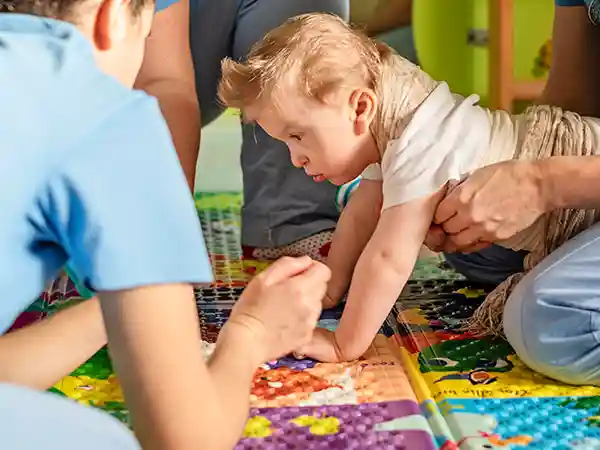
Ideas an OT might grade for a baby or toddler:
Reaching for a toy held just out of range, on the side the child uses less
Leaning on both hands on a mat to watch a toy, which puts weight through the arms
Banging, shaking and passing a rattle from one hand to the other
Pulling scarves out of a tissue box or lids off containers
Pressing large buttons on a cause and effect toy
For babies with one-sided signs, the early form of CIMT has been tested directly. A Swedish trial at Karolinska Institutet enrolled 37 infants aged 3 to 8 months, and 31 were later diagnosed with unilateral CP. Families ran two 6-week blocks of either baby-CIMT (play with the stronger hand gently restricted) or baby massage. At 18 months, the median Assisting Hand Assessment score was 51 after baby-CIMT against 24 after massage. The 2019 evidence review still rates baby-CIMT and similar infant programs yellow, a weak positive. The larger GAME trial in Australia, pairing weekly home visits from a trained OT or physiotherapist with a daily home program until age 2, was designed with 150 infants per group to answer that question at scale.
Daily routine tasks as therapy
Dressing, eating and washing are OT activities in their own right. The 2022 guideline found that whole-task practice combined with assistive devices can increase self-care independence and reduce caregiver burden.
“Whole task” means practicing the actual routine, in the actual bathroom, at the time of day it happens, instead of drilling a piece of it on a therapy table. An OT will usually break the routine into steps and hand over one step at a time. Pulling up trousers can come before stepping into them. Scooping with a spoon can come before loading it. The device matters as much as the practice: a plate with a raised rim, a long-handled sponge or elastic laces can turn a task a child cannot finish into one they can.
The 2019 State of the Evidence review, which graded 182 interventions for children with CP, rated sensory integration therapy a red light for improving function, along with passive, bottom-up approaches such as the original form of neurodevelopmental therapy. Activities where a child is moved rather than moving, or where the task has no link to a goal, spend therapy hours that active practice could use. See sensory processing and OT in CP for what sensory work can reasonably do.
Making activities stick at home
Home programs are one of the green light interventions in the 2019 review. In a 2009 trial, OT home programs worked at about 17.5 sessions a month averaging 16.5 minutes each.
Novak and colleagues’ double-blind trial in Pediatrics randomized 36 children with CP, mean age 7.7 and across all five GMFCS levels, to an 8-week home program, a 4-week home program or none. After 8 weeks, both program groups had better function and parent satisfaction than the group without one. The programs were written collaboratively with the family and carried out by parents.
Fit the activity into something that already happens: bimanual practice at snack time, a CIMT game during bath time, dressing practice on school mornings when there is time, and on weekends when there is not. Keep a simple log of date, activity and minutes so the OT can adjust the plan at the next visit. Our guide to occupational therapy at home covers setting up and logging a program in more detail.
Strength and walking goals sit with a different therapist. Leg strengthening, treadmill work and gait training belong to physical therapy for cerebral palsy, and an OT will coordinate with that plan rather than duplicate it.
Frequently asked questions about OT activities for CP
They are practice sessions built around a task the child or family wants to get better at, such as zipping a coat, opening a lunchbox or holding a cup with two hands. A 2022 international guideline for children with CP recommends client-chosen goals and whole-task practice in real-life settings, and lists bimanual therapy, constraint-induced movement therapy, goal-directed training and cognitive approaches as routes to hand use goals.
Two approaches have the most evidence: constraint-induced movement therapy (CIMT), where the stronger hand is restrained so the weaker one does the work, and bimanual training such as HABIT, where every activity needs both hands. In a trial of 42 children aged 3.5 to 10, 90 hours of either produced similar gains in hand function, and the bimanual group made more progress on the goals they had chosen themselves.
Yes. The 2021 international early intervention guideline says intervention should start as soon as a child meets the criteria for high risk of CP, with parents setting goals at the start. In a Swedish trial, infants aged 3 to 8 months who did baby-CIMT (play with the stronger hand gently restricted) had a median Assisting Hand Assessment score of 51 at 18 months, against 24 for infants given baby massage.
Ask your OT for a written home program tied to your child’s goals. In a 2009 randomized trial of 36 school-aged children, OT home programs worked when families did them about 17.5 times a month for an average of 16.5 minutes a session, over 8 weeks. Short, frequent practice inside daily routines is the pattern that trial supports.
Not as a treatment to improve function. The 2019 State of the Evidence review of 182 interventions for children with CP rated sensory integration a red light, meaning the evidence says do not use it for that purpose. Sensory accommodations for comfort or attention are a separate question from therapy aimed at motor skills.
The Manual Ability Classification System describes a child at level IV as handling a limited selection of easily managed objects in adapted situations, and at level V as not handling objects. For these children the OT works on what the child can control, such as a single switch, a head movement or eye gaze, and on equipment and positioning. The 2022 guideline found that whole-task practice combined with assistive devices can increase independence in self-care and reduce caregiver burden.