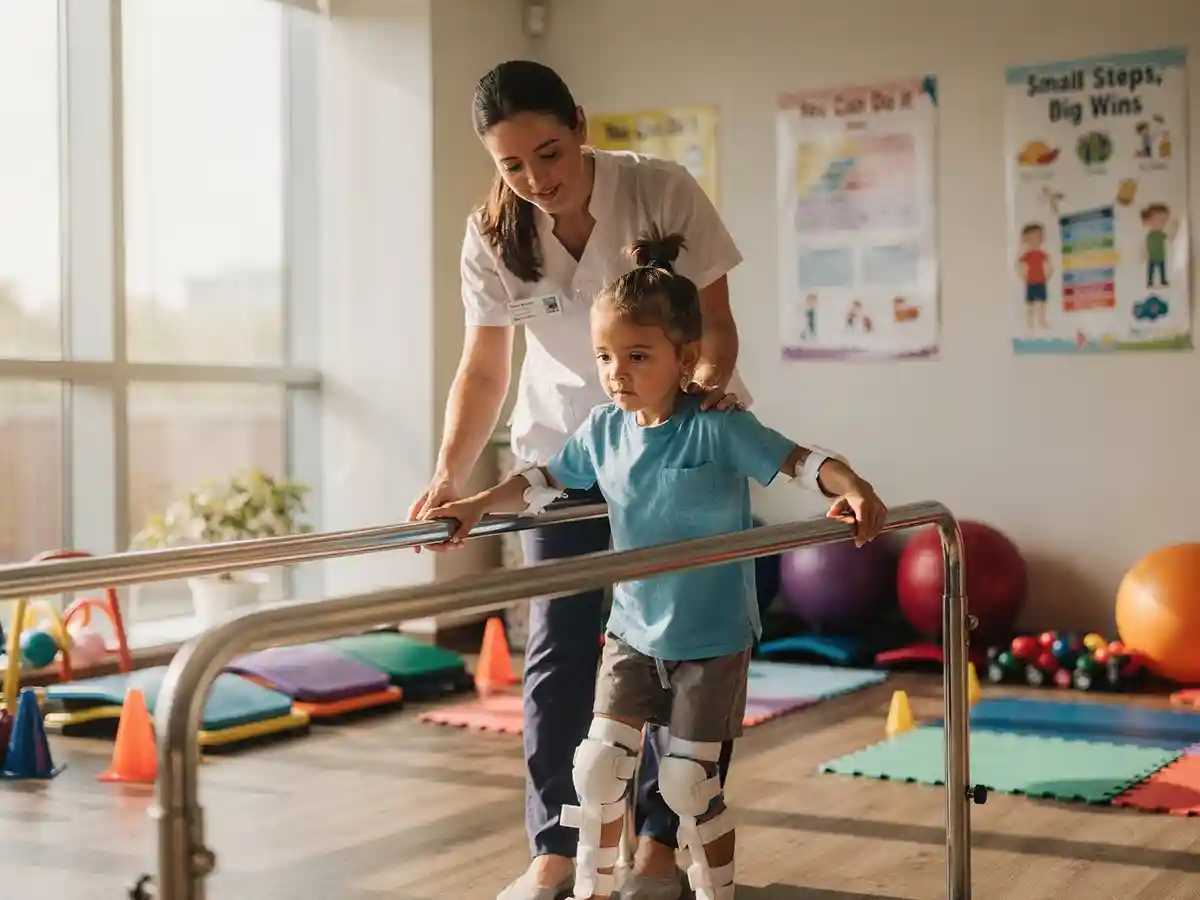
Clear, individualized goals are what turn therapy from busywork into measurable progress. Good goals are achievable, meaningful to the family, and tracked over time, with the right techniques chosen to match them.
Medically reviewed
Updated August 2026
9 min read
SMART
Specific, measurable, achievable, relevant, timed
Short + long
Near-term wins paired with multi-year direction
Family-set
Goals reflect what matters to the patient and family
A physical therapy goal is a prediction about what one child will be able to do by a particular date. Since 2002 there has been evidence to base that prediction on: 657 children with cerebral palsy, 2,632 assessments, and five separate motor development curves that diverge by GMFCS level (JAMA, 2002).
Those curves changed what a realistic goal looks like. They show rates and ceilings that differ sharply by severity, which means a target that is modest for one child is out of reach for another of the same age. A follow-up study tracked the same cohort to 21 and found something harder to say out loud: children at GMFCS levels I and II showed no average decline, while levels III, IV and V peaked at 7 years 11 months, 6 years 11 months and 6 years 11 months, then lost 4.7, 7.8 and 6.4 GMFM-66 points respectively on the way into adulthood.
That is not a reason to stop. It is the reason goals have to change shape with age and level, from acquiring to holding, and it is why a plan written once at four years old and repeated annually stops being a plan. For the wider treatment picture, see physical therapy for cerebral palsy.
From our medical reviewer
While the goals for each child are unique, the benefits of PT on day-to-day independence can’t be overstated.
The interventions that work in cerebral palsy share one feature: the child practices the actual task, with a goal attached. That is the finding, and it decides where a goal should sit.
Goal-directed training is among the interventions rated effective in the 2019 evidence review published in Current Neurology and Neuroscience Reports, which graded interventions in cerebral palsy using a traffic light system. The common thread across the interventions that earned a green light is active, task-specific, repeated practice. Passive treatment done to a child scores poorly. Work the child drives scores well.
Where the goal is written matters as much as what it says. Increasing ankle dorsiflexion by ten degrees is a goal about a body part, and a child can meet it without anything in their week changing. Getting onto the school bus without a lift by March is often the same physical work, described where it actually lands. Peter Rosenbaum and Jan Willem Gorter made the argument for that shift in a 2012 paper that has since been adopted across pediatric rehabilitation, proposing six words as the frame for any plan: function, family, fitness, fun, friends and future. Not one of them is a muscle.
Improving mobility and independence
Independence goals are usually equipment goals in disguise, and there is no credit for doing something the slow way. A walker, a powered chair or a well-fitted seating system can put a destination in reach that no amount of gait practice would have, and using one is not a failed goal. Our page on adaptive equipment covers what is available, and the broader benefits of physical therapy are set out separately.
Evidence-based interventions for cerebral palsy
Two measures do most of the work in cerebral palsy: one that compares a child against a standard scale, and one that scores whether their own individual goal was met.
The Gross Motor Function Measure is the standard scale. Its full version has 88 items across five dimensions, running from lying and rolling through sitting, crawling and kneeling, standing, and walking, running and jumping. The 66-item version is the one used in the longitudinal work above, and it produces a single score that can be tracked across years rather than sessions. Ask what a child scored last time and what they score now, because progress in cerebral palsy is measured in seasons rather than weeks.
Goal Attainment Scaling handles the individual goal. Each goal is written with five defined outcomes on a scale from minus two to plus two, where zero is the expected result, plus one is better than expected and minus two is a clear decline. Writing that scale is the discipline: it forces everyone to agree in advance what success looks like, which is where vague plans fall apart.
A critical review in Developmental Medicine & Child Neurology found every included study reported good sensitivity to change, so the method does detect real movement. The same review was blunt that knowledge of its reliability with children remains insufficient. Read the practical consequence off that: Goal Attainment Scaling is a strong tool for tracking one child against their own agreed target and a weak one for comparing children or programs.
What good PT goals look like
A goal worth writing down passes all five:
Names a real task, not a joint angle or a muscle group
States a number someone can count without interpreting it
Sits inside the range the child’s GMFCS level makes plausible
Came from the child or the family rather than from the assessment form
Carries a date, so it either happened or it did not
Recommended exercises for cerebral palsy
What belongs in the program depends on where the child sits on their own curve. Before the peak the work is acquisition. After it, the work is defending what exists.
For a child at GMFCS level I or II, the longitudinal data shows no average decline through adolescence, so goals can keep reaching: running, jumping, keeping up on uneven ground, and the fitness base that makes any of it sustainable. Aerobic and strength work belong here. Resistance training was avoided for years on the theory that it worsened spasticity, and fitness training now sits among the interventions rated effective, which makes that caution the outdated position rather than the safe one.
At levels III, IV and V the picture is different and the honest goal is different with it. Function peaks around age seven and drifts down afterwards, so a plan for an eleven-year-old at level IV that promises new skills is promising the wrong thing. What that plan should protect is hip position, range at the knees and ankles, sitting tolerance, and enough standing time to matter. Preventing a contracture is not a lesser goal than gaining a skill. It is the goal that keeps the skills already earned.
Exercises for balance and coordination
Balance work is specific to the situation it is practiced in, which is the reason a child who is steady on a balance board at the clinic still falls in a school corridor. Practice on the surfaces and in the crowds where the problem happens. Our page on PT exercises for CP covers the individual movements; what belongs in the goal is the setting, not the exercise.
Tailoring therapy to individual needs
The family chooses the goal and the therapist chooses the method. Reversing that produces a plan nobody practices between appointments.
A therapy hour is one hour of a 168-hour week, so almost all of the practice happens at home whether anyone planned for it or not. A goal the child wants gets rehearsed. A goal that arrived on a form gets performed in the clinic and forgotten in the car park. That is why the six-word frame is useful: fun and friends are not soft additions to the plan, they are what determines whether the plan is carried out.
Reviews should be scheduled rather than requested. Set a date when the goal is written, bring the numbers, and be willing to retire a goal that was wrong rather than extending it a third time. See PT for children with CP for how this works across the school years.
Examples of well-stated PT goals
For a child working on mobility: “Walk 10 feet with a walker, stopping no more than once, by [date].” For an adolescent focused on independence: “Climb a flight of stairs with a railing, using alternating feet, within 3 months.” For an adult maintaining function: “Complete 20 minutes of moderate aerobic activity 3 times per week, maintained over 6 months.”
Frequently asked questions about PT goals
Tasks the child wants to do, written where they happen. Rosenbaum and Gorter proposed six words for the frame in 2012: function, family, fitness, fun, friends and future. A goal about a joint angle can be met without anything in a child’s week changing, which is why the goal is written as getting on the bus rather than as ten degrees of dorsiflexion.
Through active, task-specific, repeated practice, which is the feature shared by the interventions rated effective in the 2019 traffic light review. Goal-directed training is one of them. Treatment done passively to a child scores badly; work the child drives scores well. See PT for children with CP.
Because it decides in advance what counts as success. Goal Attainment Scaling writes five outcomes on a scale from minus two to plus two with zero as the expected result, and a review in Developmental Medicine & Child Neurology found every included study reported good sensitivity to change. The same review noted its reliability with children is not well established, so it tracks one child rather than comparing several.
As soon as there is a concern, without waiting for a confirmed diagnosis, since cerebral palsy can now be identified in the first months of life. The gross motor curves show the steepest gains happening early, which is the argument for not losing that window to a referral queue.
Task practice, gait and transfer work, strength and aerobic training, and range of motion work, in a mix that depends on GMFCS level and age. Resistance training was once avoided on the theory that it worsened spasticity; fitness training now sits among the interventions rated effective. See PT exercises for CP.
Chiefly with the Gross Motor Function Measure, whose full version has 88 items across five dimensions from lying and rolling to walking, running and jumping, plus the 66-item version used in the longitudinal studies. GMFCS level sets the expectation the score is read against.
They differ by level, and saying so is more useful than a single claim. At GMFCS I and II the longitudinal data shows no average decline through adolescence, so goals keep reaching. At levels III, IV and V function peaks around age seven and then declines, so the benefit is holding position, range and comfort. See benefits of PT for CP.