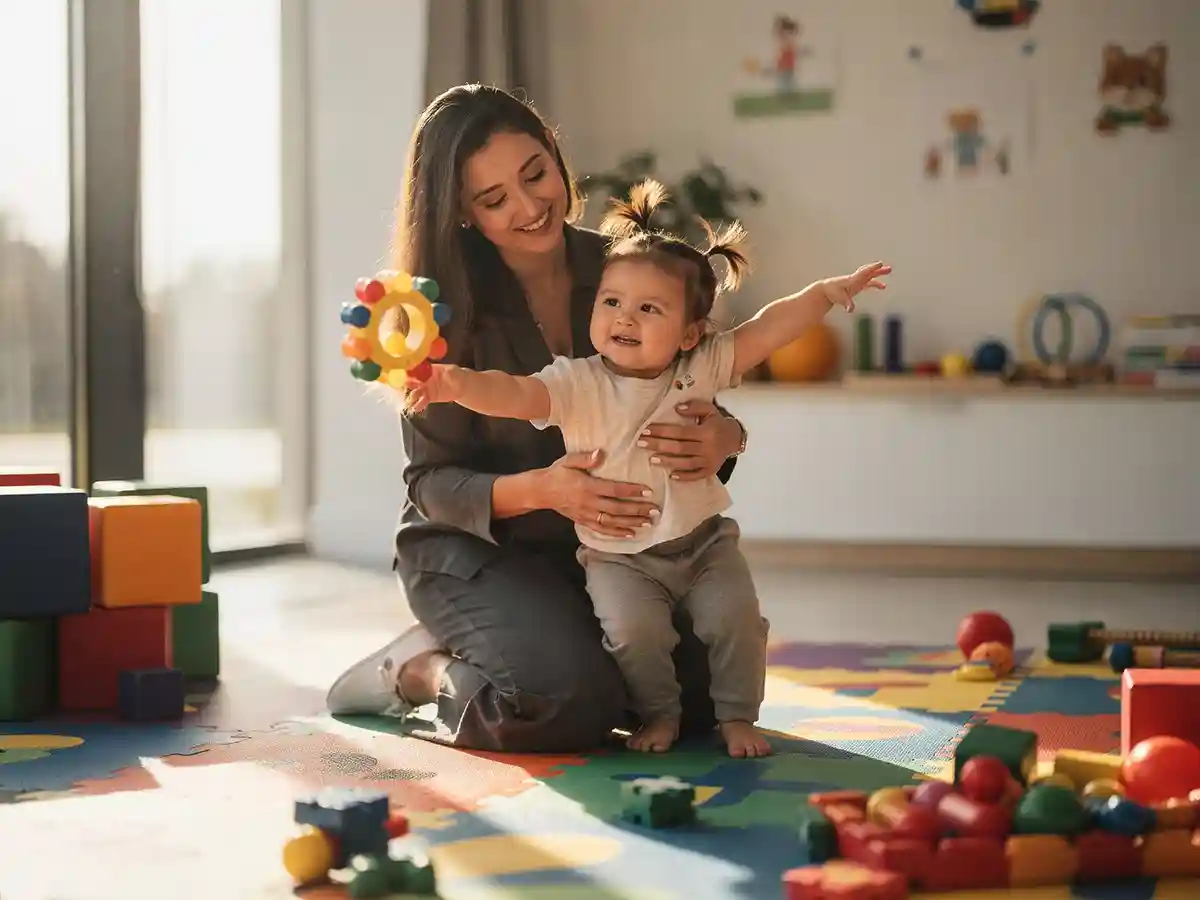
Pediatric PT is fundamentally different from adult PT: it’s play-based, milestone-driven, and built around the natural way children learn. Done well, it transforms what’s possible for a growing child.
Medically reviewed
Updated August 2026
9 min read
Play-based
Therapy that meets kids where they are, engaging and fun
Milestone-tracked
Progress measured against expected developmental goals
Earliest = best
Brain plasticity makes early therapy most impactful
Parents ask one question first, and it is rarely the one they say out loud. Will my child walk? There is evidence to answer it with, and it has existed since 2002.
Five gross motor development curves were built from 657 children with cerebral palsy and 2,632 assessments and published in JAMA, one curve for each GMFCS level, describing the rate and the ceiling of motor development at that level. GMFCS itself is valid and reliable from two years of age. So from about the second birthday there is a defensible answer to the prognosis question, and a therapist who will sit down and go through the relevant curve is giving a family something no amount of encouragement can.
That conversation shapes everything else on this page. The exercises themselves are covered in PT exercises for CP; here the subject is how pediatric therapy is organised, measured and paid for. The parent guide is physical therapy for cerebral palsy.
Benefits of physical therapy for cerebral palsy in children
Motor function in cerebral palsy does not simply improve forever, and knowing when it stops is what tells you what a program is for at a given age.
The same cohort was followed to 21 and reported in Developmental Medicine & Child Neurology. Children at GMFCS levels I and II showed no average decline through adolescence. At levels III, IV and V, average scores peaked at 7 years 11 months, 6 years 11 months and 6 years 11 months, then fell by 4.7, 7.8 and 6.4 points respectively into young adulthood, a decline the authors call clinically significant.
Read that as a change of job rather than a failure. Before the peak, therapy is buying new skills. After it, therapy is defending range, position and comfort, and preventing the secondary problems that turn a stable impairment into a painful one. The broader case is set out in the role of PT in CP management.
Enhancing motor skill development
Gains come from the child doing the thing. Every intervention rated effective in the 2019 traffic light review shares that shape: goal-directed training, bimanual training, constraint-induced movement therapy, casting, fitness training, action observation and environmental enrichment. All of them are active, task-specific and repeated, and none of them is done to a passive child.
Cerebral palsy rehab for kids: tailoring therapy
Play is not a softening of therapy, it is the delivery mechanism. A four-year-old will not perform repetitions and will do almost anything to keep a game going.
That is the whole argument for play-based work, and it explains why a session that looks like an obstacle course is doing serious work. The therapeutic content sits inside the game. What a family should be able to name afterwards is which skill the game was training, not which game it was.
Why play-based therapy works
What the format buys, in order:
Repetitions a child will actually complete
Practice in the setting the skill has to work in
Motivation that lasts past the first fortnight
Siblings and parents who can run it without a therapist present
A skill the child chose, which is the one they keep practising
How much of it happens at home
Most of it. A double-blind randomized trial in Pediatrics gave 36 children with cerebral palsy, mean age 7.7 and spanning all five GMFCS levels, a parent-delivered home program, and the dose that produced significant gains in function was 17.5 sessions a month at an average of 16.5 minutes each. Four short sessions a week. Ask for the program in writing with those two numbers on it, and say so if the plan does not fit the week you actually have, because a shorter program that happens beats a full one abandoned in March. Goal-setting is covered separately in setting PT goals.
Incorporating occupational and speech therapy
Occupational therapy takes the hands, self-care and the equipment that makes participation possible, and speech therapy covers communication and, importantly at this age, swallowing. Coordination between the three matters more than any of them individually, since a child cannot practise hand skills in a chair that does not hold their trunk. Where school is involved, the whole plan should say the same thing as the IEP.
Recommended exercises for cerebral palsy in children
One staple on most pediatric lists has weaker support than families are told, and swapping it out frees up minutes that buy more.
A Cochrane review of 35 trials and 1,391 participants found moderate to high quality evidence that stretch produces no clinically important change in joint mobility in neurological conditions: 3 degrees immediately, 1 degree in the short term, 0 degrees beyond a week. No included study ran longer than seven months. Short daily passive stretching is therefore not what prevents a contracture.
Duration is. A systematic review in Pediatric Physical Therapy screened 687 studies and set supported standing doses by purpose: five days a week, 60 to 90 minutes a day for bone mineral density, 60 minutes with the hips abducted 30 to 60 degrees for hip stability, 45 to 60 minutes for range of motion, 30 to 45 for spasticity. Hours in position, not seconds of pull. The exercise guide covers the active side in detail.
The check that belongs on every pediatric plan
Hips. In a Swedish population study following 212 children with cerebral palsy to ages 9 to 16, hip displacement developed in 64% of children at GMFCS level V and none at level I, first registered at a mean age of four, with some hips already past threshold at two. Passive range of motion did not differ between hips that were displacing and hips that were not, so an examination will not find it. A radiograph on a schedule set by age and level will. Ask whether your child is on one.
Evidence-based interventions and individualized therapy
Progress is tracked against the child’s own curve, not against typical milestones. Measuring against the wrong yardstick makes ordinary progress look like failure.
The Gross Motor Function Measure is the instrument. Its full version scores 88 items across five dimensions, from lying and rolling through sitting, crawling and kneeling, standing, and walking, running and jumping, and the 66-item version produces a single score that can be followed across years. That is the number to ask for at review: what it was last time, what it is now, and where it sits against the curve for the child’s level. Progress in cerebral palsy is measured in seasons, not weeks.
Two other scales are worth knowing by name. GMFCS grades gross motor function on five levels and is stable enough to plan around from age two. MACS does the same job for how a child handles objects, which matters because a child with one affected arm often sits at GMFCS level I, a rating that says nothing at all about the arm.
Utilizing adaptive equipment for therapy
Walkers, standing frames and seating are not a fallback position, they are what makes the dosing above possible. A standing frame is how an hour of hip abduction actually happens; seating is what lets a child use their hands at a table. Adaptive equipment for children covers selection and funding, and school-supplied equipment stays the school’s property, which is why families often pursue a separately funded device in parallel.
Where virtual reality actually sits
Virtual reality, robotic-assisted therapy and wearable movement sensors appear constantly in coverage of pediatric cerebral palsy. None has an evidence base in this condition approaching the trials cited on this page. The plausible mechanism is that a game holds a child’s attention for more repetitions, which is worth something, but that is an argument about engagement rather than a demonstrated treatment effect. Treat it as a way of delivering practice, not as a substitute for it.
Help with the cost of lifetime therapy
Years of PT, OT, and speech therapy add up, especially during the most intensive early-childhood years. When CP resulted from preventable medical events at delivery, a birth injury claim can fund therapy throughout your child’s life. Request a free case review.
Frequently asked questions about pediatric PT for CP
To buy new skills before the motor peak and to defend range, position and comfort after it. Gross motor scores at GMFCS levels III, IV and V peak around age seven and then decline, while levels I and II show no average decline through adolescence, so what a program is for depends on which side of that curve a child sits.
By watching movement and scoring it on standardized instruments rather than by impression. The Gross Motor Function Measure has 88 items across five dimensions, with a 66-item version that produces one score trackable across years. GMFCS grades severity on five levels and is reliable from age two, and MACS does the same for how a child handles objects.
Because the motor curves are steepest early, and because cerebral palsy can now be identified in the first months of life rather than in the second year. Hip surveillance also starts early: displacement is first registered at a mean age of four, with some hips already past threshold at two.
As soon as there is a concern, without waiting for the diagnosis to be confirmed. Under three the services come through the state early intervention program and are delivered in the home; after three the route runs through school services and insurance.
Mostly engagement. A game holds a child’s attention for more repetitions, and repetitions are what change function. But virtual reality has no evidence base in cerebral palsy approaching the trials behind goal-directed and bimanual training, so treat it as a way of delivering practice rather than as a treatment in itself.
Ask the child’s medical team first, then look for a therapist who works with cerebral palsy specifically and can talk about GMFCS levels and the motor curves without being prompted. Professional bodies including the American Physical Therapy Association list members by specialty, and children’s hospitals and regional rehabilitation centres are the other route.
Session frequency, location, and whether services come through early intervention, school or insurance. Insurance plans usually cap annual visits, so ask what the limit is before the plan is built, because weekly visits against a cap of twenty run out in May. Disability benefits can cover part of the gap.