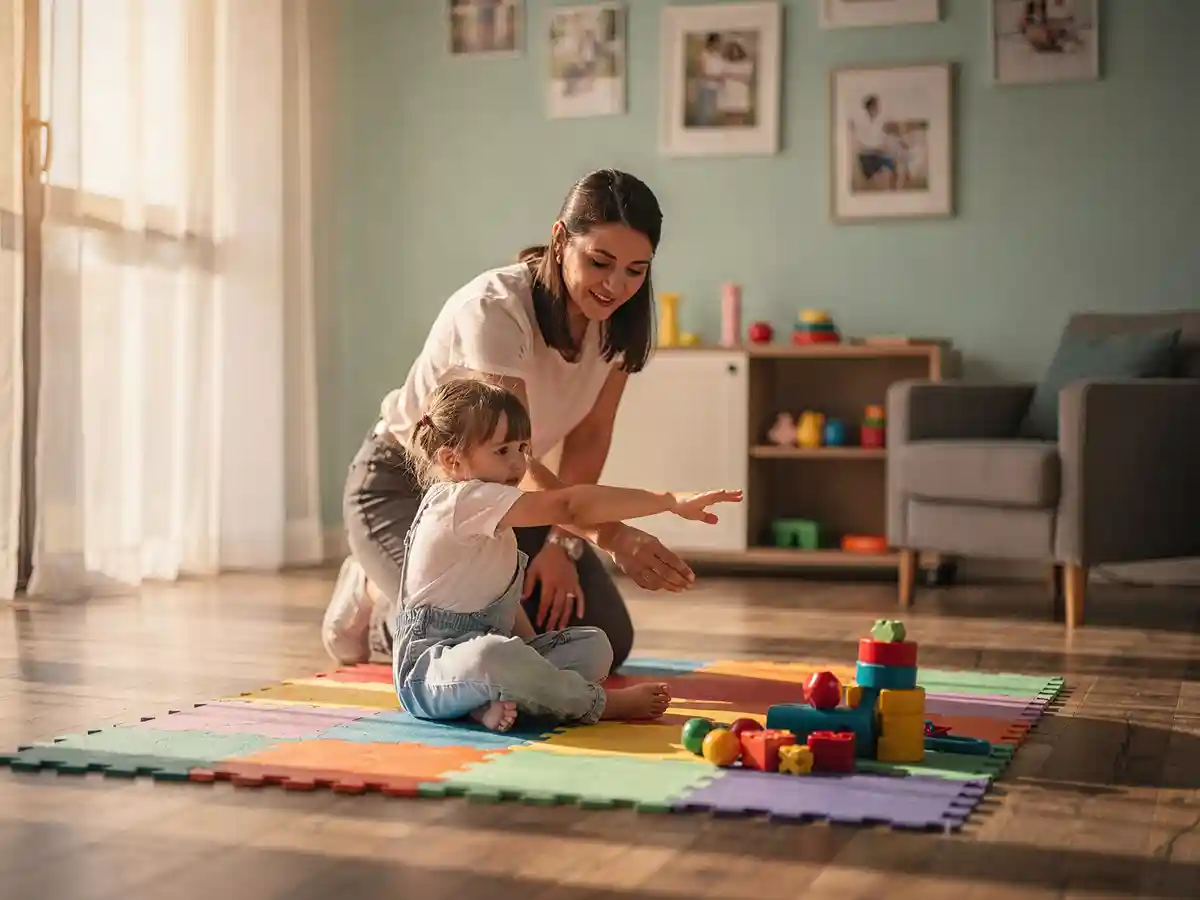
Monoplegic CP is a less-common form that affects only one limb, either an arm or a leg. Because the impairment is localized, symptoms can be subtle, and the condition is sometimes overlooked or mistaken for a soft developmental delay early on.
Often noticed first as a fine-motor or gait asymmetry
High potential
Strong outcomes when therapy begins early
Monoplegic cerebral palsy means motor impairment in one limb, an arm or a leg, while the other three work normally. It is the rarest of the topographic patterns and the least stable one. Examined closely, a single affected limb often turns out to be the most visible part of milder involvement running down the same side of the body.
That instability is measurable rather than theoretical. When 30 clinicians from the Surveillance of Cerebral Palsy in Europe network classified the same ten case vignettes, judging the distribution of spastic involvement was one of the two things they disagreed about most, and agreement was no better when 20 of them repeated the exercise five months later (Developmental Medicine & Child Neurology, 2008). European registers now record spastic cerebral palsy as unilateral or bilateral instead, which files a child described here as monoplegic alongside hemiplegic CP rather than in a category of their own, and well away from quadriplegic CP.
None of that makes the label useless. It says where to look and what to treat. It does mean a monoplegia recorded at 14 months describes what is visible then rather than settling anything, so read it next to the parent guide on the five types of cerebral palsy.
One limb is stiff and slow to respond while everything else develops on schedule. That asymmetry is the entire presentation, and a parent usually notices it before a clinic does.
Most children with monoplegia walk, talk and keep up. The affected limb shows itself in the gaps: a hand that stays closed during two-handed play, a foot that catches on the stairs, a run that looks lopsided when nobody else’s does. Because nothing is globally delayed, the first explanation offered is often early handedness or clumsiness, and the real diagnosis can arrive a year or more after the first worry.
What spasticity in one limb actually feels like
Spasticity is velocity dependent. Move the limb slowly through its range and it can feel close to normal. Move it quickly and it catches. Clinicians grade that resistance on the Modified Ashworth Scale, six grades running 0, 1, 1+, 2, 3 and 4, where 0 is no increase in tone and 4 means the limb is rigid in flexion or extension.
The limb is often smaller as well. A hand or foot that gets used less grows shorter and thinner than its partner, and the gap tends to widen through childhood rather than close. Reflexes on that side are brisk. Range of motion at the ankle or the elbow narrows if nothing is done about it, because a muscle that is never taken to full length is the one that becomes a contracture. That mechanism runs through every form of spastic CP. Here it is confined to one limb, which makes it both easier to treat and easier to overlook.
Motor function issues in monoplegic CP
What the impairment costs depends on which limb it is.
If the lower limb is affected: toe walking on that side, in-toeing, tripping, a gait that grows more asymmetric the faster the child moves, and trouble on stairs and uneven ground
If the upper limb is affected: a thumb held into the palm, a pronated forearm, a flexed wrist, and difficulty with anything needing two hands at once, including buttons, cutlery and handwriting
An affected arm carries a second problem the clinical description misses. Children stop trying to use it. The good hand is faster at everything, so it does everything, and the weaker hand drops out of the movement repertoire even where it could still contribute. That pattern, sometimes called developmental disregard, is what makes an arm harder to treat than a leg. Walking forces a leg into use every day. Nothing forces a hand.
Treatment for monoplegic cerebral palsy
For one affected upper limb the strongest evidence sits with intensive, goal-directed practice. A meta-analysis of 42 randomized trials covering 1,454 children with unilateral cerebral palsy found that how much practice a child gets predicts the result better than which named method delivers it.
That analysis, published in Pediatrics in 2014, compared 113 upper limb approaches. Constraint-induced movement therapy, which restrains the stronger hand so the weaker one has to work, produced modest to strong gains in movement quality against usual care. Set against an equal dose of bimanual training, where both hands work together on a task, the two came out much the same. Short blocks of therapy on their own did not deliver enough dose to hold. Goal-directed home programs, on the other hand, carried strong evidence, which matters because they are the part a family controls.
Physical therapy and early intervention
Physical therapy for one affected leg concentrates on the ankle, since a heel that will not reach the floor drives most of the gait problem, and on the strength difference that opens between the two sides. For an arm, occupational therapy starts from specific tasks the child wants to be able to do and works backwards to the movements they require.
Repetition is what changes function. A therapy hour a week is a coaching session for the 167 hours that follow it, and the home program is where the repetitions actually happen.
Dose is the argument, not the method
The 2014 Pediatrics meta-analysis, in order:
Constraint therapy beat usual care on the movement quality and efficiency of the impaired arm
Matched against the same number of hours of bimanual training, that advantage largely disappeared
Short therapy blocks alone were unlikely to produce sustained change
Goal-directed home programs carried strong evidence and can supplement direct therapy
Action observation and mirror therapy were classed as experimental
Medical and surgical options
Where spasticity in the limb is limiting function, the American Academy of Neurology practice parameter puts botulinum toxin type A at Level A, its strongest recommendation, for reducing localized spasticity in the upper and lower extremities. The same review is careful about what that does not establish. Evidence that tone reduction translates into better function was conflicting, and the FDA was at the time examining isolated reports of generalized weakness after injection.
Botulinum toxin injections — placed in named muscles, wearing off over a few months before repeat injection is considered
Bracing or splinting — an ankle-foot orthosis to hold the foot flat, or a hand splint to bring the thumb out of the palm
Serial casting — successive casts to regain range in a muscle that has shortened, often paired with injection
Orthopedic surgery — tendon lengthening or transfer once a contracture has become fixed rather than dynamic
Oral medications fit this pattern poorly. Diazepam and tizanidine were reviewed for generalized spasticity, and dosing an entire body to reach one limb buys sedation and side effects for a benefit confined to a single arm or leg. That trade reads very differently when three limbs are involved.
One limit belongs on the page plainly. Cerebral palsy is non-progressive, the brain injury behind it does not spread, and nothing on this list repairs it. What changes is range, strength and how much the limb takes part.
Diagnosis of monoplegic cerebral palsy
Cerebral palsy can be identified before five months corrected age with the right combination of tools. Which limbs are involved is the part that stays uncertain longest.
The 2017 international clinical practice guideline in JAMA Pediatrics set out what predicts cerebral palsy accurately in infancy: term-age MRI at 86% to 89% sensitivity, the Prechtl Qualitative Assessment of General Movements at 98%, and the Hammersmith Infant Neurological Examination at 90%. Used together with the clinical history, those move diagnosis out of the second year of life and into the first few months. The same guideline records that topography and severity are harder to establish that early, which is exactly why a monoplegia label so often changes. For the full workup, see how cerebral palsy is diagnosed.
Neurological assessments and tests
An MRI is usually abnormal. A systematic review in Developmental Medicine & Child Neurology found abnormal imaging in 334 of 388 children with cerebral palsy, 86%, and the pattern indicated the timing of the injury in 83% of them. For a single affected limb, what matters is that the lesion sits on the opposite side of the brain and is focal enough to spare the rest of the body.
Genetic testing — where imaging is clean or the presentation is atypical, since several inherited conditions imitate cerebral palsy early and a few of them are treatable
Instrumented gait analysis — where an affected leg is being considered for surgery
MACS — the Manual Ability Classification System, five levels, validated for ages 4 to 18, describing how a child handles objects in daily life
The classification detail is worth knowing. The Gross Motor Function Classification System, the scale families hear about most, sorts children by gross motor function, and a child with one affected arm sits at level I almost every time. That says nothing at all about the arm. MACS is the scale that does, and asking for both is reasonable.
Ruling out what is not cerebral palsy
One weak arm in a newborn is more often a peripheral nerve injury than a brain injury. Erb’s palsy comes from stretching the brachial plexus during delivery and produces a limp arm held against the body with the forearm turned inward. It is not cerebral palsy. The imaging differs, the examination differs, and so does the treatment. Reflexes that are reduced rather than brisk point away from cerebral palsy too, as does any weakness that worsens over time, since the injury behind CP is non-progressive by definition.
Pediatric neurology earns its place here, separating a focal brain lesion from a nerve injury, a spinal cause, or a progressive condition that has not yet declared itself.
Causes of monoplegic cerebral palsy
A focal injury to the motor areas on one side of the brain, opposite the affected limb. When it happened is usually readable from what the MRI shows.
Cerebral palsy occurs in about 2 to 3 per 1,000 live births across the European registers, and the CDC identifies it in about 1 in 345 children in the United States. Brain injury before, during or shortly after birth is the common thread. In monoplegia the injury is small and well placed rather than widespread.
Impact of brain injury on motor function
The systematic review cited above also sorted the lesions it found. Periventricular white matter damage was the most frequent at 56%, followed by cortical and deep grey matter lesions at 18%, with brain maldevelopments in 9%. Gestational age split those apart cleanly. White matter lesions turned up in 90% of preterm-born children against 20% of those born at term, while grey matter lesions ran at 33% in term births against 3.5% in preterm.
A few recognizable routes lead to one affected limb:
A focal arterial stroke around the time of birth, the classic cause of one-sided involvement
Periventricular white matter injury after premature birth, asymmetric enough to affect one limb more than the rest
A malformation such as a cortical dysplasia formed while the brain was still developing
Head trauma at delivery or in early infancy
The severity of the impairment tracks the size and the position of the lesion, not the label attached to it.
Genetic and environmental factors
Inheritance is not the mechanism. Cerebral palsy is defined by an injury to the developing brain, and monoplegia in particular is usually traceable to an event rather than to a family history. What genetic and environmental factors change is exposure and vulnerability.
Genetic factors — more often useful for finding a different diagnosis than for explaining this one
Where a family history of neurological conditions exists, genetic counseling can say what it does and does not predict.
When the cause traces back to a delivery event
Even mild forms of CP can result from preventable medical errors at delivery. If your child’s monoplegic CP followed oxygen deprivation, trauma, or a specific delivery event, our team can review the case at no cost. Request a free case review.
Frequently asked questions about monoplegic cerebral palsy
Cerebral palsy affecting one limb, an arm or a leg, with the other three working normally. It is the rarest topographic pattern and frequently turns out to be the visible part of milder involvement down the same side, which is why European cerebral palsy registers record it as unilateral spastic CP rather than as a category of its own.
Clinically, and usually later than it needs to be. The 2017 guideline in JAMA Pediatrics found cerebral palsy can be identified before five months corrected age using term-age MRI at 86% to 89% sensitivity, the Prechtl General Movements Assessment at 98%, and the Hammersmith Infant Neurological Examination at 90%. Which limbs are involved stays uncertain longest.
A focal injury to the motor areas on the opposite side of the brain, before, during or shortly after birth. A stroke around the time of birth, oxygen deprivation, asymmetric white matter injury after premature birth, and malformations formed while the brain was developing are the recognized routes.
Intensive goal-directed practice, delivered for an affected arm as constraint-induced movement therapy or bimanual training. A 2014 meta-analysis in Pediatrics covering 42 trials and 1,454 children with unilateral cerebral palsy found the two similar at equal dose and short therapy blocks alone insufficient. Botulinum toxin type A carries the American Academy of Neurology Level A recommendation for reducing localized spasticity, alongside physical therapy and occupational therapy.
Function improves with practice. The brain injury itself does not change, because cerebral palsy is non-progressive by definition, so what shifts is range, strength and how much the limb participates. Movement can also go the other way if a shortened muscle is never taken to full length, which is how a contracture forms.
Not usually. Monoplegia is generally traceable to an injury or an event rather than to inheritance. Genetic testing is most useful when imaging is clean or the presentation is atypical, because several inherited conditions imitate cerebral palsy early and a few of them respond to treatment that cerebral palsy does not.
Early intervention services before age three, school-based therapy under an IEP or a 504 plan after that, and the cerebral palsy organizations listed in our support section. For an affected arm, the home program carries most of the dose, so ask the occupational therapist to write one.