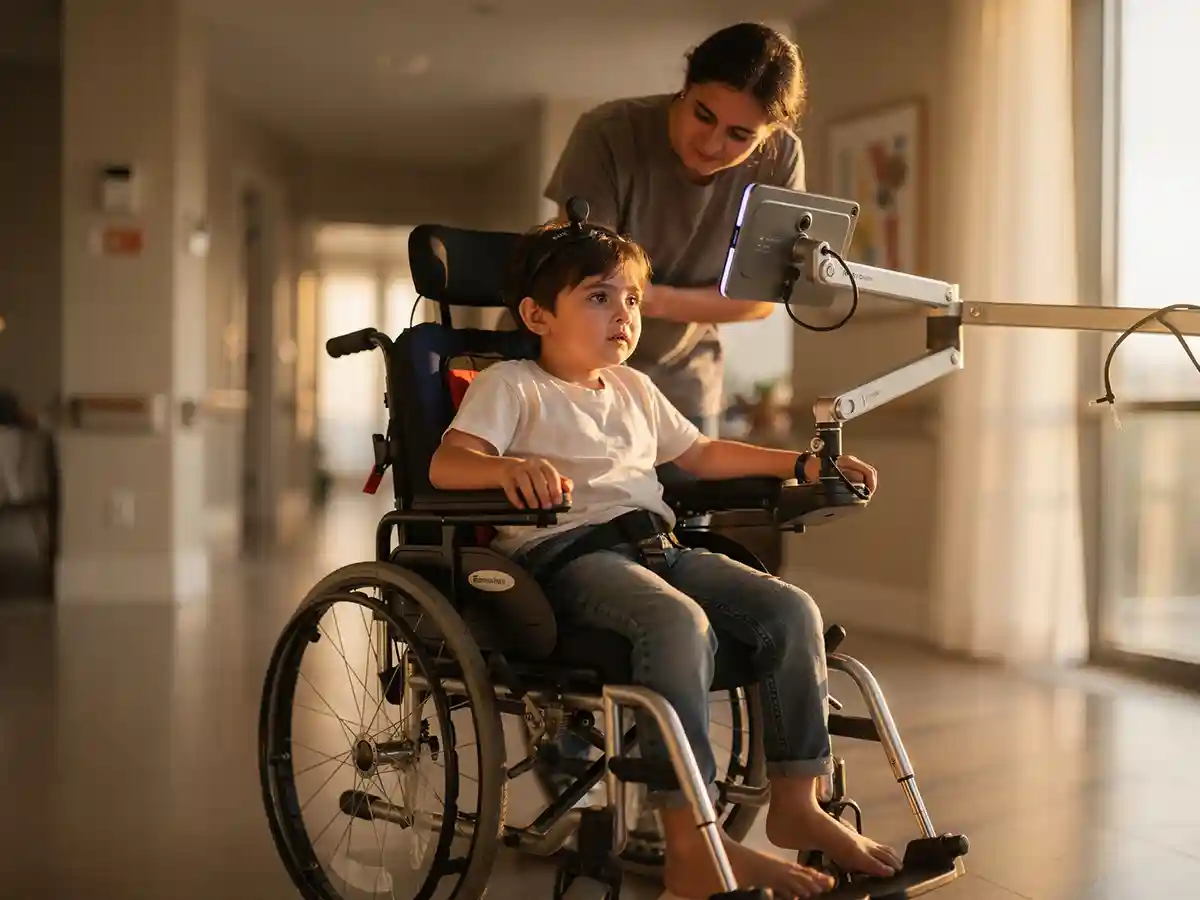
Quadriplegic CP is the most severe form, affecting all four limbs and often the trunk and face. It frequently co-occurs with intellectual disability, seizures, and feeding or communication challenges, requiring a multidisciplinary care plan.
Quadriplegic cerebral palsy means spasticity across all four limbs and usually the trunk, and most children who have it are classified at GMFCS level IV or V. One figure should shape the first five years of care. In a Swedish population study that followed 212 children with cerebral palsy to the age of 9 to 16, hip displacement developed in 79% of those with spastic tetraplegia.
The same study found displacement first registered at a mean age of four years, some hips already past the danger threshold at two, and passive range of hip motion no different in the hips that were displacing than in the ones that were not. Examination does not catch this. An x-ray does.
What happened next in that region is the reason the number is worth knowing. Southern Sweden built a register and a surveillance program in 1994, and by the twenty-year report the rate of hip dislocation had gone from 8% in a historical control group to 0.5% in children born between 1992 and 1997, then to zero among the 431 born between 1998 and 2007. Thirteen percent of the children in the program had preventive surgery. Every child who did dislocate reported severe pain. For where this type sits among the others, see the parent guide to the five types of cerebral palsy.
An injury affecting both sides of the developing brain. What distinguishes this type from the milder ones is not a different mechanism but a larger or more central area of damage.
Imaging usually shows it. A systematic review in Developmental Medicine & Child Neurology found abnormal MRI in 334 of 388 children with cerebral palsy, 86%, with the pattern indicating the timing of the injury in 83% of cases. Periventricular white matter damage was the most common finding at 56%, and it appeared in 90% of preterm-born children against 20% of those born at term. Cortical and deep grey matter lesions accounted for 18% and ran the other way, 33% in term births against 3.5% in preterm.
Read against that, the risk factors on this page stop being a list and start being two stories. Very preterm birth damages white matter, and where the damage reaches the fibers serving the arms as well as the legs, the result is bilateral involvement across all four limbs. A severe insult at term, most often profound oxygen deprivation, damages grey matter more centrally. Both routes end in the same clinical picture. Premature birth, low birth weight, multiple gestation and maternal infection raise the odds of the first.
Genetic factors and cerebral palsy
Cerebral palsy is defined by an injury to the developing brain rather than by inheritance, and genetic factors are better understood here as susceptibility than as cause. A family history of clotting disorders, of metabolic conditions, or of unexplained cerebral palsy is worth raising, and testing sometimes returns a different diagnosis altogether, since several inherited conditions present early in a way that resembles severe cerebral palsy. That distinction is not academic. A few of those conditions have specific treatments, and cerebral palsy does not.
Environmental influences on CP development
The recognized perinatal contributors are these:
Maternal infections — TORCH infections and others that reach the developing brain
Toxin exposure — some environmental toxins are associated with neurological harm
Severe trauma during childbirth — including the events grouped under birth complications
Hypoxic-ischemic encephalopathy — oxygen deprivation at term, the route most often associated with bilateral grey matter injury
Severe neonatal infection — or untreated jaundice reaching the level of kernicterus
Symptoms of quadriplegic CP
All four limbs, the trunk, and frequently the muscles that control swallowing and speech. The motor picture is the visible part, and it is not the part that consumes most of a family’s attention.
Spastic quadriplegia is the same thing under an older name, and the distinction that matters clinically is bilateral against unilateral: everything here is on both sides, where hemiplegic CP affects one. At GMFCS levels IV and V, independent walking is not the working goal and seating is. A child at level IV may sit with support and use a powered chair; a child at level V is transported in a supported seating system and has limited head and trunk control. Both need a body held in a position that lets them see, breathe, eat and use their hands, which is why positioning equipment is medical equipment rather than furniture.
Function at these levels does not follow the trajectory families are led to expect. Following 657 children with cerebral palsy to the age of 21, researchers found no average decline at GMFCS levels I and II, but at levels IV and V average gross motor scores peaked at 6 years 11 months and then fell by 7.8 and 6.4 points respectively into young adulthood. That decline is clinically significant and it is not a therapy failure. It is the reason the plan shifts from acquiring skills to defending range, position and comfort.
The conditions that travel alongside severe cerebral palsy often matter more day to day than the movement disorder. The CDC reports that around 4 in 10 children with cerebral palsy also have epilepsy. Swallowing difficulty is common at these levels and brings a risk of aspiration, which is why feeding is assessed rather than assumed. Constipation, reflux, disturbed sleep, hip and spine pain and pressure areas all appear more often here than the diagnosis alone would suggest.
One correction belongs on any page about this type. Across cerebral palsy as a whole, the 2017 international guideline in JAMA Pediatrics records that two in three people will walk, three in four will talk, and one in two have normal intelligence. Severe motor impairment does not tell you where a particular child falls, and treating an unspeaking child as an uncomprehending one is the most common and most costly error made around this diagnosis. Speech therapy here is usually about building a route to language rather than about articulation.
Diagnosis process for quadriplegic cerebral palsy
Cerebral palsy can now be identified in the first months of life, and severity can be classified reliably from age two. Both timings matter, because the interventions that prevent damage here are the early ones.
The 2017 guideline in JAMA Pediatrics sets out what predicts cerebral palsy accurately before five months corrected age: term-age MRI at 86% to 89% sensitivity, the Prechtl Qualitative Assessment of General Movements at 98%, and the Hammersmith Infant Neurological Examination at 90%. Used with the clinical history, those move a diagnosis that used to arrive at two years into the first half of the first year.
Neurological assessments and tests
Pediatric neurologists evaluate:
Motor skills, muscle tone, reflexes and posture, across all four limbs
Spontaneous movement quality, using the General Movements Assessment
Symmetry of involvement, to confirm the bilateral pattern
Standardized examination with the Hammersmith Infant Neurological Examination
Severity grading with the GMFCS, which is valid and reliable from two years of age and places quadriplegic CP most often at levels IV–V
Add one item that is often left off the list: a hip radiograph. The Swedish work found range of motion to be a poor indicator of which hips were displacing, so a normal examination is not reassurance, and a surveillance x-ray scheduled by age and GMFCS level is what finds the problem while it is still preventable.
Role of imaging in diagnosing CP
Brain imaging confirms the pattern and dates the injury rather than making the diagnosis, which stays clinical.
MRI — the standard, and abnormal in around 86% of children with cerebral palsy
Cranial ultrasound — usually the first imaging in a NICU infant
CT — where MRI is unavailable or contraindicated
EEG — where seizures are suspected, which at this severity is often
Treatment options for quadriplegic CP
Quadriplegic CP treatment has no curative arm. The interventions with the clearest evidence are preventive, and hip surveillance is the one carrying a population-level result behind it.
Start there, because it is the intervention that changed outcomes most and asks least of the child. A hip surveillance program means a radiograph on a schedule set by age and GMFCS level, a migration percentage measured off it, and preventive surgery offered when that percentage crosses a threshold rather than after the hip has dislocated. In southern Sweden that approach took dislocation from 8% to zero across two decades of birth cohorts, with 13% of children needing the preventive operation. Ask whether your child is on a surveillance schedule and what the last migration percentage was. If nobody can answer, that is the answer.
Physical therapy and rehabilitation
Physical therapy at these levels is largely about position and range: keeping hips seated in their sockets, keeping ankles and knees from fixing, building tolerance for supported standing, and making a seating system work for a body that is still growing. Occupational therapy takes the same approach to hands, self-care and the equipment that makes participation possible, and speech therapy covers feeding and swallowing as well as communication.
Sessions are a small fraction of the week. What happens between them, in the seating, the standing frame, the night positioning and the stretches, is where range is actually won or lost.
Assistive technology in everyday care
Adaptive devices are central to quadriplegic CP care:
Power and manual wheelchairs with custom seating
Eye-gaze and switch-controlled communication devices
Supportive standing frames to reduce contractures
Adaptive feeding equipment and head supports
Home modifications: lifts, ramps, accessible bathrooms
Managing tone, and the equipment that follows
Spasticity across four limbs is treated differently from spasticity in one. Injecting individual muscles reaches only part of the problem, so widespread tone is more often addressed systemically, with intrathecal baclofen delivered by an implanted pump the option carrying the most evidence at these levels. Selective dorsal rhizotomy has been studied mainly in children with milder bilateral involvement who walk, and the calculation at GMFCS IV and V is different. Medications and surgery are both worth asking specific questions about: what is this expected to change, measured how, and what does it cost in recovery time.
Mobility — power wheelchairs, gait trainers, and seating built around the child rather than adjusted to fit
Communication — speech-generating devices with eye-gaze or switch access
Standing frames — for hip position, bone density and time spent upright
Environmental controls — switch access to lights, screens and doors
None of this repairs the brain injury. Cerebral palsy is non-progressive, and what changes over a childhood is the body around the injury: joints, spine, lungs and skin. Almost every intervention listed here is aimed at that second thing.
When the cause is a preventable medical error
Quadriplegic CP linked to hypoxic-ischemic injury, prolonged delivery, or other preventable perinatal events may be the result of medical malpractice. Compensation in these cases can fund lifetime care, equipment, and home modifications. Request a free case review.
Frequently asked questions about quadriplegic cerebral palsy
The most severe pattern of spastic cerebral palsy, involving both arms, both legs and usually the trunk, with most children classified at GMFCS level IV or V. Increased muscle tone across four limbs is the defining feature, and the muscles controlling swallowing and speech are often involved too.
An injury to both sides of the developing brain, before, during or shortly after birth. Two patterns dominate: periventricular white matter damage after very preterm birth, found in 90% of preterm-born children with CP in one systematic review, and grey matter injury at term, most often after oxygen deprivation. Birth complications and infection raise the risk of both.
Clinically, supported by imaging. Before five months corrected age the most predictive tools are term-age MRI at 86% to 89% sensitivity, the Prechtl General Movements Assessment at 98%, and the Hammersmith Infant Neurological Examination at 90%. GMFCS level, which grades severity, is valid and reliable from age two.
Hip surveillance first, because it has a population-level result behind it: a Swedish program took hip dislocation from 8% to zero across twenty years of birth cohorts, with 13% of children having preventive surgery. Alongside that, physical, occupational and speech therapy for range, position, feeding and communication, and systemic tone management where spasticity is widespread.
Most need daily physical assistance throughout life, and that is a statement about bodies rather than about capability. Across cerebral palsy as a whole, one in two people have normal intelligence, and severe motor impairment says nothing about where a particular person falls. Communication access, environmental controls and supported living arrangements are what determine how much of their own life someone runs.
Where a family believes negligence contributed, birth injury lawyers can review the delivery records and the fetal monitoring strip. The costs at stake are lifetime ones: seating and mobility equipment replaced as a child grows, home modification, and paid care. Time limits apply and they vary by state, so the review is worth starting before it is convenient.