Most children with cerebral palsy have some difficulty with speech, and dysarthria is the most common form. What helps is practice on speech itself, started early, with a communication device in place if speech alone will not carry the load.
Medically reviewed
Updated August 2026
9 min read
82%
had delayed or disordered speech in a 2020 study of 84 children
78%
of the children who spoke had dysarthria
From birth
IDEA Part C covers speech services from birth through age 2
A population-based study of 84 Australian children with cerebral palsy, published in Developmental Medicine & Child Neurology in 2020, found that 82% had delayed or disordered speech. Among those who spoke, 78% had dysarthria, the weakness and poor coordination of the speech muscles that makes words sound slurred, quiet, or effortful.
That is the problem this page is about. Below is what actually improves speech in cerebral palsy, what the evidence says about the exercises families are most often handed, and where a communication device fits alongside speaking rather than instead of it. For the broader picture, see speech therapy for cerebral palsy.
A speech-language pathologist does not treat “speech” as one thing. The first job is working out which part is breaking down, because the answer changes what the sessions look like.
What the assessment is actually looking for
Dysarthria, apraxia, and a phonological disorder can all make a child hard to understand, and they call for different work. In the 2020 study above, among the children who spoke, 78% had dysarthria, 54% had an articulation delay or disorder, 43% had a phonological delay or disorder, and 17% showed features of childhood apraxia of speech. Many had more than one at once.
So the SLP listens for the pattern. Is the voice quiet and the breath running out mid-sentence, which points at respiratory support? Are specific sounds consistently wrong, which points at articulation? Is the child inconsistent on the same word from one attempt to the next, which is more typical of apraxia? Alongside that, the therapist checks whether swallowing is safe, because the same muscles are involved and aspiration is a medical risk rather than a communication one. The techniques that follow are chosen from that picture, not from a standard package.
Why starting early matters, and what pays for it
Under the Individuals with Disabilities Education Act, children can receive speech and language services from birth. Part C covers infants and toddlers from birth through age 2, delivered at home or in daycare under an Individualized Family Service Plan. At age 3 that transitions to Part B, Section 619, which covers preschool special education for children aged 3 through 5 and shifts to an IEP. Both are provided at no cost to families for the services identified in the plan.
Two things follow from that. A referral does not require a confirmed cerebral palsy diagnosis, only a suspected delay, so parents do not have to wait for the diagnostic picture to settle. And because the transition at 3 is a legal handoff rather than an automatic one, it is worth asking the Part C coordinator about it several months in advance. Our guide to speech therapy for toddlers covers what those first sessions look like.
Exercises to improve speech in cerebral palsy
Practice on speech is what changes speech. That sounds obvious, and it is the single most useful thing to know about this section, because a lot of what gets sent home in a folder is not practice on speech.
Articulation, breath support, and rate: practicing speech itself
Work that targets speech directly means saying real sounds, words, and phrases, repeatedly, with feedback on how they came out. A session might drill a sound the child consistently drops, at the start of a word and then in the middle. It might work on breath support so a sentence does not fade to nothing by the fifth word. It might slow the rate down, because for many children with dysarthria, speaking more slowly is the fastest route to being understood.
The common thread is that the child is speaking. Repetition matters, and so does the feedback loop, which is why five focused minutes several times a day usually beats one long session on a Sunday.
Blowing bubbles, straws, and tongue exercises: what the evidence shows
These are called nonspeech oral motor exercises, and they are among the most commonly assigned home activities in pediatric speech therapy. The reasoning is intuitive: strengthen the lips, tongue, and jaw, and speech should improve.
The research has not borne that out. A systematic review published in the American Journal of Speech-Language Pathology in 2009 examined 15 studies and concluded there was insufficient evidence to support or refute the use of oral motor exercises for producing effects on speech. That is not the same as proof they fail. It does mean that after decades of use, the benefit to speech has never been demonstrated, and time spent blowing bubbles is time not spent practicing words.
Two things this does not mean. Oral motor work for feeding and swallowing is a separate question with its own evidence, and nothing here applies to it. And a therapist may have a specific reason for a specific exercise with a specific child. Worth asking what a given activity is meant to achieve, and how you would know it was working.
Treatment options for speech improvement
In the 2020 cohort, 20 of the 84 children were minimally verbal, roughly one in four. For those families the question is not which drill to run. It is how the child communicates today, while speech work continues.
What a week of therapy looks like
Most plans combine four things:
Articulation practice on target sounds in real words
Breath and rate work, so sentences hold together
AAC where it is needed, from picture boards to eye-gaze
Home practice in short daily blocks, not one long session
Will a device stop my child from talking?
This is the question parents ask first, and it deserves a direct answer. A research review published in the Journal of Speech, Language, and Hearing Research in 2006 pooled studies of augmentative and alternative communication in people with developmental disabilities and found that AAC did not impede speech production. Across the studies reviewed, none reported a decrease in speech. Most reported an increase, though the authors were careful to note the gains were modest.
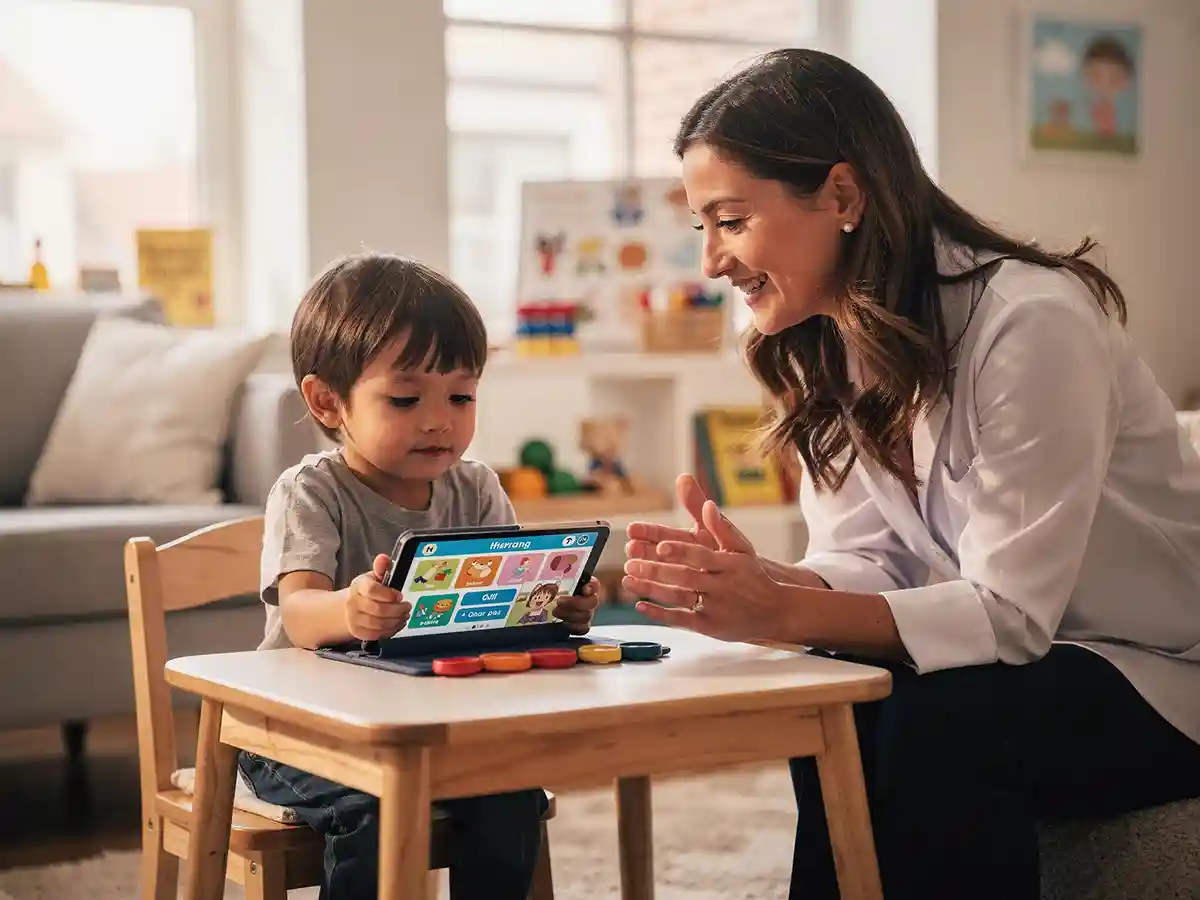
The practical reading is that a device is not a decision to stop trying to speak. AAC covers a wide range, from a laminated picture board to a tablet with a speech app to an eye-gaze system for a child with limited hand control. It runs alongside speech work, and for a child who is minimally verbal it is often what makes the rest of childhood accessible: asking for something at school, arguing with a sibling, telling someone they are in pain.
Where apps and feedback tools fit
Tablet apps have made home practice easier to sustain, mostly because a child will do fifteen repetitions inside a game and eight in a worksheet. Some tools give real-time visual feedback on volume or pitch, which helps a child hear something they cannot otherwise monitor. None of this replaces the therapist, who sets the targets and checks whether practice is drifting into the wrong habits. Our roundup of speech therapy tools goes through the categories in more detail.
Strategies for speech development in cerebral palsy
Therapy is an hour a week at most. The rest of the week is where speech is either practiced or not, which makes what happens at home the larger half of the work.
Building reasons to talk
The useful shift is from correcting speech to creating situations that require it. If a child points at the fridge and the door opens, no words were needed. Pausing, offering a choice of two things out loud, and waiting several seconds longer than feels comfortable gives the child room to produce something. That wait is harder than it sounds, and it is where most of the opportunity is.
Reading together works for the same reason, especially the same book repeatedly, because a familiar line invites a child to fill in the missing word. Songs do it too. Gestures and signs are worth encouraging rather than discouraging: the same evidence that says a device does not suppress speech applies here, and a child who can gesture is a child who is communicating while the words catch up. Our guide to language development in cerebral palsy covers this in more depth.
Goals you can actually check
A goal like “improve clarity” cannot be measured, so nobody can tell whether therapy is working. Most SLPs write goals in the SMART form instead, which is genuinely a checklist:
Specific — names the sound, word, or situation, not “speech”
Measurable — a number you can count, such as accuracy across ten attempts
Achievable — a next step from where the child is now
Relevant — something the child needs in daily life
Time-bound — a date to review it
In practice that turns into something like: produce the /k/ sound at the start of words with 80% accuracy across ten attempts, in the therapy room, by the end of the term. You can tell whether that happened. If it did not, the goal was wrong or the approach was, and either is worth knowing at the review rather than a year later. Progress is easier to read against typical speech and language milestones, keeping in mind that the comparison is a reference point, not a deadline.
Frequently asked questions about improving speech in CP
A speech-language pathologist first identifies which process is breaking down, because dysarthria, childhood apraxia of speech, and a phonological disorder can all reduce intelligibility but call for different work. Sessions then practice speech directly, and cover swallowing safety where that is a concern.
By practicing speech itself: target sounds in real words, breath support so sentences do not fade, and often a slower rate, which for many children with dysarthria is the fastest route to being understood. Communication devices are introduced alongside this when speech alone will not carry the load.
Under the Individuals with Disabilities Education Act, services can begin at birth through Part C, so families do not have to wait for a confirmed diagnosis to be referred. Starting early also means communication is developing at the same time as everything else it supports, including play and early learning.
In a 2020 population-based study of 84 children with cerebral palsy, 82% had delayed or disordered speech. Among those who spoke, 78% had dysarthria, 54% an articulation delay or disorder, 43% a phonological delay or disorder, and 17% features of childhood apraxia of speech. Many had more than one.
As soon as a delay is suspected. A referral to IDEA Part C early intervention does not require a confirmed cerebral palsy diagnosis, and the evaluation itself is free.
It depends on what is breaking down and where the child starts. Realistic aims include being understood by more listeners in more situations, and having a reliable way to communicate at every stage. Our page on the benefits of speech therapy covers what tends to change and over what timescale. Ask the therapist to write goals you can check, with a number and a review date, and read progress against typical speech and language milestones.
Services identified in an IFSP or IEP are provided at no cost to families under IDEA, from birth through age 5 and into the school years. Private therapy outside that varies by location, provider, and frequency, and insurance coverage differs by plan, so check yours.