From picture boards and apps to speech-generating devices and eye-gaze systems, modern speech therapy tools bridge the communication gap for individuals with CP. Choosing wisely is what makes them work.
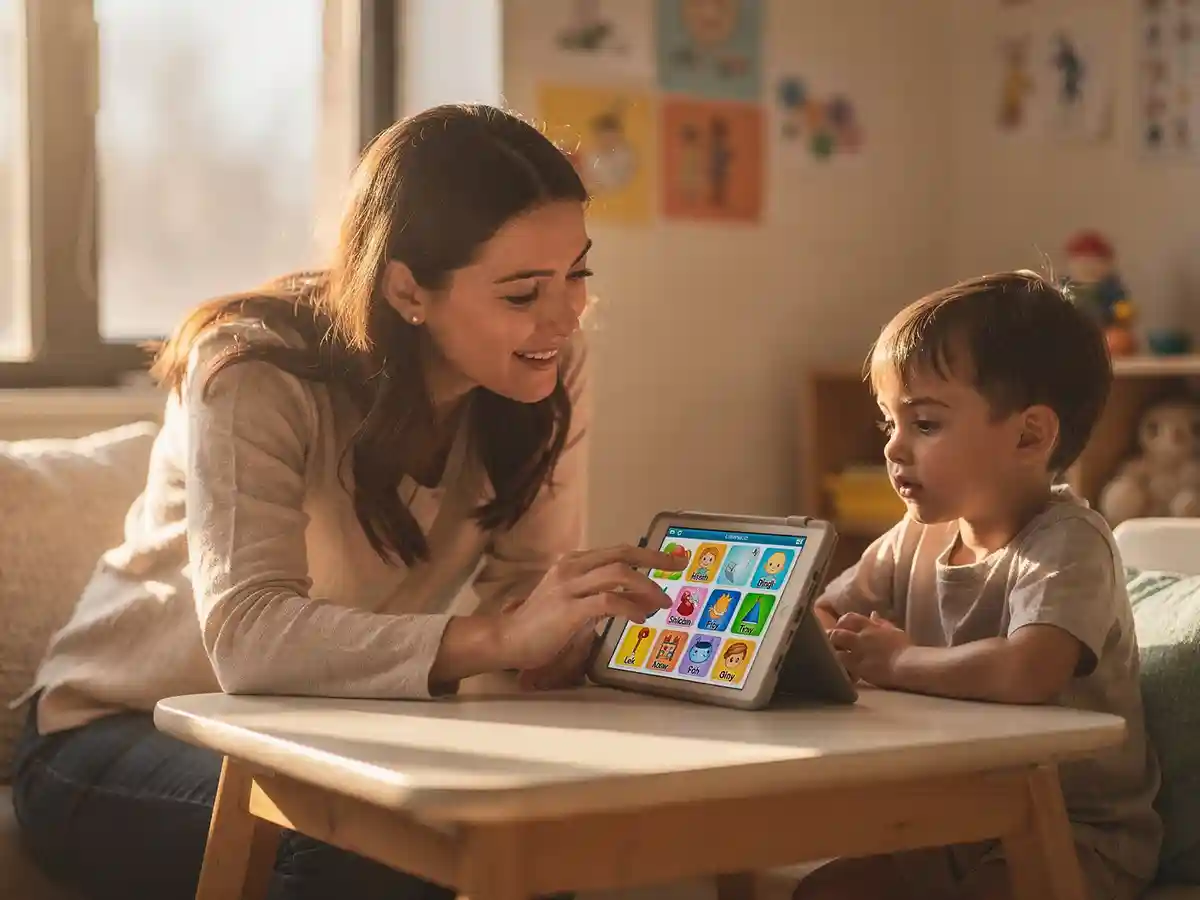
About one in four people with cerebral palsy will not speak (JAMA Pediatrics, 2017) and need another route to language. The usual tool is an AAC app on a tablet, which is cheaper and familiar to the family. A dedicated speech generating device costs more, mounts to a wheelchair, and is the version insurers fund as durable medical equipment.
No single app is best. The right one is set by the vision, motor control and literacy of the child, and it is chosen with a speech language pathologist. The evidence behind the individual tools is uneven enough to be worth knowing before anyone spends money.
Everything on this page exists for that gap, and the evidence behind the individual tools is uneven enough to be worth knowing before anyone spends money.
Most families arrive here carrying the same question, and it is rarely the one they ask out loud. Will giving my child a device stop them from talking? A review in the Journal of Speech, Language, and Hearing Research gathered every study on that point published between 1975 and 2003. Among the 27 cases in the six studies rigorous enough for its best-evidence analysis, not one showed a decrease in speech. Eleven percent showed no change and 89% gained. The answer is no, and the fear has cost children years of communication. For the wider picture, see speech therapy for cerebral palsy.
The range runs from a laminated sheet of symbols to a screen driven by eye movement. In cerebral palsy the deciding factor is usually not vocabulary. It is access: how the child is going to select what they want to say.
Low tech means paper. Communication boards, symbol books, alphabet charts, and partner-assisted scanning, where a listener reads the options aloud and the child signals the one they want. Nothing on that list needs charging, none of it minds being dropped, and none of it stops working in a swimming pool, which is why every high-tech user should own a paper set as well. Devices break. Devices go away for repair. A child with no backup goes silent for a fortnight.
High tech splits two ways. A tablet running an AAC app is cheaper and familiar, while a dedicated speech-generating device is built for the job, mounts to a wheelchair, and is the version insurers fund as durable medical equipment. Between them sit single-message switches: press once, hear one recorded phrase. They look trivial. For a child who has never controlled anything they say, one button that reliably produces a sentence is where cause and effect gets learned.
Access is the real fork in the road
How a child selects is what separates a system that gets used from one that ends up in a cupboard.
Direct touch — fastest, where hand control is good enough to hit a target reliably
Head pointing — a camera follows a reflective dot, useful where the hands are unreliable but head control is not
Switch scanning — the device steps through the options and the child hits one switch to choose, workable with a single dependable movement anywhere on the body
Eye gaze — cameras track where the eyes settle, the route for children with little voluntary movement below the neck
Partner-assisted scanning — no equipment at all, a person reading choices aloud, and the fallback that always works
Grid size follows from access rather than from age. A child who can reliably hit a quarter of the screen starts with four large cells; a child with accurate touch gets sixty small ones and far more vocabulary within reach. Our guide to CP communication devices works through the hardware in detail.
Cerebral palsy communication aids
Choosing one is an assessment, not a purchase. The written report a speech-language pathologist produces is both the clinical decision and the document that funds the device.
Choosing the right communication aid
A proper evaluation looks at what a child understands rather than only at what they produce, and that distinction decides almost everything downstream. Vocabulary sized to what a child can currently say will hold them exactly there. The safer error is the opposite one, because a system with too much on it can be simplified in an afternoon, while a system with too little takes months and another funding cycle to replace.
Trial before purchase wherever it is possible. Many device manufacturers and regional assistive technology programs lend equipment for a few weeks, and a fortnight of real use at home settles questions that no showroom demonstration will, starting with whether the mounting works in the child’s actual wheelchair and whether the family can hear the voice over a noisy kitchen. Align the choice with the goals therapy is already working toward.
Who pays
Medicare treats speech-generating devices as durable medical equipment, and Medicaid programs and private insurers largely follow its rules, which is why the therapist’s report carries so much weight. Eye-tracking accessories have their own legislative history. The Steve Gleason Act of 2015, Public Law 114-40, was signed on July 30, 2015 and applied to devices furnished on or after October 1 that year, and it exists specifically to secure Medicare beneficiary access to eye tracking accessories for speech generating devices.
School is the other route, and it works differently. Under 34 CFR 300.105, a public agency must make assistive technology devices and services available where the IEP team determines a child needs them, and the same section requires school-purchased devices to go home with the child when the team decides that access is necessary for a free appropriate public education. The device still belongs to the school. Families who want equipment that survives a change of district pursue the insurance route in parallel rather than instead.
Why devices get abandoned
The most common failure has nothing to do with the hardware. Adults hand a child a device and then keep speaking to them in ordinary speech, which is roughly like teaching a language that nobody around the learner uses. Aided language input, where the adult points to symbols on the device while talking, is the practice that corrects it, and it asks more of the family than of the child.
A device that lives in a bag between therapy sessions teaches nothing. One that is on the tray at dinner, at bath time and in the car becomes a voice. Two other things predict whether a system holds: whether it is mounted where the child can reach it without asking, and whether the same vocabulary layout appears at home and at school. Both are fixable, and the techniques used in sessions should be the ones used at the kitchen table.
Speech therapy exercises for cerebral palsy
This is where a page like this has to be careful. Blowing bubbles, tongue push-ups and horn hierarchies are widely used and thinly supported, while the therapy that has actually moved intelligibility in children with CP looks nothing like them.
A systematic review in the American Journal of Speech-Language Pathology searched the literature from 1960 to 2007 for evidence that non-speech oral motor exercises change speech. Fifteen studies met the inclusion criteria. The conclusion was that the evidence was insufficient either to support or to refute the practice, and that the critical appraisal found significant weaknesses in almost all of the studies. That is not proof the exercises fail. It is a reason not to spend therapy hours on them by default.
What has been tested in this population is speech practice itself. The Speech Systems Approach targets breath support and speaking rate rather than isolated muscles, delivered in 40-minute sessions three times a week for six weeks. It was studied in 42 children with cerebral palsy and dysarthria, aged 5 to 18 and spanning GMFCS levels I to V, and it increased how much of what they said unfamiliar listeners could understand. Notice the shape of that: a defined dose, real connected speech, and an outcome judged by strangers rather than by parents who already understand the child.
What earns a place in the kit
Sorted by what the evidence actually says:
Paper communication boards, because they never fail and cost almost nothing
A speech-generating device with the access method the child can drive
Speech practice with a defined dose, in connected speech rather than single sounds
Vocabulary the adults around the child also use, on the device, out loud
Oral motor gadgets last, and only where a therapist can say what they are for
Exercises to enhance language development
Language work sits apart from speech work and is often the more urgent of the two. A child whose articulation may never be clear still needs vocabulary, grammar, and practice at holding a conversation, and that comes from shared books, routines with a script the child can complete, and questions that cannot be closed with yes or no. Our page on language development in cerebral palsy covers the milestones this work aims at.
Assistive technology for speech therapy
Eye gaze and switch access have put expressive language within reach of children with almost no reliable voluntary movement. Both take considerably more setup than the marketing implies.
An eye-gaze system uses infrared cameras below the screen to calculate where the user is looking, then treats a fixation of a set duration as a selection. Calibration decides whether it works at all. A system calibrated in a dim therapy room can fail in a sunlit classroom, and glasses, seating angle and head position each move the result. Children whose movement disorder is dyskinetic often do better with eye gaze than with touch, because the eyes stay controllable when the hands do not.
Word prediction and stored phrases matter more than they sound. Building a sentence letter by letter through a scanning grid can take a minute, and conversation does not wait a minute. Prediction, saved phrases for the things said every day, and a quick way to interrupt are what make a device usable in a real exchange rather than only in a therapy exercise.
Apps are practice, not a voice
Therapy apps and AAC apps sit side by side in the same app store and are entirely different products. An articulation game or a vocabulary app is practice material, useful between sessions and easy to track. A full AAC app is a communication system with organized core vocabulary behind it, and substituting one for the other because it costs less leaves a child holding a toy instead of a voice. Ask which category a recommendation falls into before paying for anything.
Frequently asked questions about speech therapy tools
Two different categories that often get shelved together. Communication systems, running from paper communication boards to speech-generating devices with eye-gaze access, give a child a way to say things. Practice materials, including therapy apps and articulation games, work on the speech a child already produces. Confusing the two is the most expensive common mistake.
They separate having language from being able to speak it. A review in the Journal of Speech, Language, and Hearing Research found that among the 27 cases in its best-evidence analysis, none lost speech after AAC intervention and 89% gained. What decides whether a device works is the access method, so see CP communication devices for how touch, switch scanning and eye gaze compare.
Dysarthria in cerebral palsy is a motor problem, and it says nothing about what a child understands. The Speech Systems Approach, 40-minute sessions three times a week for six weeks aimed at breath support and speaking rate, increased intelligibility in 42 children with CP aged 5 to 18 across GMFCS levels I to V.
As soon as there is a concern, and before a diagnosis is confirmed if early intervention services are available. There are no prerequisite skills a child has to demonstrate before AAC is appropriate; the older idea that a child must first qualify for a device has been abandoned in the field. See ST for toddlers with CP.
Paper boards cost the price of laminating. Speech-generating devices are funded as durable medical equipment under Medicare, with Medicaid and private insurers largely following those rules, and the Steve Gleason Act of 2015 (Public Law 114-40) exists to secure access to eye tracking accessories. Schools fund devices separately under 34 CFR 300.105, but that equipment belongs to the school.
A way to ask, refuse, joke and argue, which is what communication is for and what a yes or no signal cannot carry. The benefit depends on use rather than on the device: a system the adults around the child model out loud every day gets learned, and one that stays in a bag between therapy sessions does not.
Start with an AAC evaluation by a speech-language pathologist, ask to borrow equipment for a few weeks before committing, and ask specifically who will train the family to model on the device. Regional assistive technology programs and device manufacturers both run loan libraries, and a fortnight of real use at home answers questions a showroom cannot.