What milestones look like
Typical CP speech milestones include:
- Babbling (delayed but still happens)
- First meaningful words
- Two-word combinations
- Simple sentence formation
- Conversational turn-taking
Typical milestones give you a reference point, not a deadline. A child with cerebral palsy may pass some on time, reach others late, and route around a few entirely using a device. Knowing which is which is the useful part.
The American Speech-Language-Hearing Association puts the two-year marker at using and understanding at least 50 different words and putting two of them together, as in more water. That is the benchmark. What it does not tell you is what to do when your child is at 12 words, or has 200 but cannot be understood by a stranger.
This page sets out the standard milestones, then the part that matters more in cerebral palsy: how to measure progress against where your own child started, rather than against a chart built from children with no motor speech impairment. For the broader picture, see speech therapy for cerebral palsy.
Ask what is being counted. Progress that cannot be stated as a number is progress nobody can confirm, and it is the difference between a plan that gets adjusted and one that runs for a year on impressions.
Three numbers do most of the work. Accuracy on a target sound, counted across a set number of attempts, shows whether a specific goal is moving. Intelligibility, the share of what a child says that a listener actually understands, is the outcome the published trials use, and it is normally measured twice: once with a listener who knows the child and once with a stranger. Those two figures are often far apart, and the gap is informative in itself.
Vocabulary count is the third, and it is the one families track most naturally. Write words down as they appear. Forty words in March and sixty-five in June is a clearer picture than any adjective.
Gestures and device use belong in the same record. A child who starts using a symbol to ask for something has gained communication, whether or not the spoken word arrived with it.
Speech development is unique to each child, influenced by the type and severity of their CP. Therapy goals aim to help children reach essential milestones for their age, with patience and innovative techniques.
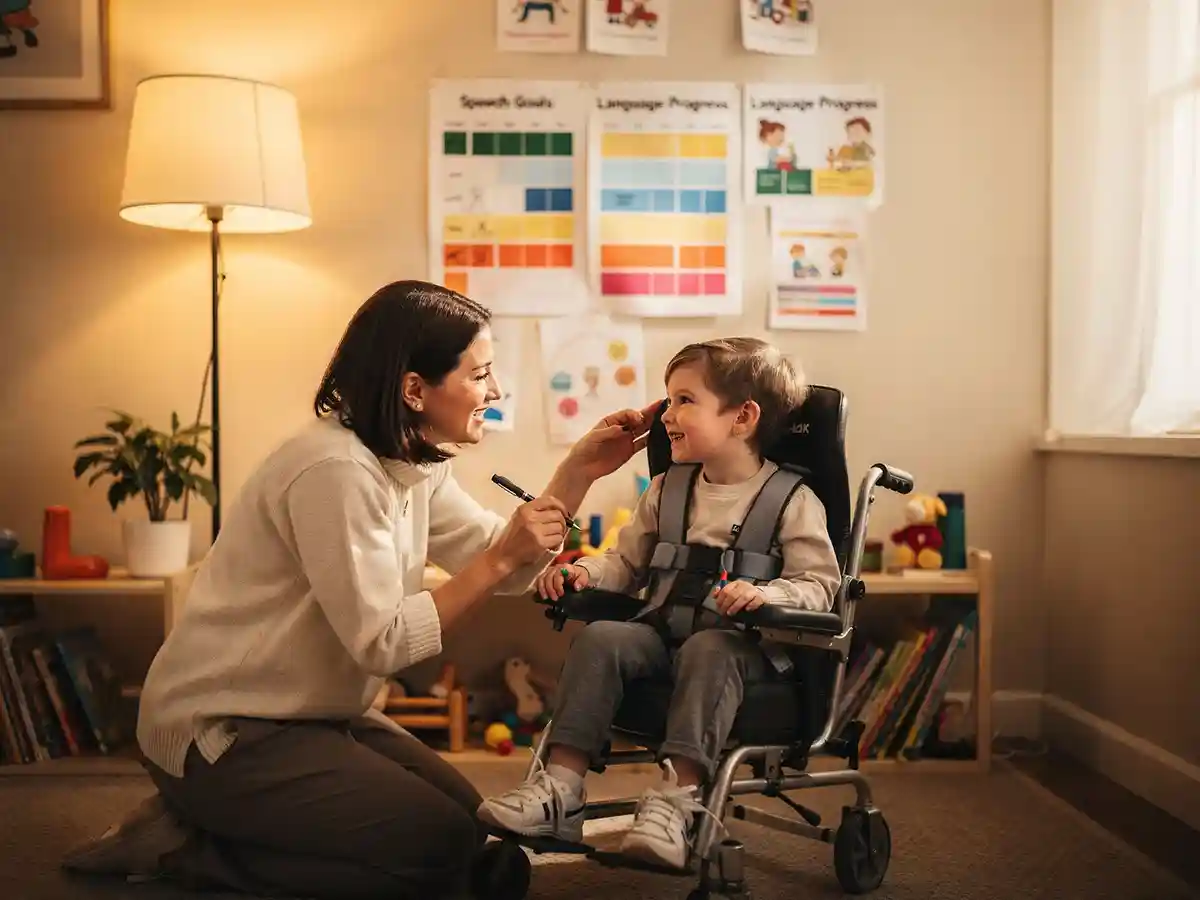
Typical CP speech milestones include:
ASHA sets out communication milestones in bands. In the first year, a child points, waves, and gives objects, and produces vowel sounds combined with consonants. Between 13 and 18 months they follow simple directions like give me the ball, point to make requests, and shake or nod their head. By 19 to 24 months the marker is at least 50 words understood and used, and two of them combined. Between two and three years, word combinations become routine, and grammar starts appearing: verbs ending in -ing, and -ed for things that already happened.
Two adjustments matter before you compare your child to that list. Use corrected age if they were born preterm, which many children with cerebral palsy were, and see speech therapy for toddlers for what the earliest sessions involve. And separate the two questions the list runs together: whether a child understands language, and whether they can produce speech. A motor speech impairment affects the second without necessarily touching the first.
Setting effective goals involves understanding the interplay between cognitive and communicative development. Goals should reflect both short-term wins and long-term direction, with early intervention as the foundation.
Compare two goals. Improve expressive language cannot be verified by anyone. Produce the /k/ sound at the start of words with 80% accuracy across ten attempts, by the end of term, can be. If the second one is not met, either the target was wrong or the approach was, and both are worth knowing at the review rather than a year later.
The SLP writes the goals, but the useful version comes out of a conversation. A parent knows which words would change the child's day, and a goal built on a word the child actually needs gets practiced far more than one drawn from a list.
Cognitive functioning impacts a child’s ability to understand and produce language. Speech delay in CP is often linked to cognitive challenges, addressing these together yields significant progress.
This is the most important thing on the page. Attention, memory, and problem-solving do shape how language develops, and some children with cerebral palsy have cognitive impairment alongside it. But a child who cannot make their mouth produce clear words is not thereby a child who does not understand. Dysarthria is a motor problem.
The practical consequence is that children with severe speech impairment are routinely underestimated, in classrooms and sometimes in clinics, because the assessment depended on spoken answers. Where that is a risk, ask how comprehension is being tested separately from speech production, and whether the child has a reliable way to answer that does not require speaking.
Give the child a means of expression that works now. That may be gestures, a symbol board, or a speech-generating device, and it does not slow spoken speech down: a research review in the Journal of Speech, Language, and Hearing Research found AAC did not impede speech production, with no study reporting a decrease.
Oral motor activities such as blowing bubbles and drinking through straws are commonly sent home, but a systematic review of 15 studies found insufficient evidence to support or refute their effect on speech. Our page on improving speech in cerebral palsy covers that evidence, and language development covers comprehension in more depth.
They are the standard communication markers: pointing and waving in the first year, following simple directions and shaking or nodding the head from 13 to 18 months, at least 50 words with two combined by 24 months, and grammar such as -ing and -ed between two and three years. In cerebral palsy they are a reference point rather than a schedule.
Most often through dysarthria, where the muscles controlling breath, voice and articulation are weak or poorly coordinated. In a 2020 population-based study, 82% of children with cerebral palsy had delayed or disordered speech, and 78% of those who spoke had dysarthria. Understanding language is a separate question from producing speech.
Because repetition is what changes a motor pattern, and starting earlier means more total practice. Under IDEA, services can begin at birth, and a referral does not require a confirmed diagnosis.
As soon as a delay is suspected, using corrected age if the child was born preterm. Waiting for certainty costs practice time that cannot be recovered.
More of what a child says being understood by more listeners, and a reliable way to communicate at every stage. Published trials of intensive therapy measured intelligibility gains of roughly ten percentage points.
Keep a written list of words as they appear, practice in short frequent blocks rather than one long session, and give the child time to answer without filling the silence. Ask the therapist which single target to work on, so home practice reinforces the plan instead of running parallel to it.
Services identified in an IFSP or IEP are provided at no cost to families under IDEA. Private therapy varies by location, provider and frequency, and insurance coverage differs by plan. Our guide to disability benefits covers the other programs families draw on.
Kelsey is an experienced surgical nurse who works extensively with pediatric patients and families navigating birth injuries and cerebral palsy diagnoses. She is licensed by the Missouri Board of Nursing and operates under the Nurse Licensure Compact, allowing her to practice across compact-member states. As both a mentor and patient advocate, Kelsey focuses on safety, communication, and compassionate care: helping families understand medical procedures, treatment options, and the realities of pediatric conditions.
View Kelsey Pabst, RN's full bio →
Our nurses, patient advocates and legal experts are solely focused on bringing you the latest cerebral palsy information, options for financial assistance and access to community support.
Editorial process →The information on this page is provided for general educational purposes and is not a substitute for professional medical or legal advice, diagnosis, or treatment. Always seek the guidance of a qualified physician or attorney with any questions about a medical condition or legal matter. Read our full disclaimer.