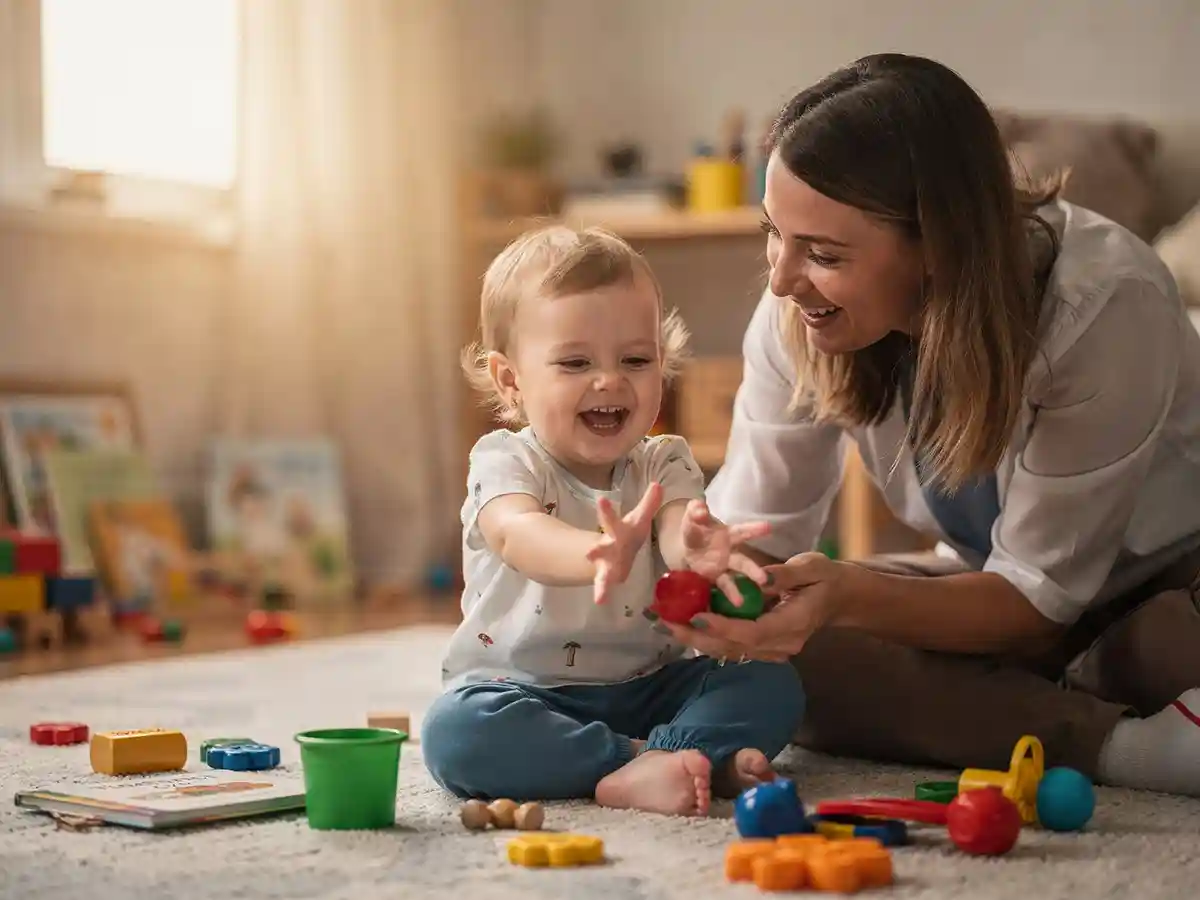
For toddlers with CP, speech therapy is one of the highest-leverage interventions available. Early, play-based, and patient, it lays the foundation for a lifetime of communication.
Medically reviewed
Updated August 2026
8 min read
Play-based
Sessions feel like play; learning happens through fun
Earliest = best
Brain plasticity makes toddler-age therapy most effective
Family-led
Parents are partners in the daily practice
Under three, the therapist is not the person doing most of the work. Early intervention at this age is delivered in the home by federal design, and what changes a toddler’s communication is what the people around them do all day.
That is worth saying plainly because it reframes what to ask for. A weekly session is a coaching appointment for the other 167 hours, and a family who leaves it knowing three things to do differently at dinner has got more from it than one who watched a specialist do something skilful. Cerebral palsy affects the muscles that produce speech, so the motor problem is real, and it sits alongside a language-learning process that runs on ordinary conversation.
Speech therapy exercises for toddlers with cerebral palsy
One long-standing staple has to go first. Blowing bubbles, horn play and tongue exercises are widely used at this age and the evidence does not support them.
A systematic review in the American Journal of Speech-Language Pathology searched the literature from 1960 to 2007 for evidence that non-speech oral motor exercises change speech. Fifteen studies met the criteria, and the conclusion was that the evidence was insufficient either to support or refute the practice, with significant methodological weaknesses in almost all of them. That is not proof they fail. It is a reason to spend a toddler’s short attention span on something with a better claim to it.
What has a better claim is talking. Not talking at a child, which is what most adults do more of when a child is not responding, but arranging the day so that communicating is worth the effort: pausing long enough for a response, putting a wanted object in sight and out of reach, offering a choice between two things rather than asking a yes or no question, and naming what the child is already looking at instead of redirecting them to what you are holding.
Incorporating play in speech therapy
Play is the format because a two-year-old will not do an exercise but will do almost anything to keep a game going. The technique underneath it is simple enough to describe in a sentence: follow the child’s attention, then add one step to whatever they just did. If they say a word, say two. If they push a car, push it and say where it is going. Puppets and books are useful props for that, not treatments in themselves.
Benefits of speech therapy for cerebral palsy in toddlers
Across cerebral palsy as a whole, roughly three in four people will talk. The point of starting at two is partly to improve the odds and partly to make sure the child in the other quarter is not left without a way to communicate while everyone waits.
That figure comes from the 2017 international clinical practice guideline in JAMA Pediatrics, which also records that two in three will walk and one in two have normal intelligence. It is worth holding all three together, because a toddler who is not yet talking is routinely assumed to be behind in every other way, and the assumption is wrong often enough to be dangerous. The benefits of speech therapy at this age include protecting a child from being underestimated.
What works at this age
Ordered by how much evidence stands behind it:
Adults modelling language on whatever the child is already attending to
Waiting, and building in reasons to communicate
Signs and gestures, which arrive before speech does
Early AAC, which does not suppress speech and often accompanies gains
Oral motor play last, and only with a stated purpose
Enhancing communication skills
The fear that stops families introducing augmentative communication early is that a device will remove the reason to speak. A review in the Journal of Speech, Language, and Hearing Research gathered every study on that question published between 1975 and 2003. Of the 27 cases in the six studies rigorous enough for its best-evidence analysis, none showed a decrease in speech. Eleven percent were unchanged and 89% gained.
So a picture board at two is not a decision to stop pursuing speech. It is a way of giving a child something to say while the speech is still arriving, and gestures and simple signs do the same job with nothing to carry.
Speech development in toddlers with cerebral palsy
Clarity develops on a schedule, and there are published norms for it. Complete intelligibility to strangers is normally reached by four years of age, with benchmarks for 50% and 75% before that.
Those norms come from work published in Pediatrics in 1988, and they are useful precisely because they measure the thing families notice rather than the thing clinicians count. A parent understands their own child, so parental comprehension is a poor gauge. Whether an unfamiliar adult follows what the child said is the question that matters, and it is the one to ask at a review appointment.
Children with cerebral palsy often reach these points later, and dysarthria in this population is a motor problem rather than a cognitive one. Our guide to speech milestones in CP sets out what to watch and when.
Recognizing early signs of speech delays
Refer on any of these rather than waiting for the next well-child visit:
No babbling with consonants by around 10 months
No single words by 15 to 18 months
No two-word combinations by around 24 months
Loss of words or skills the child previously had, which needs urgent assessment
Coughing, choking or a wet voice during feeds, which points to swallowing rather than speech
The last one is often missed. Feeding and speech use the same muscles, and a toddler struggling to swallow safely needs that assessed on its own terms.
Early intervention speech therapy strategies
Referral does not wait for a diagnosis, and services under age three come with a legal setting attached: the home, unless there is a reason it cannot work there.
Under 34 CFR 303.126, each state’s early intervention system must ensure services for infants and toddlers with disabilities are delivered in natural environments to the maximum extent appropriate, and elsewhere only when they cannot be achieved satisfactorily in a natural environment, as decided by the parent and the team. A natural environment is where a child that age would ordinarily be, which for a two-year-old means home and childcare.
There is also no threshold a toddler has to clear before AAC is appropriate. The older idea that a child must first demonstrate certain skills to qualify for a communication system has been abandoned in the field, and waiting for a child to prove they deserve a voice is the delay that does the damage. Our guide to speech therapy tools covers what is available and how it is funded, and disability benefits may cover part of what insurance does not.
Ask for the plan in writing, with what the family will do differently and how anyone will know it is working. The rest of the treatment plan should say the same.
Frequently asked questions about ST for toddlers with CP
Coaching for the adults as much as sessions for the child. Under three the services are delivered in the home by federal design, and what changes a toddler’s communication is what the people around them do all day, so a weekly appointment is a coaching slot for the other 167 hours.
By building reasons to communicate into the day and by modelling language on whatever the child is already looking at, rather than by drilling sounds. Signs, gestures and early augmentative communication give a child something to say while speech is still arriving.
Because roughly three in four people with cerebral palsy will talk, and a toddler who is not yet talking is routinely assumed to be behind in every other way. One in two people with CP have normal intelligence, so the assumption is wrong often enough to be dangerous, and early support protects a child from being underestimated.
As soon as there is a concern, without waiting for a confirmed diagnosis. Under 34 CFR 303.126 early intervention services must be provided in natural environments to the maximum extent appropriate, and there is no threshold a toddler has to clear before a communication system is appropriate.
Services under Part C are provided at no cost or reduced cost depending on the state, while past age three the route runs through school services and insurance, which usually caps visits. Ask what the annual limit is before the plan is built. Disability benefits may cover part of what insurance does not.
A way to be understood by someone who is not a parent, which is the benchmark that matters. Published norms in Pediatrics put complete intelligibility to strangers at four years of age, with markers for 50% and 75% before that, and children with cerebral palsy often reach them later. See speech milestones in CP.
Yes, and the worry that a device removes the reason to speak has been tested. A review in the Journal of Speech, Language, and Hearing Research covering studies from 1975 to 2003 found that of the 27 cases in its best-evidence analysis, none lost speech after AAC intervention, 11% were unchanged and 89% gained.