Language development and CP are intricately linked: the neurological condition shapes how a child acquires words, understands language, and communicates. Understanding the link is the first step toward effective support.
Medically reviewed
Updated September 2026
7 min read
50 words
the ASHA marker at 24 months, with two combined
82%
of children with CP had delayed or disordered speech in one study
Not the same
language and speech are different problems
Speech and language are different problems, and conflating them is the most common mistake made about children with cerebral palsy. Speech is the motor act of producing sounds. Language is the vocabulary, grammar and understanding underneath it. A child can have a severe problem with one and none with the other.
That distinction decides what therapy should target, and it decides whether a child is being assessed fairly. This page covers how the two interact, the standard milestones and how to read them, and what helps with the communication barriers that follow when a child understands more than they can say. For the wider picture see speech therapy for cerebral palsy.
Speech therapy is a cornerstone in managing the needs of CP and language development. The personalized nature of therapy techniques ensures interventions suit each child’s specific challenges and abilities.
Language and speech are not the same problem
This page is about language: vocabulary, grammar, understanding, and the use of it to get something done. Speech is the motor act of producing sounds. Cerebral palsy affects the second directly and the first indirectly, mostly by limiting how much practice a child gets at conversation.
In a 2020 population-based study of 84 children with cerebral palsy, 82% had delayed or disordered speech. That is speech. How many had a language disorder underneath it is a separate question, and answering it for an individual child is the first thing an assessment should do.
Which exercises earn their place
Work done while speaking is what carries evidence: target sounds in real words, breath support, and rate control. In a 2013 trial of 15 children aged 5 to 11 given three sessions a week for six weeks, single-word intelligibility rose 10.8% for familiar listeners and 9.3% for unfamiliar ones. Our page on the benefits of speech therapy sets out what those gains mean.
Nonspeech oral motor drills, the blowing and straw activities often sent home, were examined in a systematic review of 15 studies that found insufficient evidence to support or refute an effect on speech. See improving speech in cerebral palsy for that evidence in full.
Language milestones in cerebral palsy
Language development in CP children often follows a unique trajectory. Understanding these milestones and recognizing deviations early leads to more effective interventions.
Building a language-rich environment
Parents create the conditions for language to grow:
Daily reading aloud (even before speech emerges)
Naming objects and actions throughout the day
Singing songs and repeating familiar phrases
Gesture and sign language alongside speech
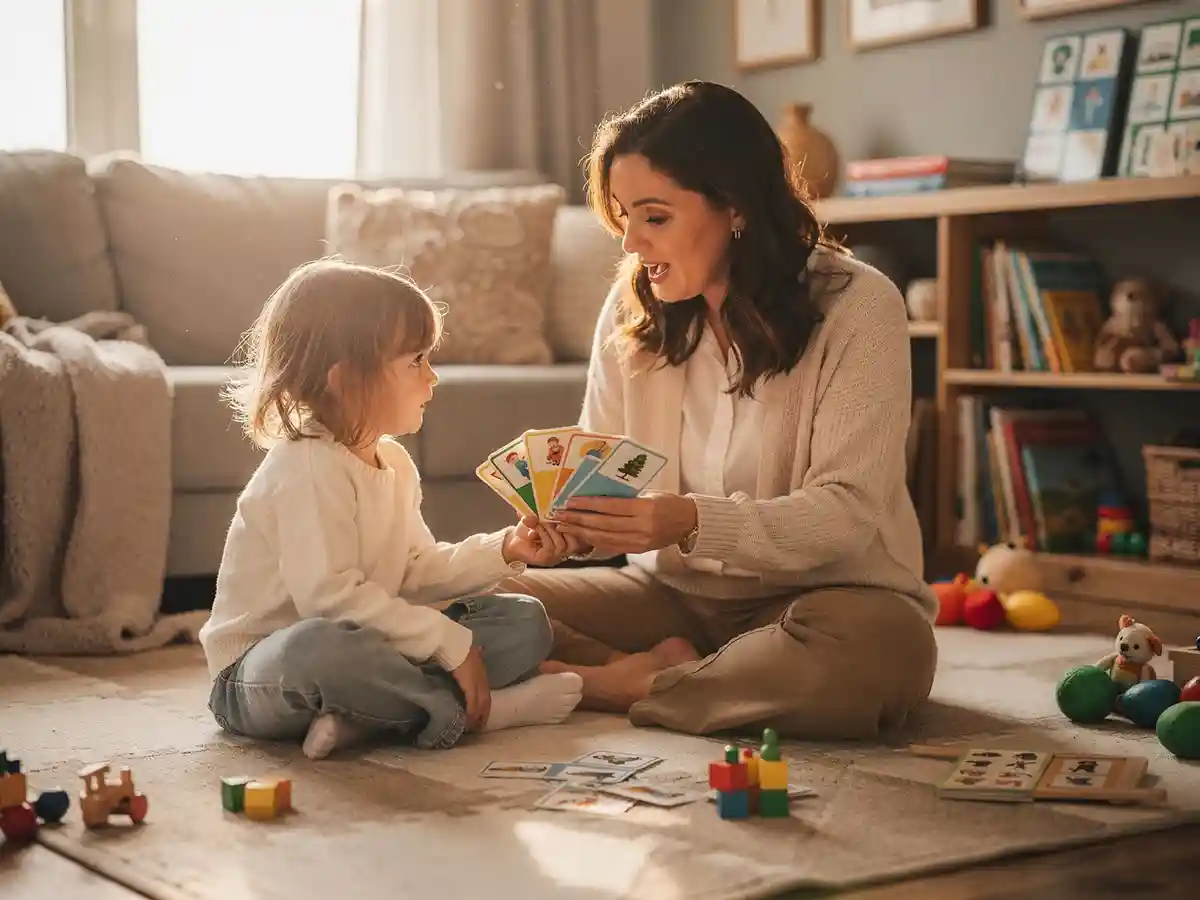
Visual aids and picture cards for everyday concepts
The standard markers
The American Speech-Language-Hearing Association sets out milestones by band. In the first year: pointing, waving, giving objects, and vowel sounds combined with consonants. From 13 to 18 months: following simple directions, pointing to request, shaking and nodding the head. By 19 to 24 months: at least 50 words understood and used, and two combined. Between two and three: word combinations become routine and grammar appears, with -ing on verbs and -ed for the past.
Use corrected age if the child was born preterm, as many children with cerebral palsy were. Then look for the gap between understanding and speaking, because that gap is the informative part: a child who follows two-step instructions but produces few words is telling you the problem is production, not comprehension.
Watch for whether the child initiates. A child who communicates only when prompted, however clearly, is showing something a word count will miss.
Communication challenges in cerebral palsy
Communication challenges are multifaceted, involving both physical and neurological components. These hinder a child’s ability to express themselves and interact, impacting social and educational experiences.
Where the breakdown actually is
Three different things get called a language problem. Motor speech impairment means the child knows the word and cannot produce it clearly. A receptive difficulty means the words coming in are not fully processed. An expressive difficulty means the language itself is not being assembled. A child can have one, two, or all three, and the therapy differs for each.
The distinction matters most for the first. Dysarthria is a motor problem, so a child who cannot make themselves understood may understand everything said to them, and is routinely underestimated when assessment relies on spoken answers.
What helps
Give the child a way to answer that does not depend on speech, whether that is a symbol board, a device, or a reliable yes and no signal. Reduce the noise, which costs a listener more than people expect. Establish the topic before the detail, because a listener who knows the subject decodes far more. And wait: the pause before a child produces a word is longer than adult conversation normally tolerates, and filling it teaches them not to bother.
Ask the child to repeat only the word that was missed rather than the whole sentence. It is faster and much less demoralizing than the alternative.
Role of speech therapists in cerebral palsy
Speech therapists play a vital role in improving communication for individuals with CP. Their specialized support is pivotal for language acquisition, offering interventions that address the neurological disorders complicating speech and language development.
What an SLP is actually doing
First, separating comprehension from production, because they need different work and only one of them is visible. Then choosing targets narrow enough to measure: a sound, a sentence structure, a set of words the child needs. Then setting up the device or symbol system if speech alone will not carry the load, and training the people around the child to use it too, since a device nobody else touches becomes a homework object rather than a way of talking.
Making the day carry the practice
Therapy is an hour a week at most, so the therapist’s real job is often coaching whoever is there the rest of the time. That means showing a parent how to pause and wait, how to offer a choice aloud instead of anticipating, and how to model a slightly longer sentence than the child produced rather than correcting the one they used.
Routines beat sessions here. Meals, dressing and the trip to school happen daily and already have a script, which makes them better practice ground than any set-aside activity.
Frequently asked questions about CP and language development
Mostly indirectly. Cerebral palsy affects speech directly, through the motor control of breath, voice and articulation. Language is affected more by the reduced practice at conversation that follows, which is why giving a child a workable way to communicate early matters so much.
Speech is the motor act of producing sounds. Language is vocabulary, grammar and understanding. A child with severe dysarthria may understand everything said to them, and is routinely underestimated when assessment depends on spoken answers.
The ASHA markers: pointing, waving and vowel-consonant sounds in the first year; following simple directions from 13 to 18 months; at least 50 words with two combined by 24 months; and grammar such as -ing and -ed between two and three. Use corrected age if the child was born preterm.
Look at the gap between understanding and speaking rather than at word count alone. A child who follows two-step instructions but produces few words is showing that production, not comprehension, is the problem. Also watch whether the child initiates at all.
As soon as a delay is suspected. A referral to IDEA Part C early intervention does not require a confirmed cerebral palsy diagnosis, and the evaluation itself is free.
Give a way to answer that does not depend on speech, reduce background noise, establish the topic before the detail, and wait longer than feels comfortable. Ask for only the missed word to be repeated rather than the whole sentence.
Work done while speaking: target sounds in real words, breath support, and rate control. In a 2013 trial of 15 children given three sessions a week for six weeks, single-word intelligibility rose 10.8% for familiar listeners. Nonspeech oral motor drills have insufficient evidence of an effect on speech.