The best-tested technique in cerebral palsy targets breath support, phonation, and speech rate together, at three sessions a week for six weeks. Here is what that involves, what it produced, and which of the other common techniques the evidence does not yet back.
Medically reviewed
Updated August 2026
9 min read
3x weekly
the dose used in the trials that measured a gain
6 weeks
length of the tested therapy block, with gains held at follow-up
21 studies
the whole evidence base for motor speech intervention in CP
In 2023, four researchers screened 1,036 studies of motor speech intervention in children with cerebral palsy and found 21 worth including. Their verdict on the quality of that evidence, published in the Journal of Speech, Language, and Hearing Research, was very low to moderate.
That is worth knowing before reading any list of techniques, including this one. Some of the methods below have been tested in children with cerebral palsy specifically, with measured results and a stated dose. Others are widely used and thinly evidenced. This page separates the two, because a parent deciding how to spend a limited number of therapy hours deserves to know which is which. For the broader picture, see speech therapy for cerebral palsy.
Dysarthria in cerebral palsy is a motor problem. The muscles that manage breath, voice, and articulation are weak or poorly coordinated, so the techniques that help are the ones that treat it like motor learning rather than like a vocabulary gap.
Why dose and repetition keep coming up
The 2023 review made a specific criticism of the field: adherence to the principles of motor learning was inconsistent across the studies it examined. Those principles are the same ones that govern learning any physical skill. Practice has to be frequent, it has to be intense enough to be hard, it has to give the learner feedback, and it has to move toward the real task rather than staying on drills.
This is why a therapist may push for three sessions a week for a fixed block rather than one session a week indefinitely. It is also why home practice carries so much weight. An hour a week of anything is not enough repetition to change a motor pattern, and the studies that produced measurable gains were built around a much heavier schedule.
What an SLP assesses before choosing a technique
The choice is not made from a menu. A speech-language pathologist works out where intelligibility is actually being lost, because breath support, voice, rate, and articulation fail in different ways and respond to different work. Swallowing safety is checked alongside it, since the same musculature is involved. Our guide to improving speech in cerebral palsy covers that assessment in more detail, and speech therapy for toddlers covers how it differs in the youngest children.
Techniques for improving speech in cerebral palsy
The best-tested approach in this population targets three things at once: breath support, phonation, and speech rate. It is usually called a speech systems approach, and unlike most of what gets recommended, it comes with published numbers.
The speech systems approach: breath support, phonation, and rate
Lesley Pennington and colleagues at Newcastle tested it twice. In a 2013 study in Developmental Medicine & Child Neurology, 15 children aged 5 to 11 received three individual sessions a week for six weeks, each 35 to 40 minutes. Intelligibility was measured before and after by listeners who knew the children and by listeners who did not.
Single-word intelligibility rose 10.8% for familiar listeners and 9.3% for unfamiliar ones. Connected speech rose 9.4% and 10.5%. The gains held at the six-week follow-up, and at twelve weeks there was no further change, which is to say the improvement stayed without more therapy. An earlier study using the same approach with 16 children aged 12 to 18 ran three sessions a week for six weeks at 30 to 45 minutes each, and families described that schedule as manageable given what it achieved.
Two things are worth taking from this. The numbers are real but modest, roughly a tenth more of what a child says being understood, which can still be the difference between a teacher following a sentence and asking for it again. Our page on the benefits of speech therapy sets out what tends to change beyond intelligibility alone. And the dose is specific. Three sessions a week for six weeks is a different proposition from a weekly session continued indefinitely, and it is the version that was actually tested.
Augmentative and alternative communication
For a child who is minimally verbal, AAC is not a fallback after speech work fails. It runs alongside it. A research review in the Journal of Speech, Language, and Hearing Research found that AAC did not impede speech production in people with developmental disabilities, and across the studies reviewed none reported a decrease. AAC systems span a wide range:
Picture boards and communication books
Speech-generating devices with switch or touch input
Eye-gaze systems for those without reliable motor control
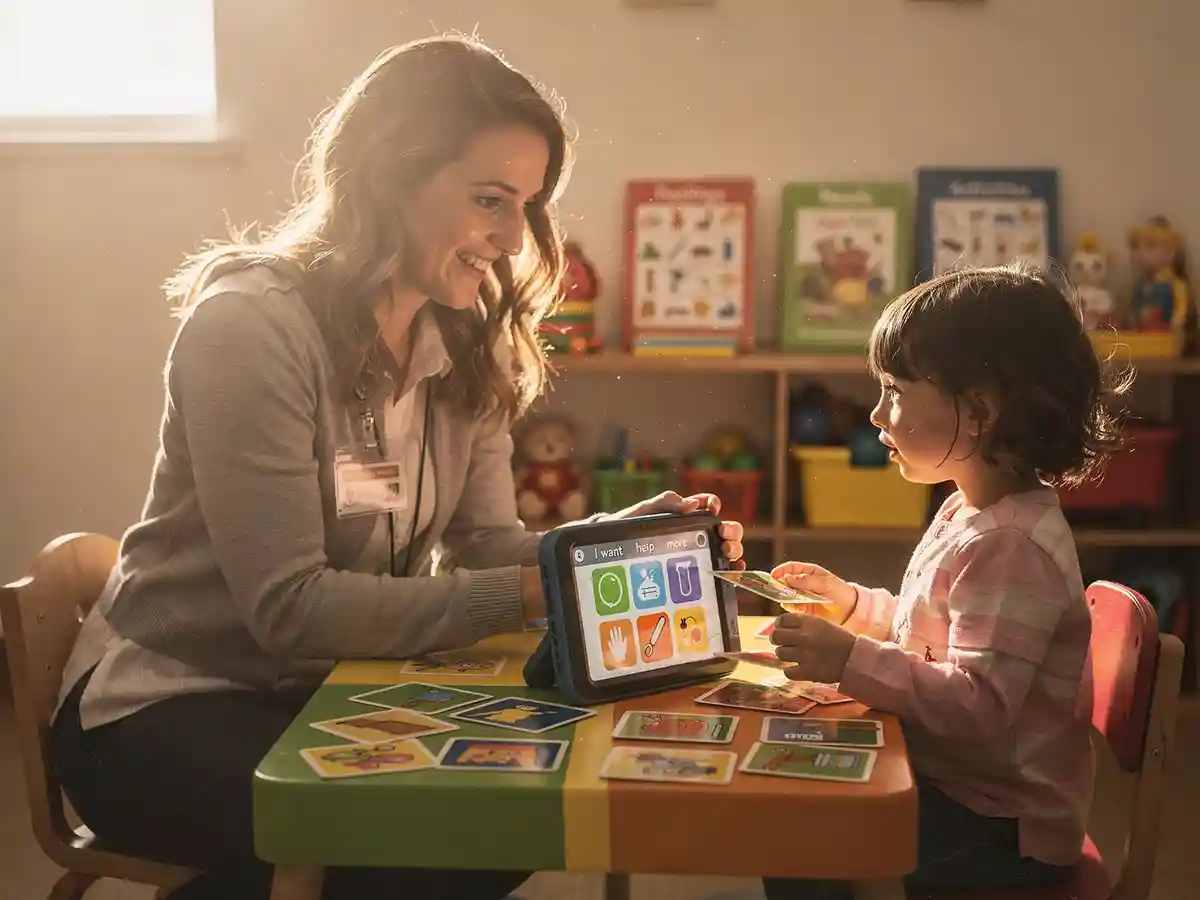
Tablet-based AAC apps with custom vocabularies
Sign language and gesture-based systems
Articulation and speech sound work
Where a child has a speech sound disorder alongside the dysarthria, and many do, the work looks more familiar: a target sound practiced in isolation, then in syllables, then at the start of words, then in the middle, then in phrases the child actually uses. Progress is tracked as accuracy across a set number of attempts, which is what makes it possible to tell whether a technique is working rather than just feeling productive.
Feedback is the part that gets skipped at home. A child repeating a sound incorrectly fifty times is practicing the error, so short sessions with someone listening beat long ones without.
Cerebral palsy communication strategies
Intelligibility is not a property of the speaker alone. The Pennington studies measured it separately for listeners who knew the child and listeners who did not, and the two numbers were different, which is a useful reminder that the listener is half of the exchange.
Play-based ST works
For young children, play is therapy:
Role-playing builds turn-taking and vocabulary
Storytelling stretches language across time
Interactive games encourage practice in a low-pressure setting
Engagement is naturally higher
Skills generalize more readily to real conversations
What the listener can do
Some of the most effective adjustments cost nothing and belong to the people around the child. Establishing the topic before the detail helps, because a listener who knows the subject can decode far more. So does asking the child to repeat only the word that was missed rather than the whole sentence, which is less demoralizing and usually faster. Reducing background noise matters more than people expect, and so does giving the child time without filling the silence for them.
Guessing and moving on is the habit worth breaking. It teaches a child that speaking did not accomplish anything, which is the opposite of the motivation therapy depends on.
Play, and why it is not just engagement
With younger children, therapy that looks like play is doing something specific: it produces far more repetitions than a worksheet does, and it produces them in something closer to real conversation. Role-play creates turn-taking. A repeated story invites a child to supply the missing word. Both put practice inside the task the skill is actually for, which is one of the motor learning principles the 2023 review found so unevenly applied.
Visual supports work alongside it. Picture cards and symbol sets give a child a way to hold the topic steady while the words come, and they are useful for a speaking child, not only for a child using AAC. Our roundup of speech therapy tools covers what is available.
Speech exercises for cerebral palsy
The exercises that carry evidence in cerebral palsy are the ones done while speaking. That distinction matters more than any individual drill, and it is where a lot of home practice goes wrong.
Breath support, phonation, and rate exercises
These are the three targets in the Pennington studies, and they are worked on through speech rather than around it. Breath support might mean taking a breath at a planned point in a sentence rather than pushing on until the voice runs out. Phonation work builds a steadier, louder voice, often by holding a sound and then carrying that volume into words. Rate work slows things down, and for many children with dysarthria it is the single change that buys the most intelligibility, because the articulators get time to arrive.
None of that is glamorous. It is repetitive, it needs feedback, and it works best in short frequent blocks rather than one long stretch.
A note on tongue, lip, and jaw drills
Exercises that strengthen the mouth without speaking, sometimes called nonspeech oral motor exercises, are among the most commonly assigned home activities and among the least supported. A systematic review in the American Journal of Speech-Language Pathology examined 15 studies and found insufficient evidence to support or refute their effect on speech.
That does not make them harmful, and oral motor work for feeding and swallowing is a separate question with its own evidence. It does mean the time is better spent on speech itself unless a therapist has a specific reason. Our page on improving speech in cerebral palsy goes through that evidence in full.
Frequently asked questions about speech therapy techniques
Dysarthria in cerebral palsy is a motor problem, so therapy treats it as motor learning: frequent practice on speech itself, with feedback, working toward real conversation rather than staying on drills. Swallowing safety is assessed alongside it because the same muscles are involved.
The best-tested approach targets breath support, phonation, and speech rate together. In a 2013 study of 15 children aged 5 to 11, single-word intelligibility rose 10.8% for familiar listeners and 9.3% for unfamiliar ones after six weeks of therapy, and the gains held at follow-up.
Repetition is what changes a motor pattern, and a 2023 systematic review criticized the field for applying the principles of motor learning inconsistently. Starting earlier means more total practice during the years a child is learning to communicate at all.
As soon as a delay is suspected. A referral does not require a confirmed cerebral palsy diagnosis, and under IDEA services can begin at birth.
Realistically, more of what a child says being understood by more people. The measured gains in the published trials were around ten percentage points of intelligibility, which is modest but can decide whether a teacher follows a sentence or asks for it again.
Services identified in an IFSP or IEP are provided at no cost to families under IDEA. Private therapy varies by location, provider, and frequency, and insurance coverage differs by plan.
Speech systems work on breath, voice and rate; articulation practice on target sounds; AAC where speech alone will not carry the load; and communication strategies for the listener. Nonspeech oral motor drills are common but have not been shown to improve speech.